
Gombrèn – Mountains, Trails and Cultural Heritage
Accommodation in Gombrèn
Gombrèn is part of the Serra de Montgrony in Ripollès, which extends across municipalities in Berguedà and Ripollès. Gombrèn itself lies in Ripollès, while the Serra de Montgrony also includes municipalities in Berguedà. At Gorg dels Banyuls, a section of flowing water on the Riera de Garfull is associated with the legend of Comte Arnau. The Jardí botànic contains a medicinal plant garden with around 250 plants, most of them originating from Gombrèn. The approximate number describes the size of the plant collection, while the origin of most of the plants highlights the garden’s local connection.
When comparing accommodation for a ski holiday in Gombrèn, you can compare travel dates, room categories and cancellation policies on the offers page. These fields provide a practical framework for the search, while the local natural and cultural attractions can be considered independently.
Nature and Trails
Stage 2 of La Volta a Peu al Ripollès begins in Gombrèn and follows the old path uphill to the Santuari de Montgrony and the Romanesque church of Sant Pere de Montgrony. The designation Stage 2 identifies it as the second section of La Volta a Peu al Ripollès. The route therefore connects a starting point in the village with two religious and historically significant destinations.
La Covil and Costa Pubilla are peaks in the immediate vicinity of Gombrèn. Pla de la Serra is a peak in the surrounding area, as is l'Emperadora. The distinction between the immediate vicinity and the surrounding area helps ensure that these destinations are not treated as having the same spatial classification when planning. La Covil and Costa Pubilla therefore belong to the same immediate geographical category, while Pla de la Serra and l'Emperadora are listed as destinations in the surrounding area.
Culture and History
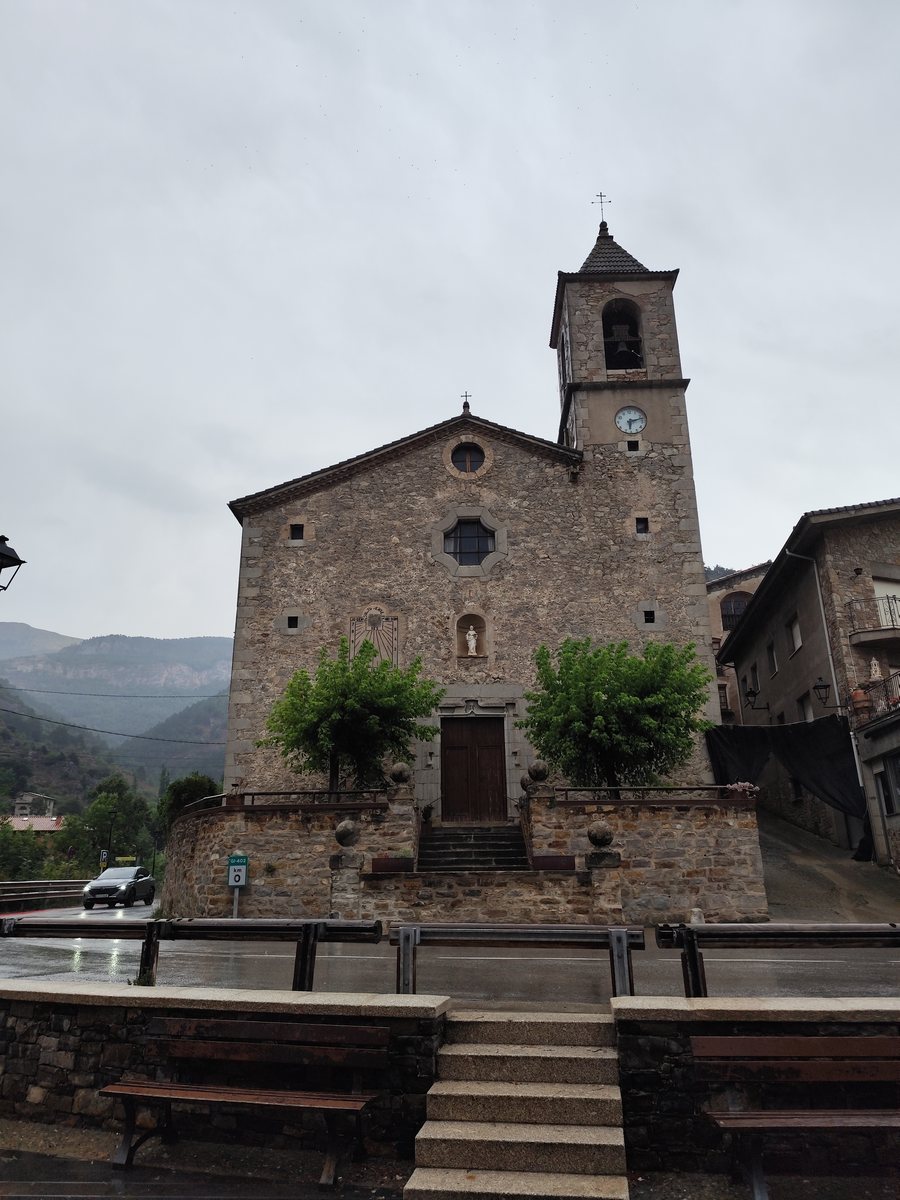
Sant Pere de Montgrony is a church consecrated in 1138 that served as a parish church until the 17th century. The Santuari de Nostra Senyora de Montgrony, at the foot of Coma Ermada, is an important centre of Marian devotion. Sant Quintí de Puig-rodon is a shrine in the immediate vicinity of Gombrèn. The religious buildings mentioned therefore differ in their names and in the historical information handed down about them.
The Mataplana heritage complex includes Sant Joan de Mataplana, a chapel dating from the 14th century. Castell de Mataplana is closely associated with the traditions that shaped and passed down the myth of Comte Arnau. Archaeological excavations at Mataplana uncovered Castell de Mataplana and an adjoining settlement where the lords’ servants lived. The complex thus brings together a chapel, the castle and the archaeologically excavated settlement within a shared local context.
The Carrers dels Porxos are also part of the local history: they recall the former processing of wool and the making of blankets in Gombrèn. The church, sanctuary, shrine, chapel, castle, settlement and crafts represent different thematic focuses and can be considered separately when making personal plans. Alongside religious and lordly sites, this also highlights the history of the area’s former local crafts.
The wider regional surroundings of Gombrèn include Pedra Dreta as an ancient site, Castell de Montesquiu as a castle and Castell de Milany as a castle ruin. The three destinations represent different forms of regional cultural heritage: an ancient site, a castle and a castle ruin.
For the broader travel overview: Girona.

.jpg)