
Prato Carnico: Clockmaking Culture, Mountain Landscapes and Val Pesarina
Accommodation in Prato Carnico
Prato Carnico combines a distinctive clockmaking and everyday culture with mountain connections and the culinary traditions of Val Pesarina. This gives you a destination whose highlights can be organised around museums, historic buildings, hiking-related sites and regional cuisine. You can therefore choose accommodation in Prato Carnico according to which of these aspects you want to shape your days: clockmaking history and craftsmanship, evidence of former life in Carnia, trails and mountains, or Val Pesarina with its food culture.
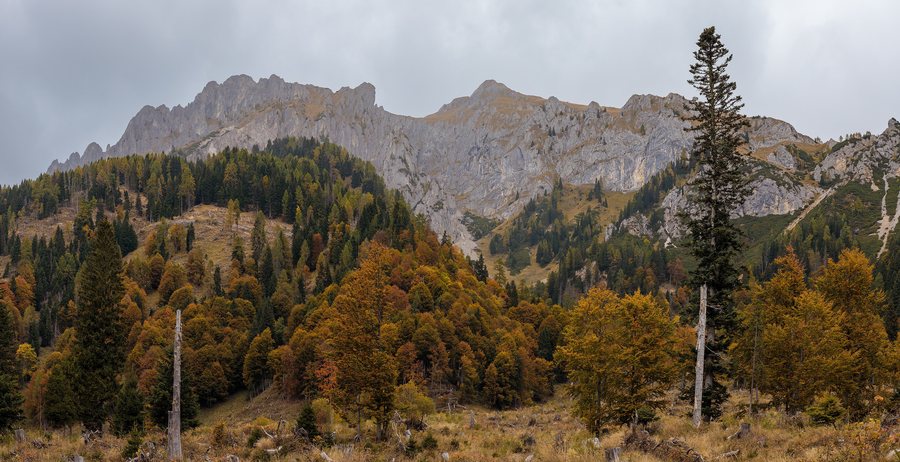 File:Walls of Creta di Mimoias at Prato Carnico, Udine, Friuli-Venezia Giulia, Italy, 2025 October.jpg
Photo: Ximonic (Simo Räsänen) via Source, CC BY-SA 4.0
File:Walls of Creta di Mimoias at Prato Carnico, Udine, Friuli-Venezia Giulia, Italy, 2025 October.jpg
Photo: Ximonic (Simo Räsänen) via Source, CC BY-SA 4.0
Clocks as a defining theme
The Percorso dell’Orologeria monumentale is an open-air museum. It complements the Museo dell’Orologeria pesarina with an exhibition trail featuring monumental clocks. In this way, the clockmaking tradition is conveyed not only through individual exhibits but also along a route in public space. The distinction between the museum and the exhibition trail is helpful for your planning: both are thematically connected, but they are not identical forms of interpretation.
Pesariis is also connected with this tradition. The production of clocks for town and church towers can be traced back there to 1725. Those interested in craftsmanship, technology and regional history will therefore find a clearly recognisable focus in Prato Carnico.
Historic houses and collections
Casa Bruseschi preserves the unchanged features of a Carnian house type dating from the 16th and 17th centuries. The collection includes original furniture and household objects, as well as documents, photographs, paintings and family furnishings belonging to the family. The house thus represents a historical view of living arrangements and family life in Carnia. The various groups of objects make it possible to connect architecture, interiors and personal heritage without having to consider these aspects separately.
A specific detail shows how closely such insights relate to the household: the kitchen of Museo Casa Bruseschi contains a traditional Fogolàr. This refers to a hearth with a double hood. Here, the term therefore denotes not a general kitchen motif but a clearly defined element of historic kitchen furnishings. This focus may be particularly interesting for you if you want to understand regional building forms and everyday culture not only through the landscape but also through preserved objects and rooms.
Another collection is housed in the rooms of a former dairy. The Historical Museum of Cameras and Cinecameras displays cameras, movie cameras and amateur projectors there. The building’s former use remains part of its spatial context, while the exhibited equipment focuses on photography, film and technical visual media. Together with the clockmaking culture and Casa Bruseschi, this creates not one unified museum theme but a broad cultural spectrum encompassing technology, residential and family history.
Mountains and historic trails
Monte Forchia is a mountain in the vicinity of Prato Carnico. The same applies to Monte Pleros. The reference to the vicinity describes their spatial relationship to Prato Carnico, not a specific route, walking time or access option.
An explicit hiking connection exists at Rifugio F.lli de Gasperi. It is a stage point on Alta Via n. 6, the Alta Via dei Silenzi. In addition, a short hike leads from Truia to the Stavoli Orias. These are a group of around fifteen old farmsteads that were formerly used as livestock shelters during transhumance.
Val Pesarina between cuisine and biodiversity
Val Pesarina adds a culinary and cultural dimension. Arlois & Fasois is a traditional event in Val Pesarina that combines gastronomy, culture and local traditions. The value of this theme therefore lies not only in individual dishes but in the connection between regional cuisine and inherited customs. This does not imply a specific event duration or current date.
In Val Pesarina, beans in their numerous varieties cultivated there are regarded as an expression of biodiversity that should be safeguarded, preserved and enhanced.
Geographical orientation for your stay
From Tolmezzo, the approach route leads via Villa Santina and Ovaro towards the Degano Valley. After Ovaro, the road branches off towards Val Pesarina and the locality of Piani di Casa.
Which focuses suit your planning
Prato Carnico cannot be reduced to a single focus in your travel planning. If you are primarily interested in historic technology, the monumental clocks, clock production and the camera museum form a coherent thematic line. If you prefer everyday history, Casa Bruseschi and the Fogolàr lead to architecture, household objects and family heritage. For mountain-related interests, there are Monte Forchia, Monte Pleros, the stage point at Rifugio F.lli de Gasperi and the Stavoli Orias with their former use.
When choosing your accommodation, you can use these differences as a basis for planning your days according to your personal interests, without reducing the destination to a specific offering. The cultural themes, nearby mountains, historic hiking connection and Val Pesarina with Arlois & Fasois and its various bean varieties appeal to different interests. Before booking, you can therefore decide whether you want to make your stay more focused on cultural history, mountains, cuisine or a combination of several themes.
For the overarching travel overview: Udine.
More destinations
More places within the same destination:

