
Friuli-Venezia Giulia: Nature, Culture and Cycle Paths
Accommodation in Friuli-Venezia Giulia
Between the Dolomites, lagoon and historic cities
The Friulian Dolomites Nature Park covers 36,950 hectares and is the larger of the two nature parks in Friuli-Venezia Giulia. The Friulian Dolomites Nature Park offers nature walks and trekking on a suitable network of trails. Numerous support facilities such as mountain huts, accommodation and bivouacs complement the network of trails. For regional classification, you will find the subregions Pordenone and Udine.
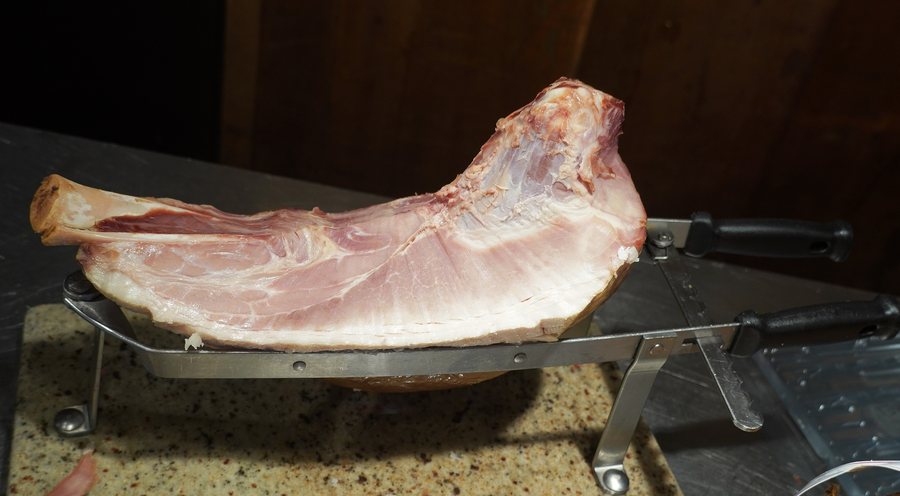 File:Prosciutta cotto naturale di Trieste, Friuli-Venezia Giulia, Italia.jpg
Photo: Naturpuur via Wikimedia Commons, CC BY-SA 4.0
File:Prosciutta cotto naturale di Trieste, Friuli-Venezia Giulia, Italia.jpg
Photo: Naturpuur via Wikimedia Commons, CC BY-SA 4.0
The Valle Cavanata Nature Reserve offers opportunities for birdwatching among salt meadows, wet forests and beaches. Numerous bird species use the Valle Cavanata Nature Reserve as a resting and breeding ground. In the Valle Cavanata Nature Reserve, designated footpaths and cycle paths enable visitors to observe birds in their natural habitat. The Valle Cavanata Nature Reserve can be reached from Grado via scenic cycle paths.
Aquileia and Palmanova: History in a distinctive form
Most of the remains of ancient Aquileia are intact and unexcavated; as a result, Aquileia is considered the most complete example of an early Roman city in the Mediterranean region. The patriarchal basilica complex of Aquileia played a decisive role in the spread of Christianity to Central Europe in the early Middle Ages.
Palmanova was built in 1593 by the Republic of Venice and has been part of the UNESCO World Heritage Site “Venetian Works of Defence between the 16th and 17th Centuries: Stato da Terra – Western Stato da Mar” since 2017. Palmanova has a regular layout in the shape of a nine-pointed star, as well as three rings of fortifications from the 16th, 17th and 19th centuries.
In Palmanova’s Bastion Park, one path leads into the moat and past a waterfall with a picnic area, while another follows the upper covered way. Both paths meet again at the Contromina tunnel. This underground defence system can be visited during the designated opening hours.
Cividale del Friuli and Grotta Gigante
Cividale del Friuli preserves significant evidence of its Lombard past. The Celtic Hypogeum in Cividale del Friuli consists of underground cavities carved into the rock, with a central chamber from which three low corridors branch off. The original function of the Celtic Hypogeum remains unknown. Access to the Celtic Hypogeum is exclusively via the guided tour service organised by the Municipality of Cividale and the Regional College of Cave Guides and Cave Masters of Friuli-Venezia Giulia.
A visit to Grotta Gigante involves a route of over 850 metres and reaches a depth of 100 metres. Access to Grotta Gigante is only possible as part of a guided tour.
Friuli-Venezia Giulia on two wheels
The Alpe-Adria Cycle Route runs from Salzburg to Grado over 400 kilometres. The Italian section of the Alpe-Adria Cycle Route begins in Tarvisio and partly follows disused railway lines. The Alpe-Adria Cycle Route crosses Friuli-Venezia Giulia from north to south, passing through Alpine valleys, along the Fella and Tagliamento rivers, over moraine hills and through the Friulian plain to the lagoon and the Adriatic Sea.
Regional cuisine with several influences
The cuisine of Friuli-Venezia Giulia reflects Habsburg and Slavic traditions around Trieste and Gorizia, the shepherding culture in Carnia, and rural culture in Friuli. Regional signature dishes include frico made from potatoes and cheese, as well as jota, a soup made from potatoes, beans and white cabbage.
For the overarching travel overview: Italy.
More about the destination
Relevant information for planning your trip:
More destinations
More places within the same destination:

