
Lahnau: Roman History and Half-Timbered Houses
Accommodation in Lahnau
Lahnau lies roughly halfway between Gießen and Wetzlar, on the north side of the Lahn. For travelers interested in history, the Roman Forum of Waldgirmes and the municipality’s local history museum offer different perspectives: one focuses on finds and Roman history, while the other also covers historic buildings, agriculture, and the history of the Celts, Romans, and Germanic peoples.
Roman Forum of Waldgirmes: Finds and Reconstruction
The visitor center at the Roman Forum of Waldgirmes displays numerous archaeological finds, replicas, models, and information panels. There is also a 3D print of the horse’s head. The exhibition thus combines different ways of presenting the subject: original finds are shown alongside reproductions and models, while the panels provide additional information.
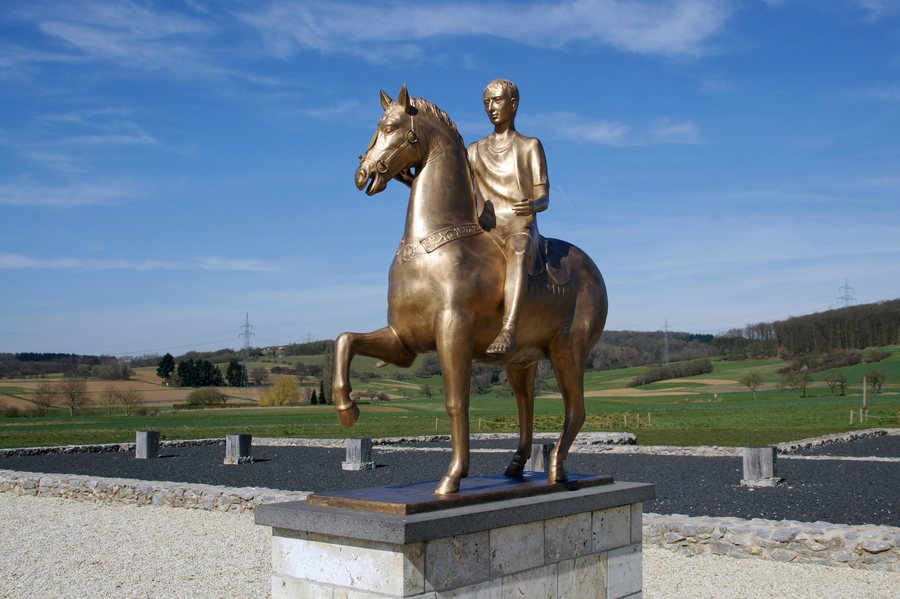
The Forum’s original foundations have also been brought to life through a reconstruction; there is also an equestrian statue on the site. The grounds and the visitor center have different focuses: the reconstructed complex makes the foundations easy to visualize, while the exhibition brings together objects and supplementary displays. Guided tours of the Roman Forum explain the peaceful coexistence of Germanic peoples and Romans, as well as the historical context. Visitors particularly interested in this historical exchange can therefore explore not only the exhibits but also a tour focused on the subject.
The Local History Museum: Listed Building, Half-Timbering, and Local History
The building housing the Lahnau local history museum was built in 1840/1841 and is itself a listed cultural monument. The farmstead includes a large farmyard complex with a core dating to 1620. A 19th-century barn completes the ensemble; both buildings are half-timbered. The setting itself therefore brings together several historical periods.
The coach house contains the mold for the equestrian statue of Emperor Augustus, created by Heinrich Janke from Braunfels. Information panels there cover the history of the Celts, Romans, and Germanic peoples, as well as the excavations at the Roman Forum. Rural life is another focus: the museum features a reconstruction of the Dorlar ladder house, along with agricultural tools. The local history museum thus brings together architecture, local history, and objects related to agriculture; its themes also extend to the excavations at Waldgirmes.
Landscape and Regional Setting
Lahnau lies in an attractive, heavily wooded landscape with good farmland. This landscape adds a perspective on the character of the area to visits to its historic sites. To get your bearings, it is worth considering Lahnau as a destination in its own right and clearly distinguishing it from cultural attractions elsewhere in the region.
Elsewhere in the wider Lahn-Dill-Kreis destination, there are other independent attractions in different towns. In Wetzlar, the Lottehaus recalls Goethe’s meeting with Charlotte Buff and the summer of 1772. Two rooms on the first floor house a permanent exhibition on the origins and impact of Goethe’s first novel, “The Sorrows of Young Werther.” Also in Wetzlar, the Optikparcours invites visitors to experiment with and discover optical phenomena; it includes a walk-through kaleidoscope.
In Dillenburg, Villa Grün presents objects and detailed displays of industrial and artisanal production in the Dill region across more than 20 rooms. The basement also houses an elaborate, media-rich mining exhibition. In Solms-Oberbiel, the Fortuna Mine visitor mine is the only Hessian anchor point on the European Route of Industrial Heritage. The Fortuna field and mine railway museum has 50 historic field and mine railway locomotives and 100 cars; trains run according to a timetable.
Further topics in the Lahn-Dill-Kreis range from technology and industrial history to nature and scenic views. The Glockenwelt Greifenstein Castle displays almost 100 bells in a tour through a thousand years of German bell history. The castle’s twin towers offer spectacular views. The Herbstlabyrinth Advent Cave System in Breitscheid is the largest cave system in Hesse and one of the most significant in Germany. On weekdays and during school holidays, the show cave can be reached on RMV bus route 510 to the Breitscheid, Rathaus stop; from there, the walk takes about 20 to 30 minutes. Check the current timetable before traveling. The region’s landscapes can also be explored on the well-known long-distance Lahn-Dill-Bergland Trail and the Lahn Hiking Trail; the latter runs through the Lahn Valley.
Discover more destinations: Dietzhölztal, Aßlar, Haiger, Dillenburg, Leun, Mittenaar, Bischoffen, Siegbach.
To the overview of the wider destination: Lahn-Dill-Kreis.

