
Hohenlinden – Forest Landscape and History
Accommodation in Hohenlinden
Hohenlinden combines a forested landscape with memorial sites commemorating the 1800 battle, churches, and trails through the village and its surroundings. When planning your stay, you can choose between historical sights and outdoor activities.
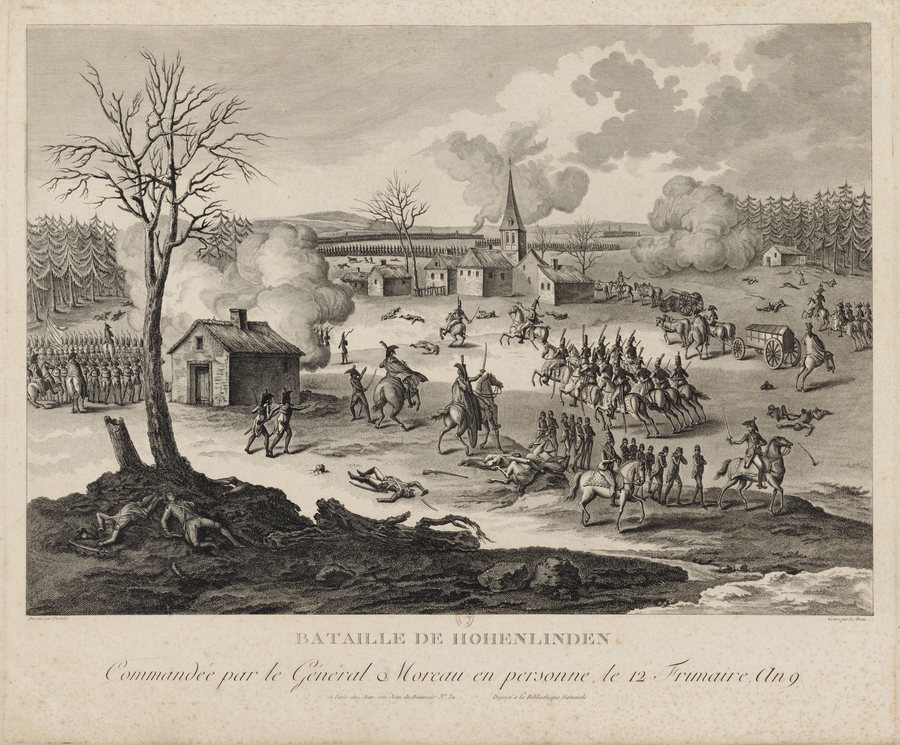 File:Bataille de Hohenlinden - estampe - btv1b8412995j.jpg
Photo: Le Beau. Graveur Desrais, Claude-Louis (1746-1816). Dessinateur du modèle via Source, Public domain
Forest Landscape and Trails
The municipal area is almost entirely surrounded by the forests of Ebersberger Forst, Großhaager Forst, Mittbacher Au, and Lindacher Wald. The forest belt opens up only to the northeast. Various cycling and hiking trails run through Hohenlinden and its surroundings, giving visitors a distinct focus alongside the village’s historical sights.
One longer cycling option is the “Battle of Hohenlinden” cycle tour: The circular route is approximately 52 kilometres long and runs clockwise to 17 destinations around Hohenlinden. These are considered the main battle sites. There are benches at the destinations and along the way. When planning a tour, distinguish between the route around the village and the individual stops it connects.
Battle History at the Museum
The Battle of Hohenlinden took place in Hohenlinden on 3 December 1800. General Moreau commanded the French forces; the allied Bavarian and Austrian troops were under the command of Archduke John. The “Battle of Hohenlinden” museum is dedicated to this event. It is located in the basement of Hohenlinden Primary School and occupies two rooms. Visits are possible only by arranging an appointment by telephone with the museum director.
One of the exhibits features 7,500 tin soldiers in period uniforms, with period equipment and weapons. They depict the armies’ positions in the early afternoon of 3 December 1800. Other exhibits include period books and prints, as well as rifles, sabres, helmets, bullets, and horseshoes. Notable items on loan include a votive tablet commemorating farmer Stephan Rumpfinger’s engagement to the Virgin Mary.
The museum visit also offers various ways to explore the historical events: Visitors can select topics via a multimedia system, learn about the Treaties of Lunéville, and retrace the battle as a strategy game. Alongside the objects on display, the programme therefore includes political topics and a playful way to engage with the event.
Churches and Chapel
The Old Church of the Visitation of Mary in Hohenlinden is considered an outstanding building of Ebersberg Abbey. Its notable features include wall piers and a Gothic net vault. The Visitation of Mary and the Massacre of the Innocents are carved into two of the keystones. The architectural forms and the depictions can thus be viewed together, without separating the building’s history from its religious themes.
Another stop is the “Maria im Felde” chapel. It lies between Hohenlinden and Preisendorf, near the district boundary, in the Hohenlinden municipal area. It was consecrated on 16 June 2002. The tower of St. Joseph’s also provides a striking landmark in the landscape: It is 70 metres high in total and visible as a pointed spire from every point on the Hohenlinden gravel plain.
Nearby
The Hohenlinder Sauschütt is located in Ebersberger Forst, close to Hohenlinden. There are three wildlife enclosures for red deer, fallow deer, and wild boar, where visitors can often see the animals at close range in their natural habitat. A 3.2-kilometre accessible circular forest nature trail also runs right by the Sauschütt. Around two hours are suggested for exploring it. By comparison, the approximately 52-kilometre cycle tour requires considerably more time: The two options differ both in activity and in scope.
When planning your stay, consider whether you would prefer to focus on visiting the museum and churches or spending time on trails and in the forest. The battle history is linked to clearly identified destinations in the village and along the cycling route; the Sauschütt and the forest nature trail add nearby excursion destinations to the mix.
Discover more destinations: Oberpframmern, Ebersberg, Baiern, Kirchseeon, Grafing bei München, Anzing, Egmating, Glonn.
For the main travel overview: Ebersberg District.

