
Snow Cannons: How Technical Snowmaking Works
Technical snowmaking can keep pistes usable when natural snowfall is insufficient. Water, humidity, temperature, wind, electricity, storage and the ground must work together.
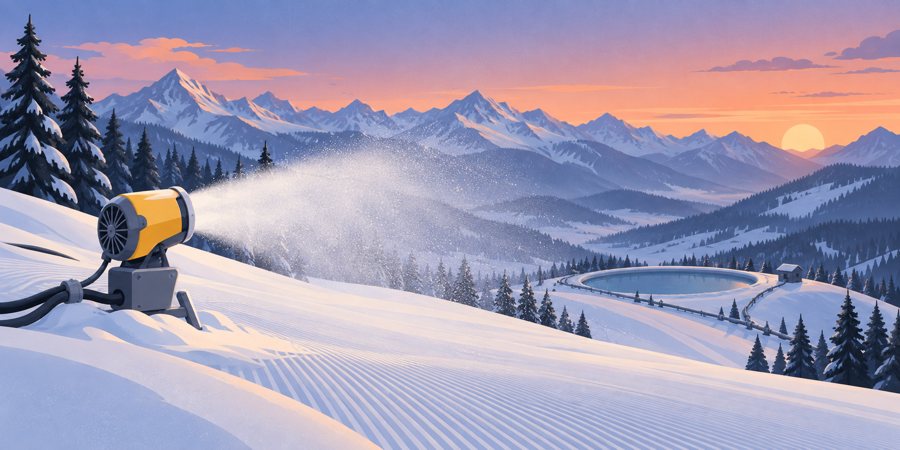 Illustrative, nicht-dokumentarische Darstellung einer Schneekanone auf einer Skipiste; kein bestimmter Ort und keine dokumentarische Aufnahme.
Photo: OpenAI / Max-TD (AI illustration)
Illustrative, nicht-dokumentarische Darstellung einer Schneekanone auf einer Skipiste; kein bestimmter Ort und keine dokumentarische Aufnahme.
Photo: OpenAI / Max-TD (AI illustration)
Quick facts
- Fine water droplets freeze in sufficiently cold, dry air.
- Temperature and humidity together matter more than temperature alone.
- Wind affects range and distribution.
- A system includes storage, pumps, pipes, power, controls and generators.
- Technical snow supports season start and busy pistes but cannot replace weather.
- Water and energy use depend on terrain, target depth, technology and repeat snowmaking.
- Snow must be spread and groomed before opening.
How technical snow is made
Water is atomised through nozzles. Droplets release heat and freeze on the way down or on the existing snowpack. Some systems use compressed air; others use a fan. The visible cannon is only the final part of a larger system.
The wet-bulb temperature combines air temperature and humidity. Cold, dry air is favourable; mild or humid air reduces freezing and range. Wind may carry snow away. Technical snow is frozen water like natural snow, but it forms differently. See the winter sports overview.
Conditions and infrastructure
Operators consider temperature, humidity, wind, fog, water, pump capacity, electricity and required depth. Snowmaking often takes place at night, but current resort information is decisive. A snowed piste is not automatically reliable for the whole season; see snow reliability.
Water must be stored or taken lawfully, pumped through pipes and delivered under pressure. Pump stations, power, controls, sensors and weather stations may be needed. Storage ponds do not remove local effects or permit requirements. A resort also needs lifts, grooming vehicles and safety systems; see ski resort technology and snow groomers.
After snowmaking
Fresh snow is uneven and must be spread, compacted and connected to existing cover. Cold can harden it; sun and warmth soften it. Technical snow is often used on busy pistes, transitions, learning areas and valley runs. See skiing.
Water, energy and environment
Criticism concerns water, energy, storage, pipe construction and alpine habitats. Demand depends on target depth, area, terrain, technology and repeat snowmaking. Pump distance affects energy use.
When and where water is taken and whether it returns to the natural cycle matter. Local permits govern withdrawals. The German Environment Agency explains water protection.
The climate balance includes electricity, pumping, operating hours, maintenance, construction and service life. Snowmaking cannot make a resort independent of rising temperatures.
Travel planning and controversy
For guests, snowmaking is information, not a guarantee. Compare altitude, slope orientation, operating times and routes. Shortly before departure, check snow reports, open lifts, piste status, weather and roads. Families may value a snowed learning slope, ski school and short routes more than difficult runs. Where snow is limited, consider winter walking or sledging where permitted. Never use closed pistes.
Snowmaking can support opening while raising questions about water, energy, noise, storage and landscape. “Snow reliable” is not a promise for a date. Current reports and open-piste conditions are more useful. Costs include construction, maintenance, power, water, staff and grooming.
FAQ
Can a cannon make snow at any temperature?
No. Temperature, humidity, wind, equipment and water all matter.
Is technical snow natural snow?
Both are frozen water, but technical snow forms from fine droplets and has different properties.
Why use cannons at night?
Temperatures are often better and pistes are less occupied.
Can snowmaking compensate for climate change?
No. It can use short cold windows but cannot replace suitable temperatures or natural snowfall.
