
Ski Piste Groomers: Grooming and Safety
A piste groomer prepares snow for the planned ski operation. Its tracks, front blade and rear tiller move and shape the snow, but they cannot guarantee the same conditions across every slope or throughout the day. This guide explains what grooming changes, when machines work and how skiers can stay clear of hazards.
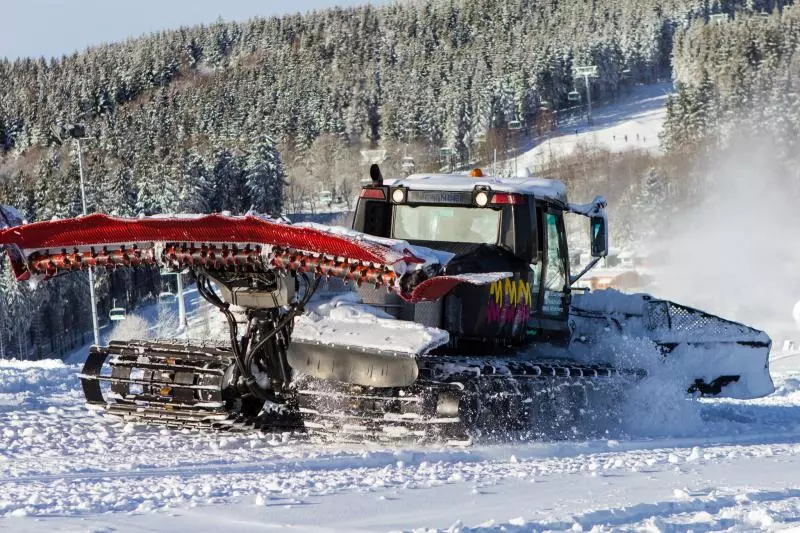 A piste groomer with a rear tiller works on a snow-covered ski run.
Photo: Dago Wiedamann, www.bayern-profi.de
A piste groomer with a rear tiller works on a snow-covered ski run.
Photo: Dago Wiedamann, www.bayern-profi.de
What a piste groomer does
The front blade redistributes snow and levels accumulated ridges. Tracks compact the surface, while the rear attachment mills or textures it. The result depends on snow depth, temperature, terrain and the resort’s plan. Sun, rain, wind and skier traffic can change a freshly groomed run soon after it opens. See how piste grooming works and how natural and machine-made snow differ.
When grooming takes place
Work often happens in the evening, overnight or early in the morning, when fewer people are on the slopes. Snowfall, wind, rain or heavy use can require additional work at other times. A run that looks finished may still be closed while machines, staff or safety checks are in progress. Follow the resort’s official status and never cross a closure.
Grooming conditions vary with weather and the surface. A run can feel firm and fast in cold conditions, softer in sunshine, or slippery after rain and refreezing. Grooming does not determine a run’s difficulty: gradient, width, turns, visibility, markings and your own ability still matter. Check slope markings and difficulty levels and the current snow conditions at the resort.
Machinery and winch-cable hazards
Groomers are heavy vehicles, and drivers may have limited visibility. Keep well away; do not follow a machine past a closure or approach it for a closer look. On steep terrain, a winch may secure the vehicle. Its steel cable can stretch a long way across a slope and may be hard to see in snow. Never enter or cross a work area. Obey barriers, warning lights and staff instructions.
On open slopes, control your speed, leave room for others and stop only where you are visible from above. Review the resort’s slope-safety guidance and rules. Families should agree on meeting points away from the skiing line; skiing with children also calls for suitable runs and regular breaks.
Planning a ski day
Before setting off, check which lifts and runs are open, the weather and visibility, and any short-notice closures. A freshly groomed surface is not a promise that a run is easy or suitable for every skier. If conditions change, choose a more manageable open route or take a break. Read more about snowmaking systems, snow cannons, ski-resort equipment and planning a ski holiday.
For a change of pace, consider other winter activities, or compare skiing in Bavaria with a trip to the Thuringian Forest.
Frequently asked questions
Can I ski on a closed slope if no groomer is visible?
No. A closure remains in force until the resort officially reopens the run. Other vehicles or safety work may still be present.
Why is a groomed slope sometimes hard?
Cold temperatures and compaction can make the surface firm. Sun, rain, wind and traffic change it during the day.
What is the danger of a winch cable?
A cable can extend far from the vehicle and be difficult to see. Stay outside the work area and follow all barriers and warnings.
