
Vicenza: Palladio, museums and historic sites
Accommodation in Vicenza
The city of Vicenza, with its 23 buildings designed by Andrea Palladio, is a UNESCO World Heritage Site. At its centre stands the Teatro Olimpico, the world's first covered theatre built of masonry. Andrea Palladio constructed it between 1580 and 1585; it was inaugurated upon completion. The Teatro Olimpico hosts theatre and music productions. The Basilica Palladiana is Vicenza's landmark. It is renowned for its Serlian loggias, designed by Andrea Palladio, which surround the medieval Palazzo della Ragione.
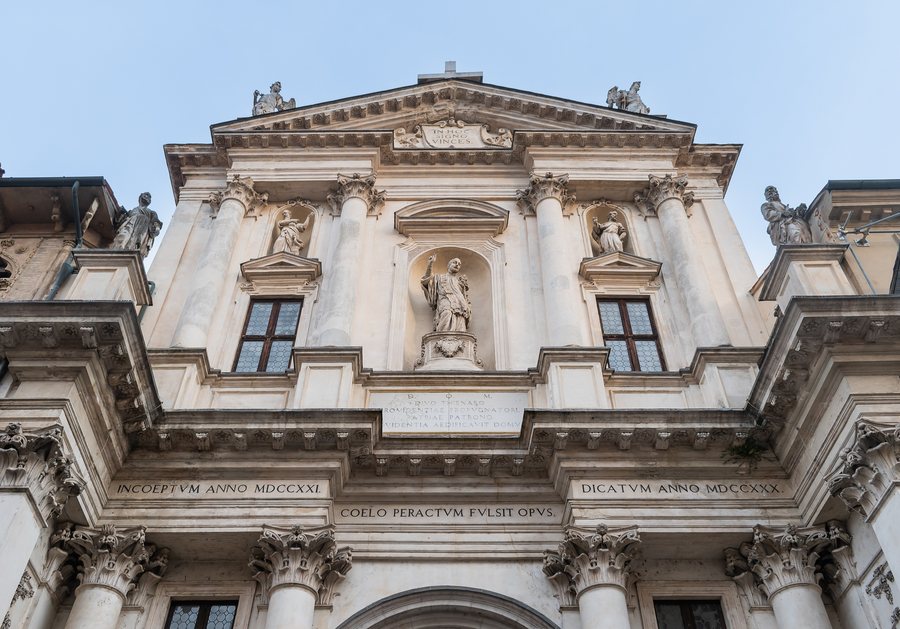 File:St Cajetan church in Vicenza (3).jpg
Photo: Krzysztof Golik via Wikimedia Commons, CC BY-SA 4.0
File:St Cajetan church in Vicenza (3).jpg
Photo: Krzysztof Golik via Wikimedia Commons, CC BY-SA 4.0
Culture
The terrace of the Basilica Palladiana is a monumental viewpoint in the heart of Vicenza. From there, the 360-degree view extends across Vicenza's historic old town and the Berici Hills. The terrace is fully accessible to people with motor disabilities; a dedicated lift provides convenient access to the second floor. The Palladio Museum presents original Palladio drawings together with models and videos. The Silk Room at the Palladio Museum is dedicated to silk production and Vicenza's international silk trade.
The Palladio Museum can be reached by taking the Venice–Milan railway line to Vicenza station, followed by a ten-minute walk. Palazzo Chiericati was designed by Andrea Palladio for Girolamo Chiericati in 1550. In Palazzo Chiericati, the Civic Museum preserves and displays more than 35,000 works from the 13th to the 20th century, including paintings, sculptures, prints and applied art. The Civic Museum is accessible to people with disabilities.
History
The Museo del Risorgimento e della Resistenza collects memories of events and figures from Italian history connected with the historical events of Vicenza. It is located in Villa Guiccioli on Colle Ambellicopoli, where the people of Vicenza resisted in defence of the city in 1848. The museum is accessible to people with disabilities.
The Valmarana Chapel in the crypt of the Church of Santa Corona also offers an insight into Vicenza's architectural history. Andrea Palladio designed it for Antonio Valmarana in 1576. A visit to Villa Valmarana ai Nani includes its frescoes, historic buildings and the new park.
Sacred sites
The Sanctuary of Santa Maria di Monte Berico was established following apparitions of the Virgin Mary on 7 March 1426 and 1 August 1428 on the hill south of Vicenza. In 1578, Andrea Palladio extended the sanctuary with a large square nave. From Vicenza's historic centre, Santa Maria di Monte Berico can be reached on foot via Viale X Giugno or via the 192-step Scalette di Monte Berico.
The Museum of Sacred Art in Monte Berico displays more than 500 artefacts from the 14th to the 21st century. It includes Greek, Russian, Neo-Byzantine and post-Byzantine icons. Thus, alongside Palladio's buildings, religious art and the history of the sanctuary are also central features.
Cuisine and parks
The people of Vicenza developed Bacalà alla vicentina as a local traditional dish. The dish has been part of Vicenza's culinary tradition for more than 500 years. Campo Marzo and the Giardini Salvi are also among Vicenza's historic parks. In Parco Querini, a tree-lined avenue leads to a small temple in the greenery.
Further places: Campese, Nove, Roana, San Giorgio Di Perlena, Solagna, Gallio, Pedemonte, Fara Vicentino, Campolongo Sul Brenta, Romano D'ezzelino, Carré, Recoaro Terme, Conco, Valstagna, Pove Del Grappa, Asiago, Marostica, Bassano Del Grappa, Lusiana.
To the higher-level travel overview: Veneto.

.jpg)