
Nature and Trails
The Přísečnice Reservoir stores water as a drinking-water source for the North Bohemian brown coal basin. Its shores are inaccessible because it is a drinking-water reservoir. Near the reservoir are the Eastern Ore Mountains Bird Protection Area, the Novodomské rašeliniště–Kovářská area and the Eastern Ore Mountains European protected area.
The Jelení hora rock formation and the three Špičáky are located in the cadastral area of Černý Potok, part of the municipality of Kryštofovy Hamry, and are notable for their distinctive steppe vegetation. Tertiary volcanic rock, identified as nephelinite, emerges at Jelení hora. The summit consists of dark porphyritic basaltoid rock with massive, irregular hexagonal columns and irregular transverse jointing. Several rock formations can be found around Kryštofovy Hamry; the most significant is considered to be the expansive Hraniční věž border tower, also known as Kryštof.
History and Culture
Kryštofovy Hamry lies on the historic route that led via Přísečnice and Vejprty to Saxony. Kryštof Grád of Grunberg built a hammer mill in the forest near Kryštofovy Hamry and named it the Hammer of Saint Christopher.
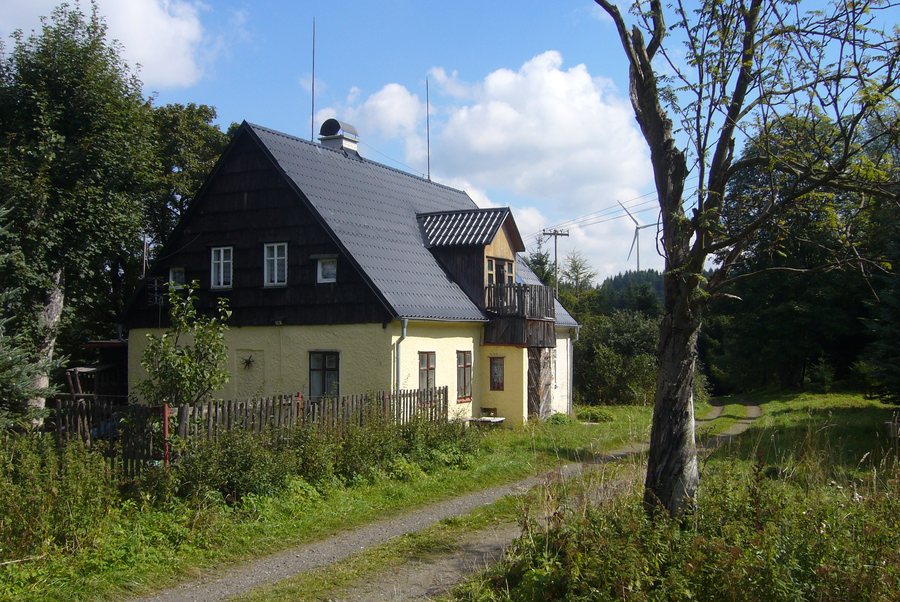
The Church of Saint Christopher in Kryštofovy Hamry was built between 1829 and 1832. Services are still held there today. The family house of Hilda Bartlová is an important historic building in Kryštofovy Hamry. The village's small mountain cemetery is maintained and preserves numerous German graves.
Memorial Trails
The “Stories of vanished Přísečnice” walking tour begins at a car park in Kryštofovy Hamry. Members of the Czech-German association Přísečnice žije – Pressnitz lebt accompany participants on this tour. Since 2016, the association has documented the local heritage of the vanished community.

.jpg)