
Piste Grooming
A piste is not automatically ready for skiing after a snowfall. Wind can redistribute the snow, repeated descents can move it around, and some areas may become thin. Piste grooming involves using specialist vehicles to work, redistribute, compact and smooth the snow cover. The aim is to create as even a surface as possible for the planned operation. The snow groomer is the most visible piece of equipment used for this work.
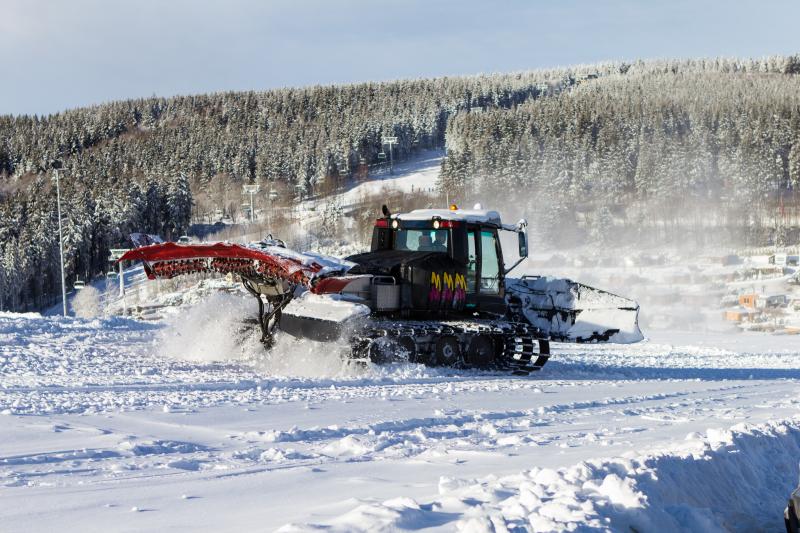 Eine Pistenraupe bearbeitet eine verschneite Skipiste.
Photo: Dago / MaxTD Imagebank
Key facts
- Grooming is usually carried out outside opening hours or on closed sections.
- A snow groomer can push, redistribute and mill snow, as well as smooth the surface.
- The result depends on the amount of snow, temperature, terrain and previous use.
- A freshly groomed piste may be harder in the morning and change later in the day.
- Artificial and natural snow are worked together as needed.
- Closures and warning notices apply even when a piste looks skiable.
What does a snow groomer do?
The groomer travels over the terrain on wide tracks and moves snow with a blade. At the rear, a tiller works the surface; a trailing attachment can create grip and an even feel underfoot. The exact technology varies depending on the vehicle, terrain and desired result. Steep slopes may require additional safety equipment.
When are pistes groomed?
Much of the work takes place in the evening or at night, when fewer people are on the piste. Additional work may be needed after heavy snowfall, rain, wind or intensive use. Not all pistes are treated in the same way every day, as this depends on snow and weather conditions, the piste’s condition and the operator’s plans.
Vehicles may be difficult to see during grooming. Cables, winches and lines stretched across the piste pose particular hazards. For this reason, affected runs are closed. Follow the instructions of the operator on site.
Snow conditions and how the piste feels
Grooming does not create an identical surface everywhere. Temperature, moisture, sunshine and the number of descents change the piste throughout the day. A hard, smooth surface in the morning may call for different skills than a softer track in the afternoon. The mix of natural and artificial snow also affects how it can be worked and how long it lasts.
Snowmaking is often used before or between grooming sessions. Snowmaking systems provide the additional snow, which is then redistributed and compacted.
On and around the piste
Use open pistes in accordance with the area’s rules. Your speed and distance from others should suit visibility, your ability and the traffic on the piste. Local piste signs and operator notices take precedence. Do not ski on closed pistes, in work areas or on routes beyond the barriers.
For holidaymakers, a freshly groomed piste does not mean that every section is equally safe or suitable for all ability levels. Children and beginners need a suitable, clearly visible section. If you cannot safely assess a run, choose an easier option or ask the ski school.
FAQ
Why are pistes often particularly hard in the morning?
After being worked overnight, the compacted snow cover can cool and firm up. Weather and use will change it again later.
Can you ski on groomed pistes at night?
Only if the operator has expressly opened the run. Work vehicles, cables and poor visibility make closed pistes dangerous.
Does a snow groomer groom every piste daily?
Not necessarily. The frequency and schedule depend on conditions, weather, snow volume, use and the operator’s plans.
Why are there sometimes bumps or uneven patches?
Snow, terrain, wind, temperature and use all change the surface. Grooming cannot permanently prevent every natural change.
