
Teglio: Winter Sports, Trails and Cultural Heritage
Accommodation in Teglio
Teglio combines a strong connection to winter with trails, mountain views, churches and regional cuisine. Prato Valentino lies at an altitude of 1,667 metres on the slopes of the Rhaetian Alps and offers panoramic views of the Orobie. In winter, downhill skiing and snowshoe hikes on marked trails are possible there in the Alpe di Teglio ski area.
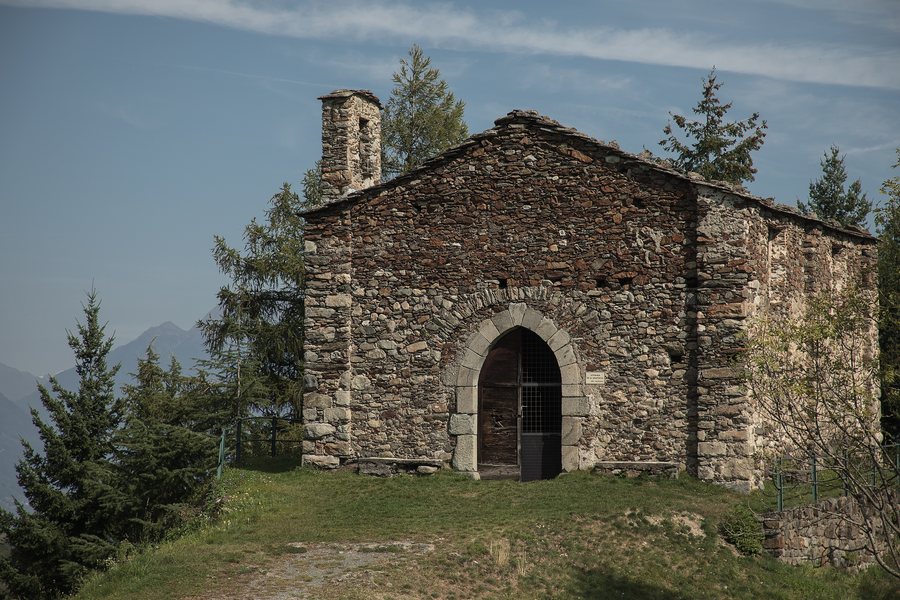 File:Teglio (SO) - chiesa di Santo Stefano - 01.jpg
Photo: Maurizio Moro5153 via Wikimedia Commons, CC BY-SA 4.0
File:Teglio (SO) - chiesa di Santo Stefano - 01.jpg
Photo: Maurizio Moro5153 via Wikimedia Commons, CC BY-SA 4.0
Prato Valentino and winter activities
Another point of reference in the landscape is the rooftop terrace of the Torre de li Beli Miri: from there, the panoramic view extends for about 60 kilometres.
Hiking trails and sporting route planning
The Teglio–San Silvestro–Fonte della Frascesca hiking trail begins in the centre of Teglio and takes 2 hours and 30 minutes from Teglio. The Teglio–S. Rocco–Mulini trail leads to the Church of Santa Maria di Ligone, the Church of San Rocco and the area of the local mills. Along the way, there are panoramic views of the Orobie range and Val Malgina. On the San Giovanni–Dos de la Forca trail, you can see prehistoric cup- and channel-marked rock carvings, as well as a paved section of an ancient Roman road.
The cycling climb from Tresenda to Teglio follows a low-traffic road, is a little over 7 kilometres long, has an elevation gain of 477 metres and takes approximately one hour.
Getting to Teglio
Teglio can be reached via the Milan–Lecco–Sondrio railway line. From Sondrio or Aprica–Tresenda–Teglio station, connecting bus services are available. STPS local buses connect Teglio with Sondrio and lower Valtellina; Perego buses connect the town with Tirano, Tresenda and upper Valtellina.
Palaces, churches and regional history
At Palazzo Besta, the Antiquarium Tellinum displays engraved prehistoric stelae from the Copper Age, the 3rd millennium BC. The stelae have been found at various locations in the Teglio area since 1940. The Salone d’onore in Palazzo Besta is decorated with 21 episodes from Ludovico Ariosto’s Orlando Furioso. The surviving part of Palazzo Piatti-Reghenzani belonged to a large 16th-century palace owned by the Piatti family.
The reconstructed Church of Sant’Eufemia has a Romanesque basilica layout with three naves. Its Romanesque reconstruction was consecrated on 8 November 1117 by Bishop Guido Grimoldi; the façade features a damaged image of Christ Pantocrator. The Church of San Silvestro certainly dates back to the Early Middle Ages and has a pentagonal apse and a small bell tower with an open bell chamber. The 11th-century Church of San Pietro features Romanesque architecture in the style of Como and Ticino. The Oratorio di San Biagio, attached to the Church of San Martino, is a Baroque building that served as an ossuary.
Pizzoccheri and milling tradition
The origins of pizzoccheri are attributed to the Teglio area. The Accademia del Pizzocchero di Teglio has codified the authentic recipe, which local restaurateurs must follow. Mulino Menaglio houses a small museum with tools that bear witness to agricultural work and eating habits associated with grain cultivation. The well-preserved water mill still enables some local producers to grind their grain.
To the main travel overview: Sondrio.
More destinations
More places within the same destination:

_-_chiesa_di_Santo_Stefano_-_01.jpg)