
Discover Turrivalignani: Rocky Landscapes, Churches and Local Cuisine
Rocky Landscapes and Views
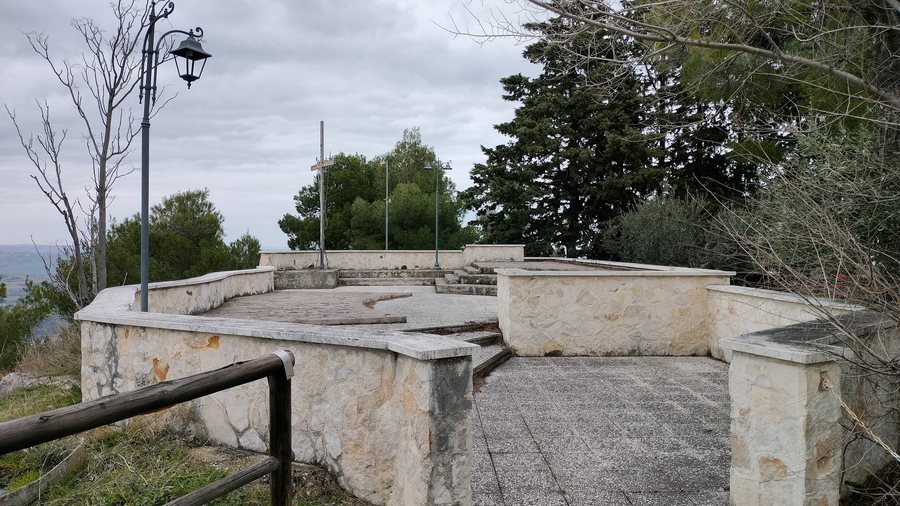
The Rupe di Turrivalignani is an imposing rock formation above the town. The Belvedere sulla Rupe di Turrivalignani is a viewpoint on a spectacular rocky cliff that dominates the entire landscape. The two landscape features differ in their specific function: the Rupe is the rock formation above the town, while the Belvedere is the viewpoint on the rocky cliff.
The Costone di Arenaria offers views of the Valle del Pescara and the Majella, Gran Sasso d'Italia and Morrone mountains. The Costone consists of conglomeratic deposits from the Pleistocene. Conglomeratic deposits consist of compacted gravel. The Pleistocene is a geological epoch and here refers to the time period in which these deposits formed. At the same location, visitors can observe the rare Lanner falcon (Falco biarmicus). For nature enthusiasts, the Costone therefore combines views of the valley and mountains with Pleistocene deposits and the opportunity to observe a rare bird of prey. At the Costone, you can thus focus successively on the distant view, the geological substrate and birdwatching.
Visiting the Costone di Arenaria is free of charge. When planning a visit to the town, this landscape feature can therefore be included without admission costs. At San Vincenzo, by contrast, prior contact is required for the agreed guided tour.
Churches with Different Building Histories
The Chiesa Parrocchiale di Santo Stefano Protomartire in Turrivalignani was built in the 14th century. Its interior is Baroque in style and has a single nave. “Single nave” refers to a church interior without side aisles. The bell tower is built as a square tower. The Baroque design concerns the interior, while the square form concerns the bell tower. The square tower shape and the single-nave layout refer to different parts of the same church.
The Abbazia di San Giovanni Battista e San Vincenzo is dated to approximately the 12th century. Compared with the Chiesa Parrocchiale di Santo Stefano Protomartire, built in the 14th century, this is therefore an earlier date. Guided tours of the San Vincenzo church can be arranged after prior contact with Roberta di Renzo. The two churches thus represent different dates within the sacred architectural history of Turrivalignani.
The religious buildings offer a direct comparison: Santo Stefano combines the 14th century with a Baroque, single-nave interior and a square bell tower; San Vincenzo refers to the abbey dated to approximately the 12th century and the possibility of a guided tour after prior contact.
Local Flavors: Libretto di fichi secchi
One of Turrivalignani's culinary specialties is the traditional dessert Libretto di fichi secchi. It is pressed into molds using a traditional “torchietto.” The traditional “torchietto” is therefore part of shaping the sweet. Pressing the dessert into molds gives it a firm shape, with the torchietto used as a tool in its traditional preparation. With Libretto di fichi secchi, the shaping process is therefore just as much a culinary specialty as the dessert itself.
Other places in the same regional area: Abbateggio, San Valentino In Abruzzo Citeriore, Caramanico Terme, Roccamorice, Sant'eufemia A Maiella and Manoppello.
For the broader travel overview: Pescara.
Check prices, availability and amenities for your travel dates directly on Booking.com.
View accommodations and offersAdvertisement · Affiliate link to Booking.com
