
Abbateggio: Culture, Nature and History
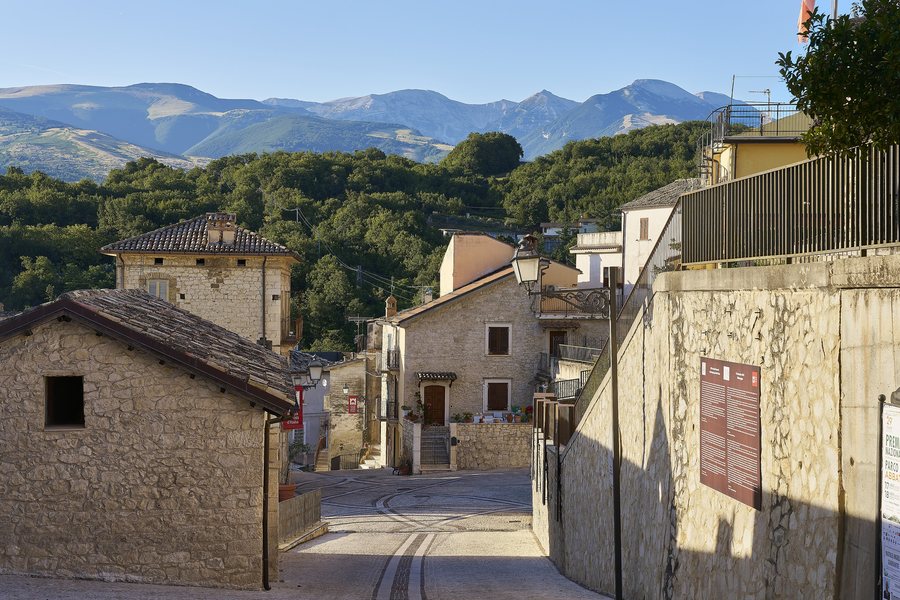 File:20260725 via angelo de thomasis abbateggio PD02005.jpg
Photo: Paul Danese via Wikimedia Commons, CC BY-SA 4.0
File:20260725 via angelo de thomasis abbateggio PD02005.jpg
Photo: Paul Danese via Wikimedia Commons, CC BY-SA 4.0
Abbateggio is a destination for travelers who want to combine sacred buildings, archaeology, landscapes and local cuisine in a single stay. When choosing a hotel in Abbateggio, you can therefore decide whether the historic center, Valle Giumentina or local traditions will be the focus of your days.
Sacred Sites and Distinctive Architectural Forms
The Santuario della Madonna dell’Elcina stands on a rocky hill near the historic center of Abbateggio. Inside is a painted terracotta statue of the Madonna, dated to the transition from the 15th to the 16th century.
The Chiesa di San Lorenzo Martire also features characteristic details: its portal is designed in the style of the 15th century, while an ornate spiral staircase made of local stone leads to the square bell tower. The Chiesa della Madonna del Carmine is a small, fully renovated church made of local stone. It has a rectangular layout, a single nave, a barrel vault and a hemispherical apse semi-dome. The year of construction is unknown; it already existed in 1743 and stood outside the town’s fortification walls, as indicated by the historical name “Chiesa della M. del Carmine extra moenia”.
Valle Giumentina and Traces of Early History
The Ecomuseo del Paleolitico - Valle Giumentina features six dry-stone huts as part of an educational tour through the natural, archaeological and historical landscape. The ecomuseum also includes an open-air laboratory for experimental archaeology, where methods of flint knapping are taught. This area is therefore aimed not only at visitors who want to view archaeological sites, but also at anyone who wants to understand early technical processes.
The archaeological site of Valle Giumentina is one of the most important testimonies to the Lower and Middle Paleolithic in Abruzzo. At the same time, an important practical distinction for planning your day is that the archaeological park presents access difficulties.
From Valle Giumentina in Abbateggio, the Eremo di San Bartolomeo in Legio can be reached on foot via a round trip of approximately two hours. The approximate time refers to the entire journey there and back and allows for different walking speeds as well as time spent at the destination.
Landscape, Dry-Stone Structures and Local Traditions
Abbateggio is set in a natural environment among beech and Turkey oak forests. From Abbateggio, views extend from the Gran Sasso massif to the sea in the distance.
The Capanne a tholos are among the area’s characteristic architectural forms. These dry-stone structures were built by shepherds and farmers as shelters. The main building is the largest of approximately 500 examples scattered throughout the surrounding area and also the only one with two floors. The approximate figure retains the character of an estimate; it is not an exact inventory count.
One culinary tradition is the Sagra del Farro in Abbateggio. It takes place every year for the feast day of the town’s patron saint, San Lorenzo. During the festival, you can taste traditional dishes prepared exclusively with spelt. In July, the Premio Nazionale di Letteratura Naturalistica “Parco Majella” also takes place in Abbateggio (PE). The competition is dedicated to nature and ecology-focused literature.
For regional comparison, you can also consider Caramanico Terme, Roccamorice, San Valentino In Abruzzo Citeriore, Turrivalignani, Sant'eufemia A Maiella and Manoppello.
For the broader travel overview: Pescara.
Check prices, availability and amenities for your travel dates directly on Booking.com.
View Accommodations and OffersAdvertisement · Affiliate link to Booking.com
