
Roccamorice: Hermits, Mining and Hiking Trails
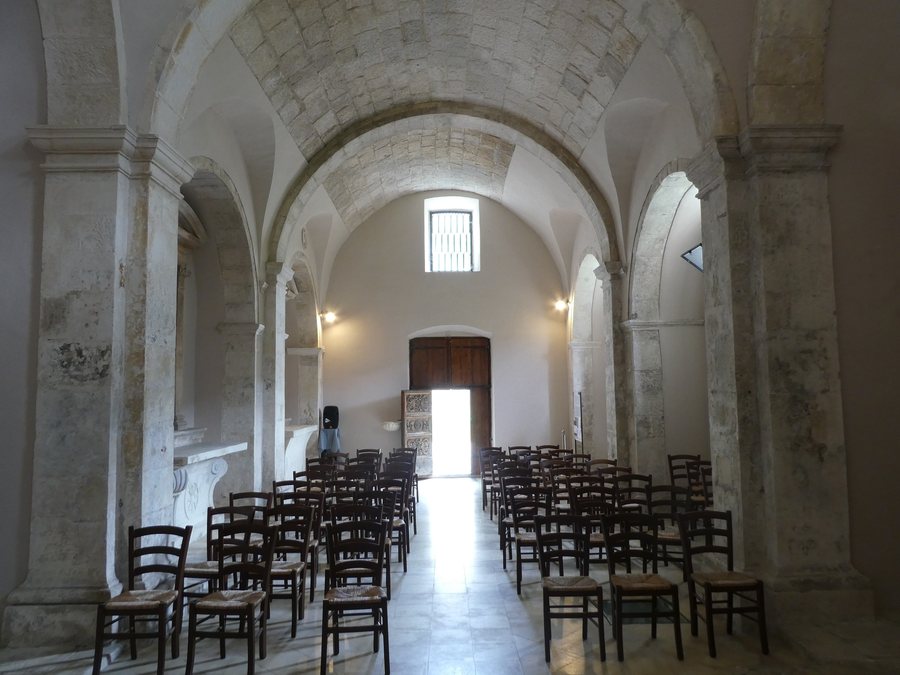 File:Roccamorice, chiesa di Santo Spirito - Interno 02.jpg
Photo: Syrio via Wikimedia Commons, CC BY-SA 4.0
File:Roccamorice, chiesa di Santo Spirito - Interno 02.jpg
Photo: Syrio via Wikimedia Commons, CC BY-SA 4.0
Roccamorice can be discovered through an unusual combination of natural landscapes, working history and rural building culture. In Località Acquafredda, industrial archaeology and the surviving mining landscape overlap with the natural surroundings and traces of the former agro-pastoral culture.
Historical building forms: The Capanne in Pietra a Secco of Roccamorice were built by farmers and shepherds from the early years of the 19th century onwards. They mainly served as temporary accommodation and storage spaces for agricultural equipment.
Extent of the cultural heritage: The cultural heritage of the Capanne in Pietra a Secco includes more than 250 dry-stone huts. Their large number makes it clear that this building form in Roccamorice is not limited to a single surviving structure.
Orientation on site: The information centre of the Parco Nazionale della Majella in Roccamorice is open daily from 10:00 to 13:00 and from 16:00 to 19:00, from 15 June to 31 August.
Art and religious architecture: The Centro d’Arte e Cultura “Alberto Di Giovanni” is located in the Chiesa dell’Annunziata. The church is also known as Chiesa del Barone.
A prominent destination: The Eremo-Abbazia di Santo Spirito a Maiella is located in the territory of Roccamorice within the Parco Nazionale della Majella.
Hermits and mountain landscapes
The Chiesa di Santo Spirito a Maiella is located at 1,132 metres above sea level on a limestone rock face. The rock face is surrounded by an extensive beech forest and is situated in the territory of Roccamorice, in the heart of the Parco Nazionale della Maiella.
The Eremo di San Bartolomeo in Legio was built beneath a 50-metre-long rock overhang at an altitude of approximately 600 metres.
Hikes with different levels of difficulty
Hiking trail C7 leads on foot from Roccamorice to the Sentiero Spirito near Località Macchia Metola or to C1 at Località Pagliari. The route is 5.9 km long, takes approximately 1 hour and 30 minutes, and has difficulty level E – Escursionistico.
A considerably more extensive option is the hiking route between Sant’Eufemia a Maiella and Roccamorice. It is completed on foot, is 22 km long, takes 7 hours and has difficulty level EE for experienced hikers. Compared directly with C7, it is therefore a substantially longer day hike with an explicitly higher level of difficulty.
For further town pages, you can expand your regional orientation with Sant'eufemia A Maiella, Manoppello, Abbateggio, Caramanico Terme, San Valentino In Abruzzo Citeriore and Turrivalignani.
Check prices, availability and facilities for your travel dates directly on Booking.com.
View accommodation and offersAdvertisement · Affiliate link to Booking.comFAQ
Where can sport climbing be practised?
Sport climbing can be practised at Parete dell’Orso in the Valle di Santo Spirito. Parete dell’Orso offers several climbing routes with different levels of difficulty. The rock area is therefore not limited to a uniform level of ability; the specific choice of route depends on the respective difficulty level.
Which guided tour can be booked?
The information centre of the Parco Nazionale della Majella in Roccamorice offers the possibility of booking guided tours of the Eremo di San Bartolomeo in Legio.
Which guided excursions are offered?
The information centre offers bookings for guided excursions with AIGAE guides from the Valle di Santo Spirito to the Block Haus.
How extensive is the art collection?
The Centro d’Arte e Cultura “Alberto Di Giovanni” contains a collection of more than 70 paintings.
What period does the mining history cover?
The territory of Roccamorice is home to some of the most significant mines of the Bacino di estrazione di asfalto e bitume della Maiella, including San Giorgio, Torretta, Acquafredda and Santo Spirito. The history of this industrial complex and the associated working culture extends approximately from 1850 to 1950.
For the higher-level travel overview: Pescara.

