
San Valentino In Abruzzo Citeriore between geosite, history and tradition
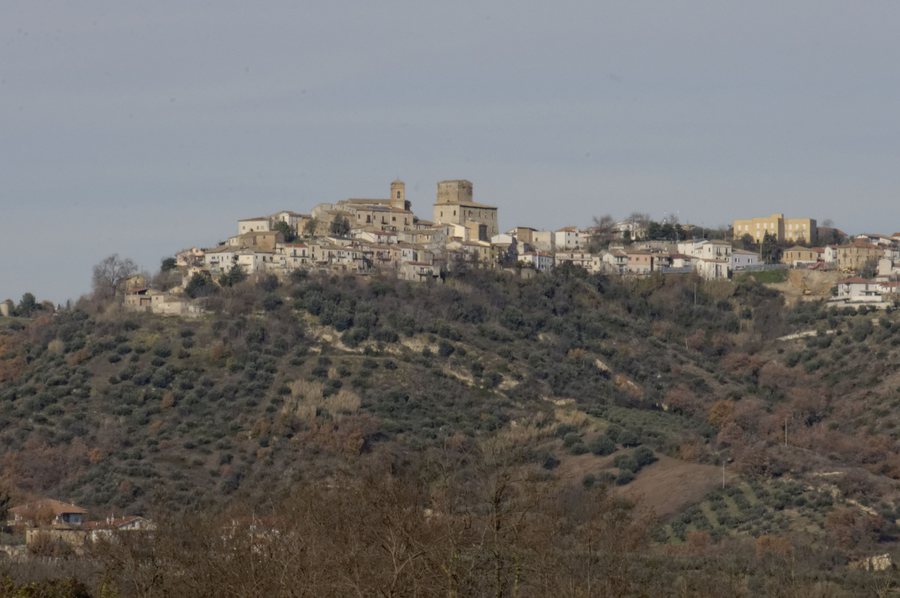 File:San Valentino in Abruzzo Citeriore 2018 by-RaBoe 036.jpg
Photo: © Ra Boe / Wikipedia via Wikimedia Commons, CC BY-SA 3.0 de
File:San Valentino in Abruzzo Citeriore 2018 by-RaBoe 036.jpg
Photo: © Ra Boe / Wikipedia via Wikimedia Commons, CC BY-SA 3.0 de
San Valentino In Abruzzo Citeriore combines the landscape of the Maiella and Morrone foothills with buildings, geological history, local festivals and traditional confectionery. The Grotta dei Callarelli and the Museo dei Fossili e delle Ambre represent natural and geological history, while the Cathedral of Saints Valentine and Damian and the Palazzo Farnese represent architectural history.
Location in the Maiella and Morrone foothills
San Valentino In Abruzzo Citeriore lies at about 450 metres above sea level in the foothills of Maiella and Morrone, in the Valle dell’Orta area. This elevation describes the landscape setting of the town without equating it with any specific mountain or winter-sports function.
Grotta dei Callarelli and prehistoric rock paintings
A special connection with nature and history can be found in the Grotta dei Callarelli. It is a UNESCO geosite and contains prehistoric rock paintings. Geological significance and early human pictorial evidence thus come together at this site. The cave is thematically connected with the landscape of the Valle dell’Orta and broadens the perspective on San Valentino with a very long view of time that extends beyond the later buildings and local traditions.
Cathedral of Saints Valentine and Damian
The Cathedral of Saints Valentine and Damian has an 18th-century structure and two characteristic bell towers. According to local traditions, it was founded in the 12th century to house the martyrs Valentine and Damian. Its architectural history includes several clearly dated phases: between 1777 and 1791, the cathedral was rebuilt, allegedly according to an undocumented design by Vanvitelli. Between 1916 and 1926, it was renovated according to a design by and under the direction of Antonino Liberi.
For this reason, both the long-standing tradition and the later architectural development are important for understanding the cathedral. The information about the 12th century belongs to local tradition, while the rebuilding and renovation phases are associated with specific periods. The cathedral can therefore be understood not only through its bell towers but also through the interplay of different historical layers.
Museo dei Fossili e delle Ambre
The Museo dei Fossili e delle Ambre is divided into two interpretive halls. The palaeontological hall includes a fossil section and a human history section; alongside it is the amber hall.
The extensive fossil collection offers a particularly broad perspective in terms of time. It illustrates the history of the last 500 million years of the Earth. In connection with the Grotta dei Callarelli, this creates a focus on natural history extending from prehistoric rock paintings to geological eras reaching far back into the past.
Palazzo Farnese and medieval origins
The Palazzo Farnese combines the form of a medieval castle, a fortified enclosure, a noble palace and a rural house. The complex has medieval origins and can be dated to the 13th century. It includes buildings within the walls of the original castle.
The present form of the Palazzo Farnese is also the result of a later alteration. It derives from extensive work commissioned by the Counts Perigiis della Tolfa in the early years of the 16th century. Those interested in architecture can therefore view the Palazzo both through its medieval origins and through its different functions and later transformation.
Local festivals and traditional confectionery
The local traditions of San Valentino In Abruzzo Citeriore include an impressive procession on Good Friday. The festival in honour of Saint Anthony the Abbot is marked by popular rites and “lu sbannimènde”. Both traditions add their own accents to the annual cycle and show that the town’s cultural identity consists not only of historic buildings and collections.
Traditional confectionery such as Torroncini, Ritagliati and Morette provides a culinary complement. Morette are described as a typical sweet.
Chiesa di San Rocco: documented accessibility
The Chiesa di San Rocco is accessible by stairs and has ramps for people with disabilities; it is free of architectural barriers. This information refers to the Chiesa di San Rocco itself and does not automatically apply to other buildings or routes in San Valentino In Abruzzo Citeriore.
Abbateggio, Manoppello, Caramanico Terme, Sant'eufemia A Maiella, Turrivalignani and Roccamorice.
Check prices, availability and amenities for your travel dates directly on Booking.com.
View accommodation and offersAdvertisement · Affiliate link to Booking.com
