
Central Saxony: Winter, Landscape and Culture
Accommodation in Central Saxony
Central Saxony offers a range of reasons to plan a trip: The ridge area of the Ore Mountains has ski slopes and cross-country trails, while geology, castles and mining provide other themes. If you are planning your stay around winter sports, the information about groomed slopes and trails is a useful starting point. The region also has exhibitions and guided activities that you can consider as separate interests when planning your trip.
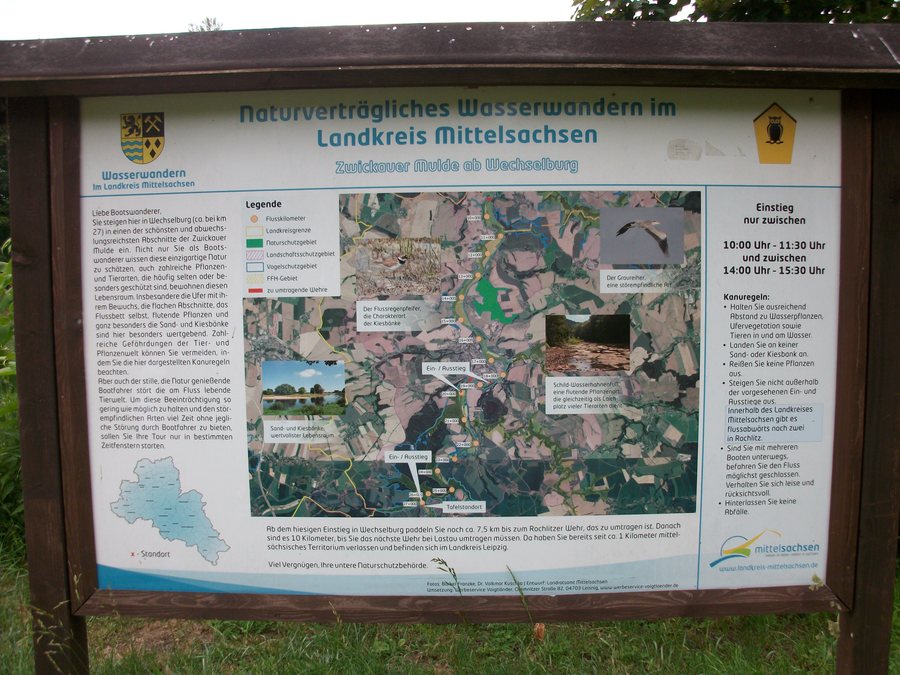 Nature-compatible water touring on the Zwickauer Mulde from Wechselburg
Photo: Aagnverglaser via Source, CC BY-SA 4.0
Winter Sports and Landscape
The ridge area of the Ore Mountains in Central Saxony has excellently groomed ski slopes and cross-country trails. Both downhill skiing and cross-country skiing are therefore part of the winter sports scene. Which of the two activities is most important to you can shape your trip. This information applies to the ridge area; it does not automatically describe every location in Central Saxony.
The landscape also offers specific points of interest beyond winter sports: the Porphyrland Geopark in Central Saxony invites visitors to hike and cycle. Those interested in geology can explore the 353-metre-high Rochlitzer Berg. It is a remnant of volcanic activity and contains red porphyry tuff, considered unique in Germany and Europe. This offers a choice of different travel focuses: outdoor activities or a distinctive geological connection.
Castles and Exhibitions
Rochsburg Castle has housed a museum since 1911. The exhibition “People Make Clothes” features 52 costumes spanning 1,000 years of European fashion history. This gives the visit a clear theme: rather than a general tour of the castle, the focus here is on the development of fashion through the costumes. Rochsburg Castle is not fully accessible to visitors with mobility impairments; however, some highlights can be explored with only a few steps. Keep this limitation in mind when planning your visit.
A different collection awaits you at the terra mineralia exhibition in Freudenstein Castle: it presents more than 3,500 minerals, gemstones and meteorites. Lichtenwalde Castle and Park now display exhibits from foreign cultures, as well as porcelain, lacquerware, furniture and silk embroideries. If you would like to include several cultural themes in your trip plans, you can choose these exhibitions according to your interests, for example minerals, fashion or crafts.
Rochlitz Castle offers guided experiences in which visitors learn about the history of the castle and its residents over several centuries. This is a different way to visit than seeing an exhibition with a clearly defined collection: the focus here is on the history of the castle and the people who lived there.
Mining and Regional Experiences
At the “Reiche Zeche” educational mine, underground tours begin with a descent by hoist, usually via the “Reiche Zeche” shaft. The hoist cage reaches the landing at a depth of around 150 metres. The approximate depth and the descent by hoist give the underground visit a distinctive character. In Schönborn-Dreiwerden, in the municipality of Rossau, visitors can travel underground by boat at the “Alte Hoffnung Erbstolln” visitor mine. The two experiences have different focuses: a descent by hoist and hoist cage on the one hand, and a boat ride on the other.
A historic ore train carriage from the original Dreiwerden mining railway can take visitors directly to the entrance of the mine. The “Historic Settlement Train” also takes place annually in the Striegis valleys. Sailing is possible at the Kriebstein Reservoir. These activities expand the travel options with an annual event and an activity on the water; each caters to particular interests.
For information about other places, you can also refer to the details on Sayda, Augustusburg, Leubsdorf, Frauenstein, Falkenau, Eppendorf, Oederan, Rechenberg-Bienenmühle, Niederwiesa and Frankenberg/Saxony.
For an overview of the wider region: Saxony.

