
Arft among mixed forests and juniper heaths
Accommodation in Arft
Arft is nestled among the mixed forests and protected mountain and juniper heaths of the Eastern Eifel. If you are looking for accommodation in Arft, the landscape and local hiking trails provide a concrete point of reference when choosing where to stay. The routes pass through varied landscapes and have different profiles. This makes it possible to get a sense of the area through its natural features and trails.
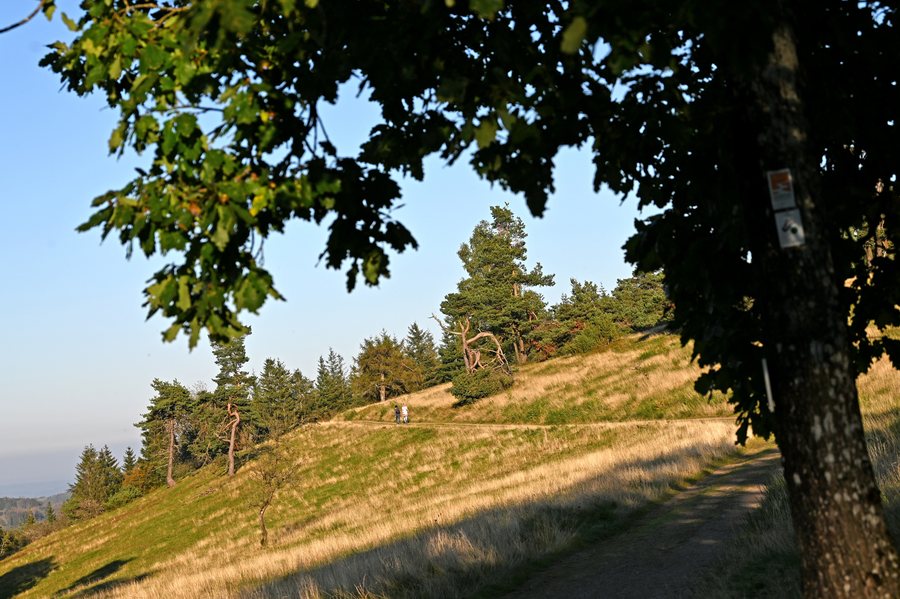
Juniper heaths and mixed forest
The uplands around Arft are home to wild-rose and juniper heaths, interspersed with broom and heather heaths. The mostly dense juniper stands sometimes grow up to three metres tall. Together with the area’s setting among mixed forests and protected mountain and juniper heaths, these heathland types shape the character of the landscape. Forest and open heathland are equally part of the surrounding scenery.
Hiking trails with different profiles
The award-winning Eifel Dream Trails Bergheidenweg and Wacholderweg both pass through the municipal area of Arft. The Historic School Route offers a different option: this scenic circular hiking trail in the municipality is nine kilometres long and links heathland with trails through mixed forests and along streams. The route is thus described by both its circular layout and length, as well as the transitions between heath, forest and streams.
The family-friendly Arfter Runde has a different profile. It follows well-maintained hiking trails through forest and juniper heath, then passes through the village of Arft. The German Alpine Club’s Jubilee Trail 100, Koblenz section, also passes through the municipal area. When comparing the options, you can focus on their specific differences: the circular layout and nine-kilometre length of the Historic School Route, the family-friendly nature and route through the village of the Arfter Runde, and the names and awards of the two Eifel Dream Trails.
Excursions and group activities
Local activities also include a focus on plant life: Hedda Edel, a medicinal herb specialist, usually leads an excursion in Arft about once a year. If you would like to plan your stay around this excursion, check the date in advance.
In the nearby area, Wacholderwacht offers nature-focused guided hikes and activities for school classes or groups of five or more. This minimum group size is a useful point of reference when planning a group visit. The activities include both guided hikes and events, complementing the choice of trails that you can compare according to your own interests.
Culture in the wider destination of Mayen-Koblenz
The wider destination of Mayen-Koblenz offers a distinct cultural and museum context. Genovevaburg Castle was built in 1280 by Heinrich von Finstingen, Archbishop of Trier, and is one of Mayen’s landmarks. The abbey in Sayn was founded around 1200, and its abbey church was consecrated in 1202. The abbey’s exterior paintings, dating from around 1255, are considered the best-preserved examples of their kind in Germany from the High Middle Ages.
Industrial heritage is also represented: Sayner Hütte is an anchor point on the European Route of Industrial Heritage and the only monument in Rhineland-Palatinate to receive this distinction. In Mendig, the Lava-Dome is the German Volcano Museum. Its five exhibition areas explain how the world’s tallest cold-water geyser works. The broader regional themes thus range from castle and abbey history to industrial heritage and volcanology, complementing the landscape and hiking trail themes that define Arft.
Discover more destinations: Acht, Welschenbach, Virneburg, Baar, Kürrenberg, Vordereifel, Herresbach, Ettringen
Back to the wider travel guide: Mayen-Koblenz.

