
Choosing Skis: Find the Right Length, Shape and Use
Skis should suit your ability, height and intended use. For a relaxing ski holiday, the most athletic-looking model is therefore not necessarily the right choice. What matters more is a manageable length, a suitable width and a condition you can rely on. If you ski only a few days a year or would like to try different models, you can get expert advice on various options at a ski rental shop.
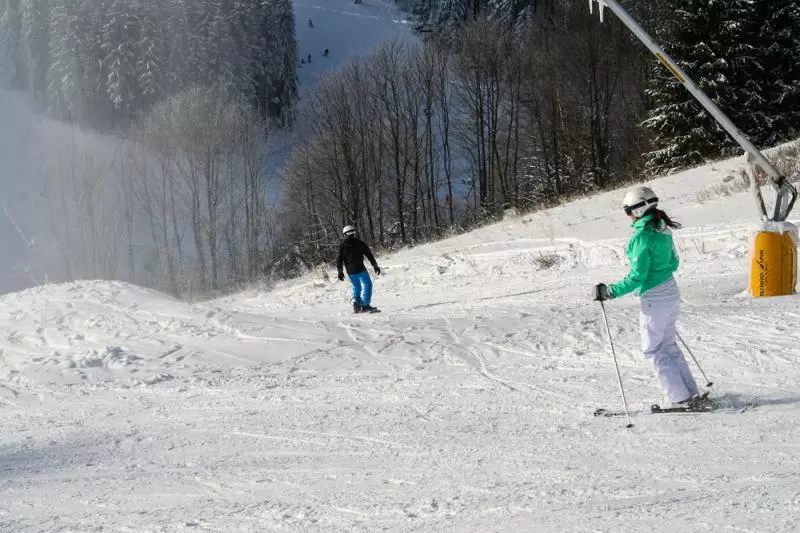 Eine Skifahrerin und ein Snowboarder fahren auf einer verschneiten, präparierten Piste.
Photo: Sabine Wiedamann | MaxTD Imagebank
Key facts
- Skis should match your ability and preferred terrain, not just your height.
- Shorter skis are easier for many beginners to turn; longer models can feel more stable at higher speeds.
- Width and shape affect how a ski feels on hard slopes, soft snow or off-piste.
- Ski boots and bindings must work together and be checked by a professional.
- Before your first day, check the edges, base and bindings.
- For children, skis that are too long are not automatically a sensible choice for future growth.
Choosing length and shape for your ability
The right length depends on factors including height, weight, strength, ability and intended use. Beginners often find a ski that is easy to control more manageable, because turning and braking require less effort. More confident skiers can focus more on stability, edge grip and their preferred speed. Fixed length-in-centimetres rules are only rough guidelines; advice should take the individual into account.
Shape also affects how a ski feels. A narrower piste ski can respond precisely on hard, groomed snow. Depending on the snow, a wider model offers more surface area, but may feel different on a firm slope. All-mountain models are practical for many holidaymakers expecting varied conditions. Ski bindings and ski boots must be compatible with each other and with the skis you choose.
Consider the slopes, your style and your group
Before buying or booking, think about where you will actually ski. Wide, groomed slopes call for different priorities than changeable snow. Beginners generally need skis that are easy to understand and control; more advanced skiers also consider edge grip, turn transitions and stability. If you are travelling with a mixed-ability group, you do not have to choose the same model as the fastest person. Skis suited to your own pace make the day safer and more enjoyable.
For families, it is also important that the equipment is easy to handle. Children grow quickly, so renting can be economical and practical. Check each child’s height, weight and boot fit again every year. A beginner ski lesson can help you assess your needs realistically before investing in skis of your own. For days out together, short distances and breaks are just as important as ski length.
Buying, renting and adjusting your skis
When renting, be honest about your ability, weight, height and intended use. Ask which model you are getting, and ski cautiously at first on the morning of your first day. If the skis are hard to turn, chatter or feel unusual on their edges, contact the rental shop. When buying, consider storage, maintenance, transport and access to professional servicing as well as the price. Ski maintenance includes checking the base and edges.
Ski boots need to fit snugly so that your movements are transferred precisely. Bindings are a safety-critical component and should never be adjusted by guesswork. Have them checked after a fall, a change of boots or a long break from skiing. Ski binding adjustments should be carried out by a specialist shop.
Pre-ski-day checklist
At home or at the rental shop, check for visible damage to the base, deep nicks in the edges and any loose parts on the bindings. The boot should click into the binding cleanly and release without unusual resistance. If several pairs look alike, take the time to match each pair to the right person. Poles should be the right length so they do not get in the way when standing normally or using your chosen technique.
For safety on the slopes, start on an easy run. Assess the snow, visibility and traffic before picking up speed. If conditions are very different from what you expected, choosing another route is wiser than forcing yourself to ski the run you had planned.
It is also worth considering how you feel on the day. Skis that are easy to turn in the morning may become tiring after several hours, as your strength and concentration fade. So plan not just for the most challenging run you hope to ski, but also for return routes, breaks and an easy way off the mountain. As part of your preparations, you can also plan your ski holiday step by step and check your equipment well before departure.
If you buy skis online, read all the details about the model year, length, width and bindings. Product photos rarely show how skis will feel on the slopes you use. If you are unsure, ask for advice or try a comparable model from a rental shop. Your overall equipment check should also include ski goggles and a helmet for eye and head protection.
FAQ
How long should skis be?
It depends on your height, weight, ability and intended use. Advice from a professional is more reliable than a general length-in-centimetres rule, especially for children and beginners.
Are short skis always better for beginners?
They can be easier to turn, but still need to suit the skier and the model. The key is that the skis are easy to control and can be used safely.
When does renting skis make sense?
Renting is often practical if you ski only a few days, have changing needs or are buying for children who are still growing. Book early during busy periods and check your equipment when you collect it.
