
Candelario – Sierra, Culture and Mountain Trails
Accommodation in Candelario
From the second platform, the route to the Lagunas del Trampal continues on foot; after a little more than an hour, you reach terraced glacial lakes in the province of Ávila, which are almost always covered in snow.
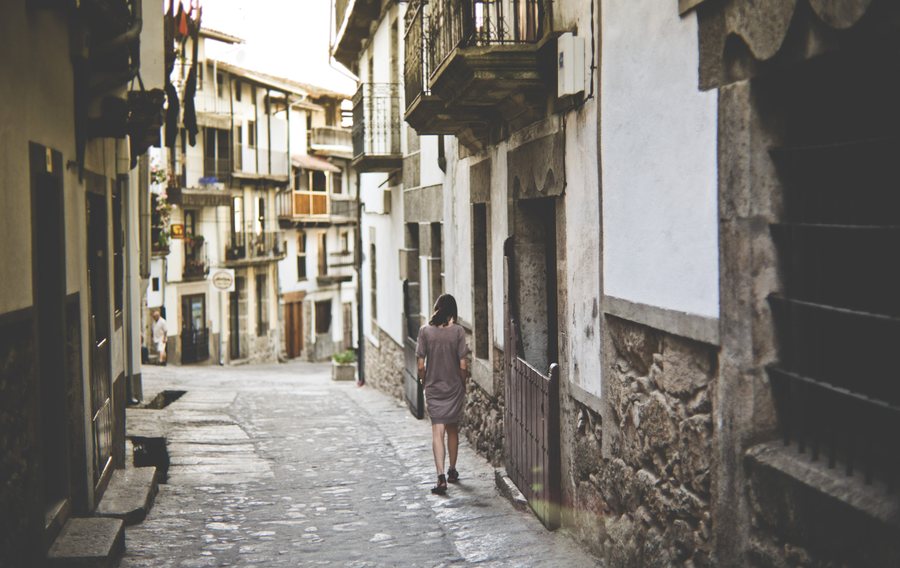 File:Candelario, Spain (Unsplash).jpg
Photo: Francisco Moreno franciscomoreno via Wikimedia Commons, CC0
File:Candelario, Spain (Unsplash).jpg
Photo: Francisco Moreno franciscomoreno via Wikimedia Commons, CC0
Nature
The Sierra de Candelario, Béjar or Solana is a Paleozoic massif of the Central System, shaped by intense glacial and fluvial processes of varying degrees. The landscape around Candelario rises to great heights and is dominated by the Calvitero, which stands at more than 2,400 metres; forests extend up the slopes of the Sierra.
Hoya Moros is considered an area of great ecological value. Its access begins east of Candelario next to the municipal swimming pools, at a junction where the road to La Garganta begins. The route passes through an oak forest into a glacial valley, where an extensive meadow surrounded by high rock walls forms the source of the Río Cuerpo de Hombre.
Routes
You can follow the Ruta de La garganta del Oso on foot or by mountain bike; it is rated moderate to fairly easy. The Ruta del Cancho de la Muela can likewise be explored on foot or by mountain bike and is considered moderate.
The different activity types and difficulty levels allow you to compare the two routes directly. At the first platform on the route to the Lagunas del Trampal, reached after approximately 7 kilometres, there is a car park and a hostel-refuge.
Culture
Candelario was declared a Historic-Artistic Site in 1975. The narrow, cobbled streets are crossed by the famous Regaderas, small water channels fed by snowmelt from the surrounding Sierra.
The Regaderas were used to irrigate nearby gardens and, during the period of home slaughtering, to carry away slaughter waste and pig’s blood. Traditional residential architecture includes three-storey houses whose upper floor was fitted with a structure for hanging and curing sausages.
The Iglesia de Nuestra Señora de la Asunción combines Mudejar, Baroque, Romanesque and Gothic architectural elements. It also contains a 16th-century altarpiece dedicated to martyrdom, featuring wood carving and panel painting.
The Museo Casa Chacinera illustrates the town’s way of life at the end of the 19th century and the beginning of the 20th century through original furniture and household objects provided by Candelario’s residents. A theatrical presentation recreates the atmosphere of a home slaughter in Candelario around 1920. More than 400 original pieces and everyday objects were loaned to the museum by residents of Candelario.
The Boda Típica de Candelario is recognised as a festival of regional tourist interest. Batipuertas are half-doors positioned in front of the actual entrance to a house in Candelario, protecting it from the outside.
Cuisine
Candelario’s cuisine highlights cured meats, cocido de matanza and the traditional hornazo, accompanied by excellent regional wines.
An excursion option in the vicinity of Candelario is the Béjar Textile Mills Route.
La Hoya, Béjar, Navacarros, Vallejera De Riofrío
To the overview of the wider travel area: Salamanca.

.jpg)