
Escunhau among mountain trails and Romanesque architecture
Accommodation in Escunhau
A clear winter-related reference point in Escunhau is La Tuca at 1,800 m. The area extends along the right-hand side of Vielha, Betren, Escunhau and Casarilh; from these places, forest tracks and hiking trails of varying difficulty lead through dense fir forests. La Tuca should be understood as a former ski resort. For your stay, this historical connection with winter sports combines with Romanesque architecture, village character and trails through the mountain landscape.
 File:Sant Pere d'Escunhau, Val d'Aran. - Flickr - Angela Llop.jpg
Photo: Angela Llop from Spain via Wikimedia Commons, CC BY-SA 2.0
File:Sant Pere d'Escunhau, Val d'Aran. - Flickr - Angela Llop.jpg
Photo: Angela Llop from Spain via Wikimedia Commons, CC BY-SA 2.0
Trailhead: The forest track to the hiking trail for Lac d’Escunhau begins in Escunhau.
Access to the lake: The route follows an 8 km forest track to a small car park and a hut. You then reach the lake via a comfortable ascent of less than an hour.
Forest route: The Pueblos de Castièro route follows part of the track rising to the former La Tuca ski resort, passing through a shaded forest of ash trees, maple trees and oaks to Escunhau and Casarilh.
Villagescape: The centre of Escunhau consists of intersecting streets and numerous stone houses in the purest Aranese vernacular architectural style.
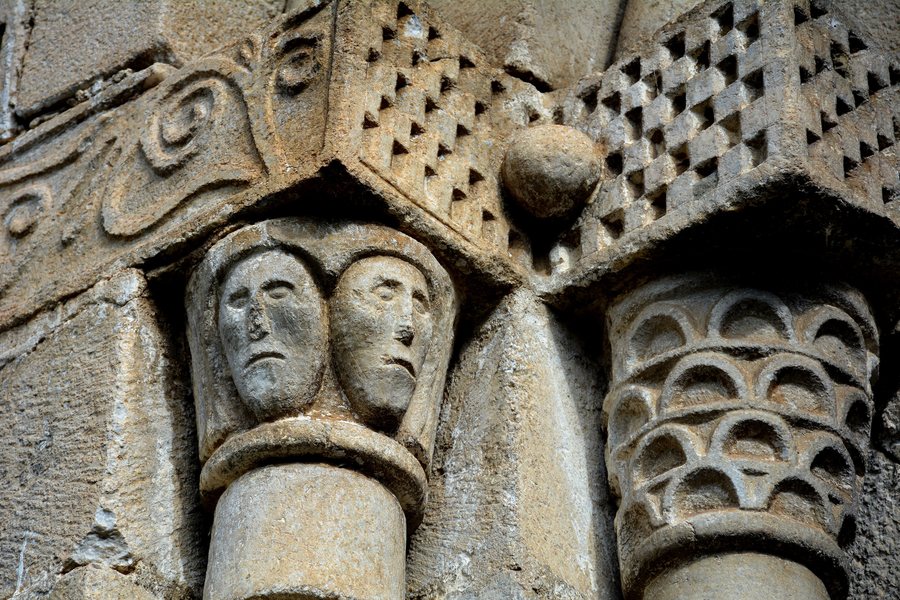
Church portal: The portal of Sant Pèir d’Escunhau is structured by three concentric arches and two archivolts supported by columns.
Romanesque baptismal font: In a small side chapel of Sant Pèir d’Escunhau that serves as a baptistery, there is a large Romanesque marble baptismal font on a simple cylindrical base.
Surroundings: The mountains and peaks in the surrounding area include Monte Calvo, Tuc de Sarrahèra, Tuc Nere and Tuc de Somont.
Romanesque architecture and historic trails
The church of Escunhau is part of the Ruta Románica de Arán, the Romanesque route of Val d’Aran. This gives the village centre a clear cultural connection that can be directly understood through the church and its architectural design. The portal of Sant Pèir d’Escunhau and the marble font in the side chapel add specific details to this impression, which can be deliberately observed while walking through the village.
The Camin Reiau also refers to the history of the landscape. It uses routes that once connected the various villages of Val d’Aran and were already used by the Romans in antiquity. The historical status of this connection is essential: these are routes with an inherited former function, not a statement about current operations or specific tourist infrastructure.
Mountain landscape around Escunhau
Monte Calvo is a mountain in the immediate surroundings of Escunhau. Tuc de Sarrahèra, Tuc Nere and Tuc de Somont are peaks in the area around the village.
For travellers who take La Tuca’s historical status as a former ski resort into account and plan activities in the forest and mountain landscape, several themes come together here: forest trails, mountain scenery and historic village culture. The routes differ considerably in their layout. Access to Lac d’Escunhau combines a longer drive along a forest track with a subsequent ascent, while other trails pass through forest and across mountainous terrain. This is particularly helpful for groups with different interests, as culture, nature observation and hiking can be considered separate themes for different days.
Churches in the wider regional area
There are also sacred destinations in the wider regional area around Escunhau, beyond the immediate village setting. Esglesia de Sant Esteve de Ginast is a church in this wider regional area. Pilaret de Sant Urbà is also a church in the wider regional area around Escunhau. Both destinations expand the Romanesque and ecclesiastical-history theme beyond Sant Pèir d’Escunhau, without a specific distance or particular access route being established for them.
Summer visits and practical context
Guided visits to Sant Pèir d’Escunhau are scheduled during the summer months as part of the Ruta Románica de Arán. As a result, the cultural focus of a stay may vary seasonally from the focus on mountain trails and the former ski resort.
When choosing a hotel or accommodation for a skiing holiday in Escunhau, the reference to La Tuca should be read clearly as historical: it denotes a former ski resort and does not provide current operating or lift information. For families, couples and mixed groups, it therefore remains sensible to keep interests separate in a matter-of-fact way. Some travellers can focus on the Romanesque church and village centre, while others can concentrate on the trails through the forest and mountain landscape. A short ascent or a former connection with winter sports does not imply either general ease or suitability for every group.
In this combination, Escunhau is particularly suitable for visitors who do not want to reduce their stay to a single theme. Romanesque architectural forms, historic trails, Lac d’Escunhau and several surrounding peaks provide different starting points for planning your days. The specific conditions of a route or visit remain tied to the individual destination in each case.
Other destinations in the area: Arròs, Casau, Betlan, Aubèrt
For the general travel overview: Vielha.

