
El Pont de Suert: Culture, River Routes and Local History
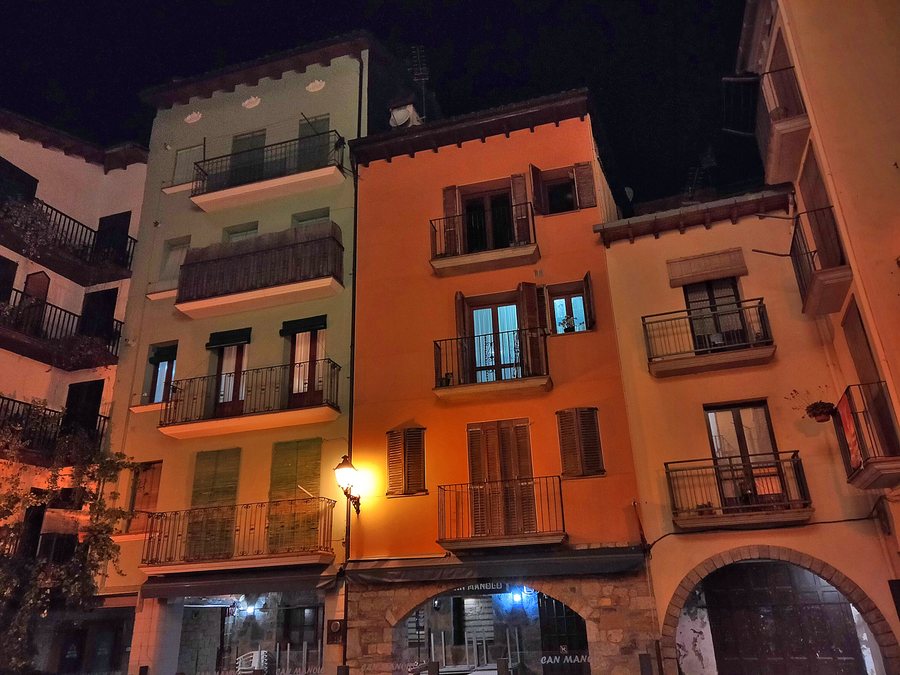 File:002 Plaça Major (el Pont de Suert), cases de la banda nord.jpg
Photo: Enric via Wikimedia Commons, CC BY-SA 4.0
File:002 Plaça Major (el Pont de Suert), cases de la banda nord.jpg
Photo: Enric via Wikimedia Commons, CC BY-SA 4.0
On its third stage, the Grand Tour of Catalonia passes through El Pont de Suert. The stage is named “Molt a prop del cel”.
Other pages about nearby places will take you to Gotarta and Malpas.
Routes
Els Ponts del Pont is a two-kilometre circular route with a low level of difficulty. The route follows the Noguera Ribagorçana River as a central river corridor. The Noguera Ribagorçana flows through El Pont de Suert and offers opportunities for walks along its banks.
The Camí de l’Aigua begins at the Font de la Mena near El Pont de Suert and ends at the Balneari de Caldes de Boí. The route is suitable for mountain biking, is signposted throughout, and is not open to motorised vehicles. For planning purposes, the circular route, riverside paths and mountain-bike route can be compared as different types of routes. The different route formats help distinguish them: a circular route returns to its starting point, while the Camí de l’Aigua runs between a starting point and an endpoint. Together with the designated mountain-bike use and the exclusion of motorised vehicles, this clearly distinguishes the two routes described.
History
The old town of El Pont de Suert dates from the Middle Ages, particularly from the 13th to the 15th century. Plaça del Mercadal was created as an extension of the old town; two of its sides are lined with arcades, and most of the buildings were constructed in the 18th century. Casa Jaumot, also known as Ca de Jaumot, is a Baroque palace house in the old town.
The Església Vella was built in the Romanesque period, around the 12th century, and was extensively altered in the 17th and 18th centuries during the Baroque period. The former Palau Abacial forms an architectural complex with the Església Vella and was the residence of the abbots of the Monestir de Santa Maria de Lavaix. The Església Vella houses the Col·lecció d’Art Sacre de la Ribagorça.
The Església de l’Assumpció was consecrated on 7 September 1955. The architectural project was drawn up by Eduardo Torroja Miret in collaboration with José Rodríguez Mijares.
Nature
The Centre de Fauna de Pont de Suert is dedicated to semi-aquatic mammals and, since 2013, to the ex-situ breeding of the Montseny brook newt, which is highly threatened with extinction.
Cuisine
The Fira de la Girella takes place every year on the third or fourth Sunday in October. Girella is a sausage made from rice and lamb, traditionally produced in the Pyrenees.
Festivals
During the Falles de Casós, participants, to the ringing of the bells of the Església Vella, walk from the edge of the village over the palanca d’Aragó and along Carrer d’Avall to Plaça Major and Plaça del Mercadal. There, they form a circle and throw the torches into the centre, where a large fire is created, before drinks are served and a celebration begins that lasts until dawn.
To the higher-level travel overview: Lleida.
Check prices, availability and amenities for your travel dates directly on Booking.com.
View accommodation and offersAdvertisement · Affiliate link to Booking.comMore destinations
More places within the same destination:

,_cases_de_la_banda_nord.jpg)