
Ski Hotels in Stola: Cross-Country Skiing and the High Tatras
Accommodation in Stola
In winter, cross-country ski trails are maintained in Štôla. They run through nature along the Poprad River and offer views of the panorama of the High Tatras. If weather conditions permit, Štôla organizes the Štôlska lyža sporting event in February or March.
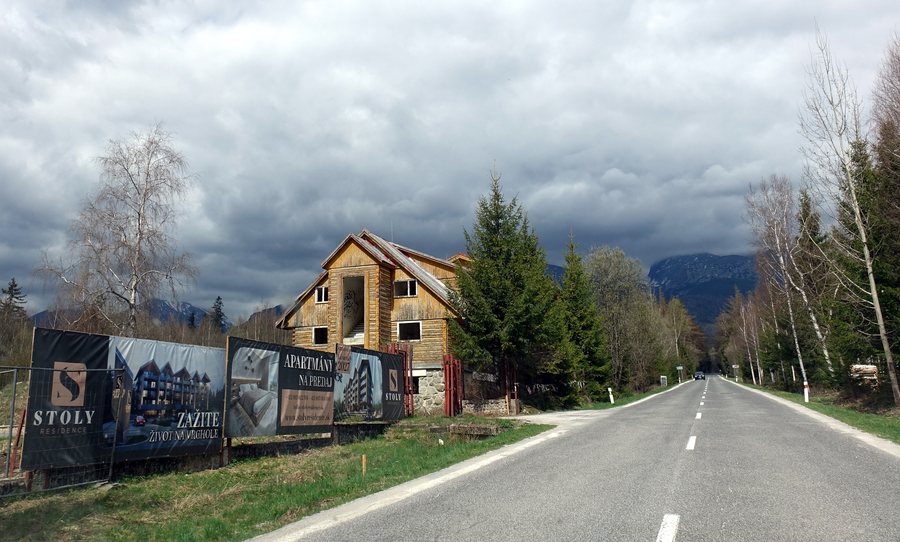 File:Bývalá Liečebňa respiračných chorôb Štôla 25 Slovakia 3.jpg
Photo: Jozef Kotulič via Source, CC BY 4.0
Winter and Trails
The Batizovce–Gerlachov–Mengusovce–Štôla educational and hiking trail belongs to the municipality. It serves educational and nature conservation purposes and is intended for the general public, including less experienced hikers, children, and older people. The trail consists of one large and three small information boards. Each of these boards has seating with a table and benches, a bicycle rack, and a litter bin. Several viewpoints offer views of the Tatra peaks.
The educational and hiking trail follows marked paths around artificial lakes. Its cycling paths are connected to the cycle route network below the Tatras. Thus, the route combines educational and nature conservation content with designated trail sections, viewpoints, and integration into the regional cycle route network, without these elements being presented as a single route with uniform use.
Other marked hiking routes to Štôla are also recorded: Between Vyšné Hágy and Štôla, there is a yellow-marked route with the times 0:45/0:35. Between Tatranská Polianka and Štôla, a green-marked route is listed with the times 1:15/1:00. Between Batizovské pleso and Štôla, a yellow-marked route is recorded with the times 3:15/2:35. Between Sliezsky dom and Štôla, there is a yellow-and-red-marked route with the times 4:15/3:35.
History and Character of the Village
Štôla lies in the western part of the Poprad Basin on the southern slope of the High Tatras. The village was established on the site of a former Benedictine monastery built in 1314. This Benedictine monastery burned down around 1436 during the Hussite Wars and the unrest surrounding the Hungarian throne and was never rebuilt.
The Evangelical neoclassical church in Štôla dates from 1870 and houses an altarpiece by Peter Bohúň. It is usually closed; visits must be arranged with the local priest from Mengusovce.
The Štôla military cemetery contains 296 war graves. A wooden bell tower with a double cross and a bronze bell stands in the village as the probably last surviving public relic of the former monastery. The former monastery also includes an orchard that still preserves several centuries-old field boundaries overgrown with plum trees. These are considered a rarity in fruit cultivation.
Traditional and craft-related traces have also been preserved. Štôla still has four traditional Hlemajzy, which serve as grain stores or storage rooms. Local crafts are presented at various cultural and social events, including woven carpets, scratched and painted Easter eggs, wooden sculptures, painted pictures, and blown-glass products. Visitors can arrange an appointment with Mr. Kocián at his glass workshop, where he presents his craft.
Another local landmark is a wooden house built in 1929 and designed by the renowned Slovak architect Dušan Jurkovič.
Other destinations: Vysoké Tatry, Zdiar, Strba, Liptovská Teplicka, Velký Slavkov, Poprad, Mengusovce, Vernár.
To the higher-level travel overview: Okres Poprad.

