
Vodo Cadore: Trails, Mountain Landscapes and Local History
Accommodation in Vodo Cadore
When you choose Vodo Cadore as your travel destination, you can expect a combination of mountain landscapes, historic trails, local religious history and insights into agriculture. The various points of interest appeal to travelers who do not want to limit their stay to a single experience: in addition to Monte Pelmo and the Boite Valley, the character of the area includes a striking reservoir, a former railway line, churches dating from several centuries and local food traditions.
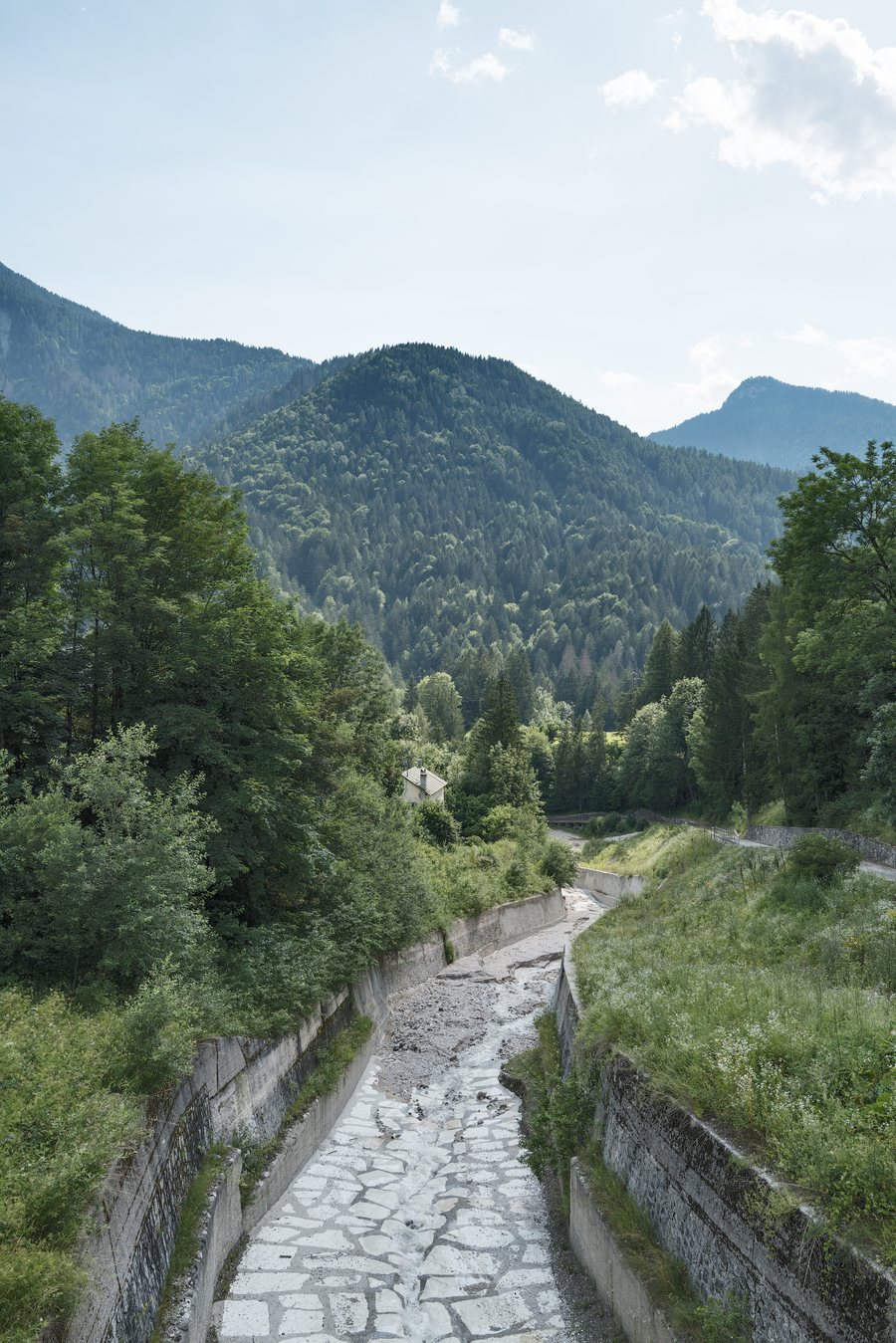 File:Rio Rudan - Peaio, Vodo di Cadore, Belluno, Italia - 10 Luglio 2023 01.jpg
Photo: Giorgio Galeotti via Wikimedia Commons, CC BY-SA 4.0
File:Rio Rudan - Peaio, Vodo di Cadore, Belluno, Italia - 10 Luglio 2023 01.jpg
Photo: Giorgio Galeotti via Wikimedia Commons, CC BY-SA 4.0
If you would like to compare other destinations with Vodo Cadore, you can also check San Vito Di Cadore, Masarè, Puos Dʼalpago, Livinallongo Del Col Di Lana, San Nicolò Di Comelico, Borca Di Cadore, Arabba and Belluno.
Location: Vodo di Cadore lies in the valley of the Torrente Boite at an elevation of 910 meters, between the Pelmo and Antelao Dolomite massifs.
Water and structure: Lago di Vodo is an artificial reservoir created by a dam on the Boite immediately below the town. The Vodo dam is over 40 meters high and is designed as a dome dam in the shape of a quarter of a sphere.
Cycling route: The Lunga Via delle Dolomiti passes through Vodo and, in the route sequence described, connects Calalzo di Cadore, Pieve, Valle, Vodo, Borca and San Vito di Cadore.
Railway history: The former Ferrovia delle Dolomiti had railway stations or station buildings in Peaio and Vodo. The last train ran on May 17, 1964; the railway was then closed.
Church history: The existence of a church dedicated to Saint Lucia has been documented in Vodo since the 13th century.
Mountain trails and orientation around Monte Pelmo
A specific mountain connection can be found around Rifugio Venezia. The mountain hut is located at Campi di Rutorto on the southeastern slopes of Monte Pelmo, in the municipality of Vodo di Cadore. It was inaugurated in 1892 as the first mountain hut built on Italian soil in the Dolomites. This makes the site both an alpine trail destination and a place with historical significance for the development of mountaineering.
From the Vodo di Cadore–Forcella De Cuze starting point, Rifugio Venezia can be reached via trails 493 and 471 in approximately 2 hours 30 minutes to 2 hours 45 minutes. The approximate time range is more useful for planning than an apparently exact duration: it shows that the trail can be regarded as an independent mountain experience with a clearly defined starting point and a documented walking time.
Cycling on a former railway line
The Lunga Via delle Dolomiti, which passes through Vodo, is completely closed to traffic, paved and has consistent, easily manageable gradients. For your planning, this means a clearly described connection in which not only the route but also the surface and gradient characteristics are known.
The route follows the track of the former Ferrovia delle Dolomiti. This railway was built during the First World War and closed in 1964. Those who use the Lunga Via are therefore also traveling along a route with a clear connection to transport history; Peaio and Vodo are among the places where the former railway was present through railway stations or station buildings.
Churches and memorial sites in Vodo and Vinigo
The Church of Santa Lucia in Vodo can be recognized by its distinctive bell tower with a crenellated top. In addition to its considerable historical age, the building therefore has a clear architectural feature that allows you to distinguish it in the townscape.
Another date is associated with the Church of San Giovanni Battista in Vodo: it was founded on June 25, 1493. Together with Santa Lucia, this makes the town’s long ecclesiastical development tangible, without assigning both buildings the same historical role.
Vinigo also extends the cultural radius. The present-day church in Vinigo was rebuilt between the late 15th and early 16th centuries. In the same village, a simple and level road can be reached from an old mill. This allows cultural and historical destinations to be combined with a short, straightforwardly described walk.
Peaio is also associated with the name Italo Marchioni. Italo Marchioni (1868–1954), who is considered the inventor of the ice cream cone in Vodo, was born in Peaio on December 21, 1868. A memorial artwork dedicated to him was installed in Peaio in 2003. This gives the place an additional connection to local commemorative culture and to a figure whose life dates and attribution have been specifically documented.
Milk production and agricultural insights
The history of the local economy can be traced through Vodo’s first officially established Latteria Sociale. It was founded on November 16, 1881; the following day, butter, cheese and ricotta were produced there. This sequence combines a precisely dated founding event with the products made there immediately afterward.
For visitors, Azienda Agricola Talamini De La Tela offers a different way of accessing regional agriculture. The farm is certified as a Fattoria Didattica and provides insights into milk production and agricultural practices. This makes the farm an independent point of interest for travelers who, alongside trails, mountains and history, would also like to learn about food production.
For the overall travel overview: Province of Belluno.

