
Sappada: Cross-country skiing, mountain landscapes and culture
Accommodation in Sappada
Sappada is considered a German-speaking linguistic island in a different-language environment. Historic houses, museums and regional specialities characterise Sappada even away from the snow. Historical and culinary themes thus complement the winter trails.
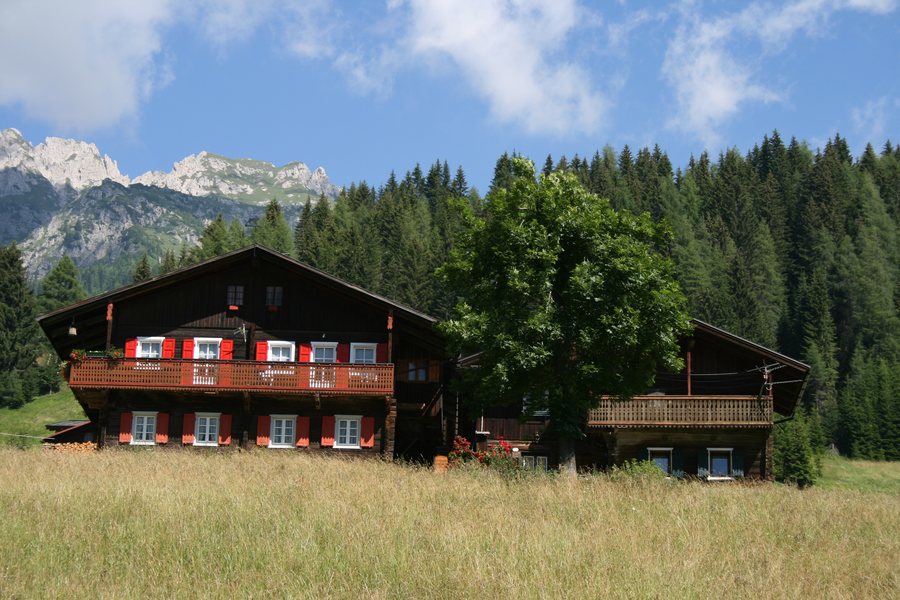 File:Sappada Vecchia (1150146575).jpg
Photo: Sergio from Sappada/Trieste, Italy via Wikimedia Commons, CC BY-SA 2.0
File:Sappada Vecchia (1150146575).jpg
Photo: Sergio from Sappada/Trieste, Italy via Wikimedia Commons, CC BY-SA 2.0
Cross-country skiing in the valley
A 15-kilometre cross-country ski trail runs through the entire valley as a circular route. Unlike the trails leading up into the mountains, this winter route remains in the valley.
Val Sesis and trails leading up into the mountains
The high valley of Val Sesis stretches out at the foot of Monte Peralba. The 2,694-metre-high summit is regarded as a symbolic mountain of the Carnic Alps; the high valley is also home to the famous springs of the Piave. Sappada offers trekking opportunities ranging from easy walking paths in the valley and comfortable forest trails to nature trails and more challenging high-altitude tours. The combination of valley paths, forest trails, nature trails and high-altitude tours covers several levels of difficulty. The route to the Laghi d’Olbe, classified as easy, leads from Sappada 2000 via trail 315 and thus complements the more challenging high-altitude tours.
Nevelandia
Nevelandia is a snow and play park for families in Sappada.
Wooden houses and museums
In Sappada Vecchia, historic wooden houses shape the appearance of the village; they were built using the traditional log construction method. The Museo Etnografico Giuseppe Fontana in Cima Sappada presents a tour ranging from the natural environment to the identity of the local community. The tour provides insights into the geology and the flora and fauna of the Sappada valley. A historical section covers the origins and history of the people of Sappada up to the present day. The natural history section and the historical section therefore focus on two different aspects within the same museum.
History in two museums
The Piccolo Museo della Grande Guerra preserves an extensive collection of finds and memorabilia from both opposing sides of the First World War. The Casa Museo della Civiltà Contadina Puicher s’Kottlars haus/schtol in Borgata Cretta is a simple dwelling house dating from the second quarter of the 19th century, with an adjoining stable and hayloft. The two sites therefore represent different historical themes: military history on the one hand, and rural domestic and working life on the other.
Traditions and products
Plodar Vosenòcht, the Sappada carnival, involves the entire village and takes place over three Sundays. At the Casa dell’Antica Civiltà Contadina, visitors can sample cheeses, cured sausages and air-dried meats produced in Sappada, accompanied by expert explanations. The carnival takes place on several dates throughout the village, while the tasting focuses on products from Sappada.
Other destinations
Mareson-Pecol, Cencenighe Agordino, Borca Di Cadore, Corte, Arabba, Zoldo Alto and Puos Dʼalpago.
More about the destination
To the higher-level travel overview: Belluno Province.

.jpg)