
Lucca: ski hotel, city walls and Puccini
Accommodation in Lucca
The Mura di Lucca have been completely preserved to this day and extend for more than four kilometres as an urban park. They can be explored free of charge on foot or by bicycle. This creates a direct connection between a striking architectural landmark and a route through the city.
Culture
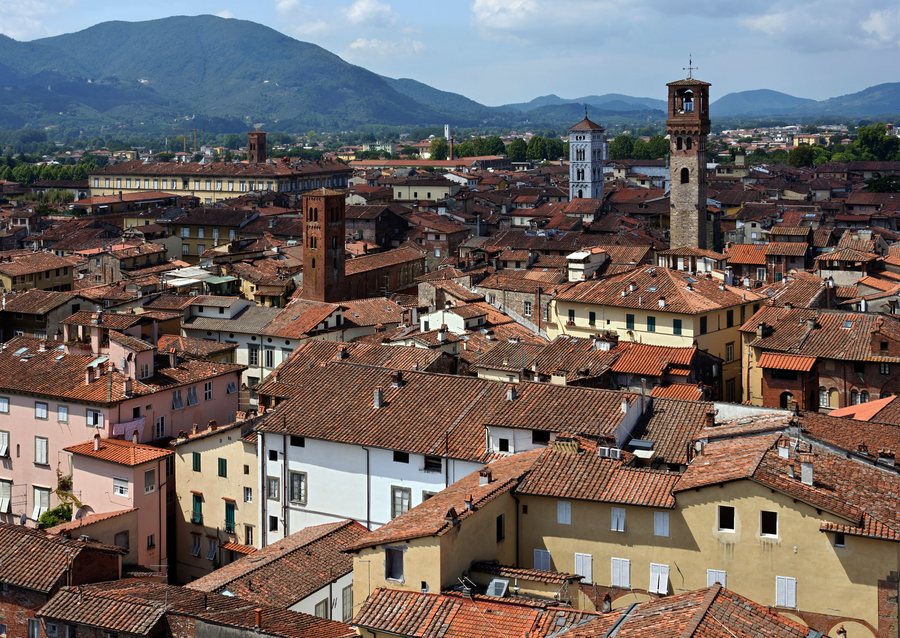
The Torre Guinigi is 45 metres high and features a rooftop garden where holm oaks grow. Together with the nearby Torre delle Ore, it is one of two surviving towers among Lucca’s approximately 130 medieval towers. The terrace of the Torre Guinigi can be reached via 25 flights of stairs comprising a total of 230 steps. In clear weather, the view extends across the city, the green hills and mountains, the Apuan Alps to the northwest, the Apennines to the northeast, and Monte Pisano to the south.
The Cattedrale di San Martino has an asymmetrical façade and was consecrated by Pope Alessandro in 1070. Inside is the Renaissance sarcophagus of Ilaria del Carretto. The bell tower of the Cattedrale di San Martino was opened to the public in August 2016 following restoration work. It is approximately 60 metres high, the climb comprises 217 steps, and the belfry offers a 360-degree panorama over Lucca and the plain of Lucca.
In June 2023, access to the bell tower of the Basilica di San Frediano was made possible. The tower is 55.20 metres high and, through its 31 openings, offers a unique view of the old town and the plain of Lucca.
The Piazza Anfiteatro was built over a Roman amphitheatre dating from the 1st or 2nd century AD, which had an elliptical layout. Today’s Piazza Anfiteatro was created from 1830 onwards by the architect Nottolini. The Luminara di Santa Croce is a tradition deeply rooted in Lucca’s history.
The Puccini Museum displays original furnishings, handwritten scores, and the Steinway & Sons grand piano on which Puccini composed his unfinished final masterpiece Turandot. The Puccini Museum – Casa Natale houses the apartment in Corte San Lorenzo where Giacomo Puccini was born on 22 December 1858 and spent his childhood and early youth. The museum is located in the heart of Lucca, between Piazza Cittadella and Corte San Lorenzo.
Getting around
The Ciclopedonale Puccini runs through the walled city of Lucca and includes the Puccini Museum as a stop along the route. The Via Francigena Entry Point Museum is located in the former Casa del Boia and offers an interactive multimedia tour.
The Via Francigena Entry Point includes a hospitality area with a cafeteria, refreshment facilities, and a rest area in the barracks section of the Baluardo San Salvatore, where visitors can rest and refresh themselves before continuing their journey.
Nature
The Orto Botanico di Lucca covers two hectares on the southeastern side of the historic old town. It was established as a scientific garden in 1820, preserves endangered species and varieties, and supports botanical research and education.
The Parco fluviale del Serchio offers an 11-kilometre circular route for pedestrians and cyclists from the area around Ponte San Quirico to Ponte San Pietro and back.
Cuisine
In the Lucca area, filled pasta parcels with meat and meat ragù are called tordelli. They have the classic ridged half-moon shape.
Arrival
Lucca railway station is located on Piazza Ricasoli, directly outside the city walls, and can be reached on foot in just a few minutes.
More pages about local destinations: Molazzana, Vergemoli, Careggine, San Romano In Garfagnana, Castelnuovo Di Garfagnana, Giuncugnano, Pieve Fosciana, Sillano, Vagli Sotto, Villa Collemandina, Camporgiano, Piazza Al Serchio, Gallicano.
To the higher-level travel overview: Tuscany.

