
Floh-Seligenthal
Accommodation in Floh-Seligenthal
Floh-Seligenthal offers reasons to visit at different times of year: hiking trails wind through forests and across mountain meadows, while nature and events come together at Lake Ebertswiese. For cross-country skiing, there is the 8 km Bergseeloipe, a loop through wintry landscapes and past the lake. Which accommodation suits your trip therefore also depends on whether you want to focus on hiking, natural attractions, swimming, local culture or this winter loop.
Hiking Trails and Geology
The moderately challenging Höhnberg Loop is 14.3 km long; the stated walking time is about 3 hours, with an ascent of 286 m. The route follows historic paths through spruce and mixed forests to the mountain ridge, follows the Rennsteig for a stretch, then crosses mountain meadows and valleys. These details can help you fit the loop into your day’s plans.
Another option is the 11 km Große Haderholzroute between Seligenthal and Kleinschmalkalden. It takes you to geological features and viewpoints around Haderholzstein. On the Kleinschmalkalden Volcanic Trail, you can learn about the region’s volcanism; the hike is family-friendly. Certified geopark guides lead tours and answer questions about geology, flora and fauna. At the two Geopark routes, stone parks invite you to discover different types of rock through interactive features.
There are also different routes for cyclists. The Mommelstein cycling trail connects the long-distance cycling routes Rennsteig and Werratal. Its paved route passes through an illuminated tunnel, over the viaduct before Kleinschmalkalden and through a 170 m-long railway cutting to the former Auwallenburg stop. This is distinct from the challenging mountain bike trail that leads directly from Floh-Seligenthal to the Rennsteig.
Lake Ebertswiese and Natural Attractions
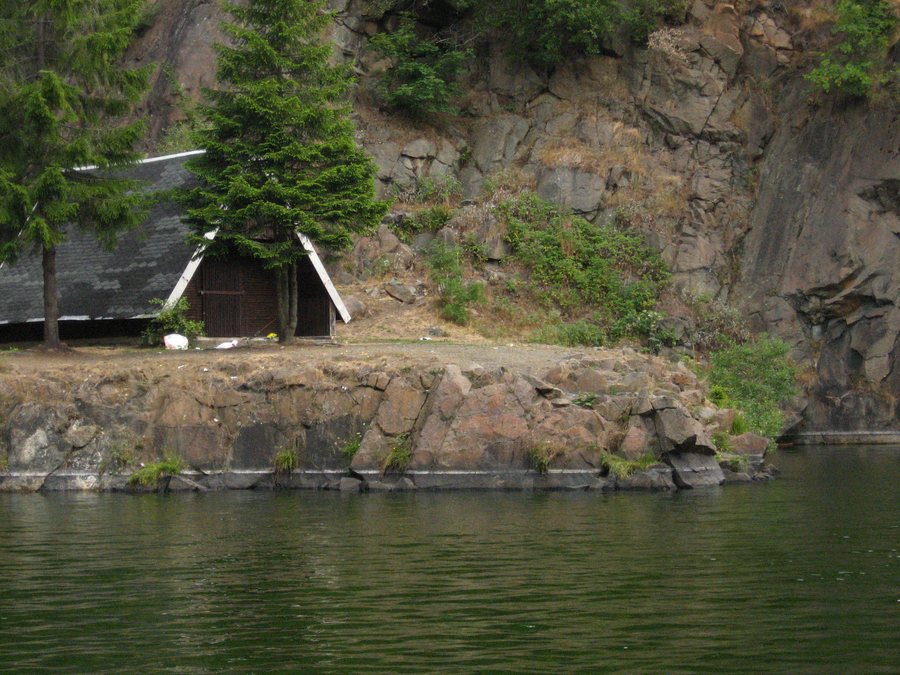
Lake Ebertswiese was created by quarrying and lies between rock faces up to 30 m high. Ebertswiese is a mountain meadow where several varieties of wild orchids and globeflowers grow. The Spitter also rises there. Further along its course, it forms Thuringia’s highest natural waterfall, at 19 m.
The lake is also the setting for the Bergseefest, held every year one week after the summer solstice. The program includes music by local music associations and choirs, as well as performances by local clubs. If you are looking for a winter activity, the Bergseeloipe offers a clearly defined loop: it is 8 km long and runs past the lake through wintry landscapes.
Districts, Swimming Pools and Regional Culture
The world’s largest cowbell is in the district of Kleinschmalkalden. It was made by the local company Venter-Glocken GmbH, which received an entry in the Guinness Book of Records for it. At the Trachtenstube in the district of Schnellbach, you can learn about traditional customs and the way of life of the local people.
There are two different options for swimming outings. The solar-heated outdoor pool on the edge of Struth-Helmershof has pools for swimmers and non-swimmers, a water slide and a children’s paddling pool. The Kleinschmalkalden forest swimming pool has around 1,250 m² of water surface and 50 m lanes. The two pools differ in their facilities; when planning your day, you can start by choosing the one that better matches your interests.
Traditional festivals are also held throughout the year. The districts’ Kirmes festivals take place every year from August to September and include dances and festive parades. The carnival season includes seven Büttenabende (carnival speech evenings) in Struth-Helmershof and Floh, as well as a large parade through Floh every year. These festive occasions therefore vary both by season and by district.
Getting Here and Finding Your Way Around
Floh-Seligenthal is accessible by bus and train. The tourist information office provides local and event maps, bus timetables, and hiking and cycling maps. If you are planning several activities, these maps can help you find your way between the different routes and districts. Some of the attractions described are specifically located in a particular district; bear these locations in mind when choosing your accommodation and outings.
To compare other places, you can also consider Breitungen/Werra, Bermbach, Struth-Helmershof, Schmalkalden, Fambach, Altersbach, Kleinschmalkalden and Trusetal.
For the broader travel overview: Schmalkalden-Meiningen.

