
Fambach: Kirchberg, Local History and the Quellenweg
Accommodation in Fambach
Explore Fambach through its church and local history, the Kirchberg and the Quellenweg. In the wider Schmalkalden-Meiningen travel region, Oberhof has alpine slopes for fast descents; their seasonal operation depends on snow and facility conditions.
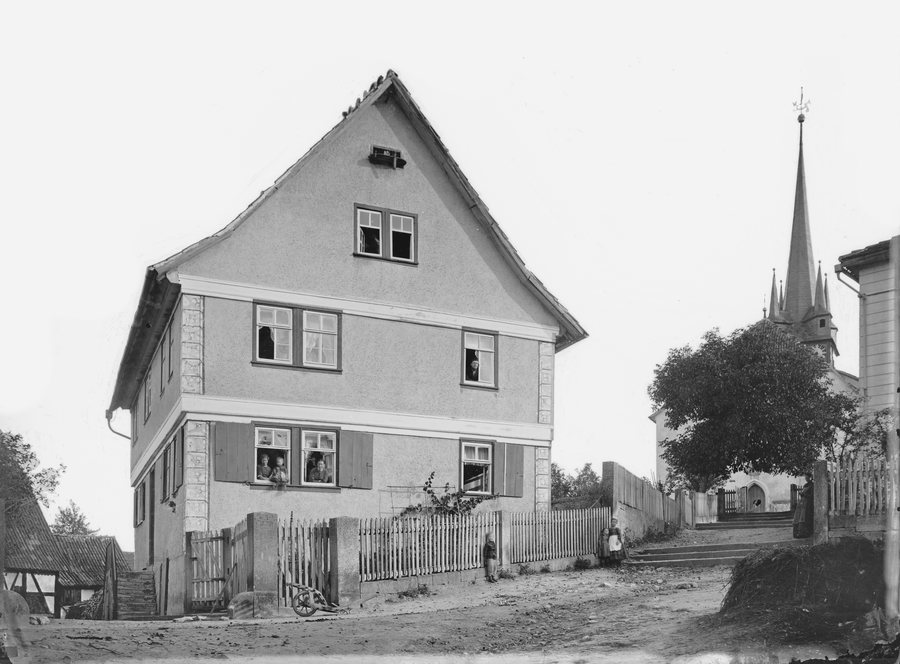
Kirchberg and Local History
Today’s St. James’ Church stands on the site of a church mentioned in documents from 1507 and presumably built as early as the 12th century. The year 1507 refers to the documentary mention, while construction in the 12th century is considered likely. The church in Fambach is regarded as one of southern Thuringia’s fortified churches.
A walk on the Kirchberg takes in the Baroque village church, the rectory, the Albert Schweitzer House and the old school as a unique ensemble. The linden tree is considered a landmark of the municipality of Fambach and is immortalized in the municipal coat of arms. A linden tree planted in 1707 also stood at the western end of the Kirchberg for 283 years.
Another historical destination is the Todenwarth castle ruins in Fambach. They are the remains of a late medieval hilltop castle with a manor house and historic castle grounds. The fortified-church character and the Kirchberg ensemble thus provide one approach to local history, complemented by a second, distinct one.
Walks and Getting Around
The Kirchberg walk focuses on architecture and local history; the Quellenweg leads through the Rote Hohle to Lampertsborn, the largest spring area in the Fambach district. The routes therefore differ mainly in their focus: an architectural ensemble on the one hand and a spring area as the destination on the other.
The B 19 federal highway runs directly past Fambach. Together with the local stops, this provides clear orientation between the village, the Kirchberg and the Quellenweg destination, without specifying a particular walking time or route length.
Winter Activities in the Wider Schmalkalden-Meiningen Travel Region
The cross-country skiing hall in Oberhof is also part of the wider Schmalkalden-Meiningen travel region: Germany’s first cross-country skiing hall makes it possible to ski even in summer. Operating and booking conditions may change. Alongside the alpine slopes, this offers an option specifically for cross-country skiing, with a different seasonal focus.
Oberhof’s snow park has straight boxes, butter boxes, A-frame boxes and various tubes for freestyle-oriented skiers and snowboarders. These features describe the snow park’s freestyle offering; they are a different kind of winter activity from the alpine slopes. The alpine slopes and the snow park are attractions in Oberhof in the wider travel region, not descriptions of local stops in Fambach.
More Destinations in the Wider Schmalkalden-Meiningen Travel Region
For a cultural and culinary experience, the Viba Nougat World in Schmalkalden offers a glass-fronted workshop where visitors can see how nougat is made. In hands-on confectionery courses, they can pour chocolate, decorate nougat and create pralines. Course times and booking conditions may change.
Industrial heritage is another regional theme: the “Neue Hütte” blast furnace museum in Schmalkalden is a blast furnace complex dating from 1835. Local iron ores were smelted there using charcoal to produce pig iron until 1924. Exhibitions explore the region of Schmalkalden’s almost 1,300-year history of iron and steel goods production, including the well-known “Schmalkalder Artikel.”
Discover more destinations: Trusetal, Wernshausen, Altersbach, Floh-Seligenthal, Oberschönau, Kleinschmalkalden, Schwarza, Trusetal-Laudenbach.
Go to the wider travel overview: Schmalkalden-Meiningen.

