
Discover Edermünde
Accommodation in Edermünde
If you are looking for accommodation in Edermünde, you can plan your stay around the landscape, local history and cycling. In Besse, the “Centre of Germany” stele marks a viewpoint at the edge of the Langenberge; in Haldorf, a horse’s grave, a distinctive stone and the shepherd’s house offer different ways to explore the past. The “Town-Country-River” circular tour adds a route along the Eder and Fulda to these themes.
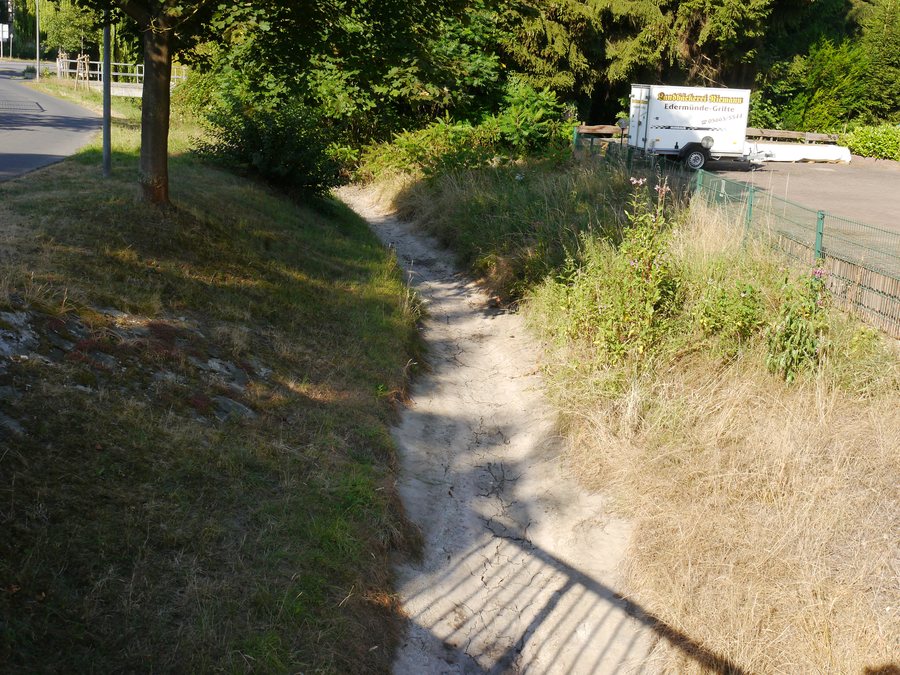 File:Der Lauf des Pilgerbaches in Edermünde-Grifte.jpg
Photo: Lampenputzer2 via Wikimedia Commons, CC BY-SA 4.0
Viewpoint and orientation in Besse
The “Centre of Germany” stele stands in an idyllic meadow at the edge of the Langenberge in Besse. From there, the view stretches across the Chattengau landscape to the Söhre. The spot is marked by a basalt stele about 3 m high; it can be clearly seen from a small rest area with a bench and information board. The stele can be reached via the Habichtswald Nature Park hiking car park on Röder Weg in Besse. This place thus combines a clearly recognisable landmark with views of two named landscape areas. The bench and information board complement the viewpoint with a place to rest and information to help visitors find their way.
Historical traces in Haldorf
The Haldorf horse’s grave lies above Wolfershausen in the woods within the Haldorf district. The weathered inscription reads: “Here lie Bella and Rosa, 13 February 1868”. It names the two horses and gives an exact date. The Ederhöhenweg leads to the grave from Haldorf in the direction of Wolfershausen, near the Amselhof. Both the inscription and the specific location details are central to understanding this memorial site.
The Haldorf Giant Stone lies in the vicinity of Edermünde. It consists of quartzite, which is not found in the immediate area. As explanations for how it could have been transported naturally have proved unsuccessful, it is thought to be a menhir. This remains one possibility: the menhir interpretation is not presented as a confirmed fact. While the dated inscription establishes the historical connection at the horse’s grave, the Giant Stone invites a more cautious interpretation of its origin.
The shepherd’s house in Haldorf was built in 1726; the last shepherd lived there until his death in 1948. The house contains a local history museum with a permanent exhibition of objects from village life. The year it was built, its former use and the exhibition offer three different points of connection to local history: the building itself, the life story of its last shepherd and everyday village life. Cultural offerings also include exhibitions of paintings, ceramics and glass art.
Cycling route and other leisure destinations
The “Town-Country-River” circular tour runs from Edermünde to Kassel and back, following the Eder and Fulda. It starts at Edermünde-Grifte railway station and follows the Eder Cycle Route towards Guntershausen. Along the way, the tour passes through typical North Hessian half-timbered villages and by farm shops and small, cosy inns. The river landscapes, villages and the places mentioned together shape the character of the route. Unlike the individual local attractions, the circular tour brings these different landscape and settlement connections together in a single route.
Another leisure attraction is the outdoor swimming pool in Holzhausen, a district of Edermünde. Its swimming pool is solar-heated. Alongside the landscape and cultural attractions, the pool is another local place to visit.
The wider region: Schwalm-Eder District
The Schwalm-Eder District encompasses low mountain landscapes around the Knüll, Kellerwald and Habichtswald ranges. A cultural highlight in the district is the Malerstübchen Museum in Willingshausen: it presents 19th- and 20th-century art history and displays paintings featuring the traditional dress of the Schwalm region. The traditional rural crafts featured there include whitework embroidery, knitting and spinning. Guided by an expert, visitors can attend talks about the artists’ colony and its artists, Schwalm customs, and Schwalm craftsmanship and whitework embroidery. These regional themes complement the local history and landscape connections you can discover in Edermünde.
Discover more destinations: Ottrau, Homberg/Efze, Frielendorf, Oberaula, Neukirchen, Niedenstein, Knüllwald
Go to the main travel overview: Schwalm-Eder District.

