
Saulgrub between the Alpine foothills, the sensory trail and culture
Accommodation in Saulgrub
Saulgrub is set in a forest- and meadow-rich landscape in the Alpine foothills. To the east is the 1,548-metre-high Hörnle, and to the west the 1,396-metre-high Hochschergen. The Ammer’s natural course and the distinct themes of the sensory trail, churches and technical structures also help visitors find their way around the area.
Landscape, the Ammer and the Scheibum
The Ammer flows through the valley shaped by Saulgrub, Altenau and Wurmansau along a natural, unaltered river course. Near Saulgrub lies the Scheibum: a 600-metre-long, up to 80-metre-deep rock passage and gorge that is also a natural monument. At Saulgrub, the Scheibum has been a protected natural area since 1949.
The Eckfilz near Saulgrub is a different kind of landscape. It is a raised bog fed exclusively by precipitation. The gorge and the raised bog thus offer different insights into the surrounding natural environment: the Scheibum is defined by its rock passage, while the Eckfilz is distinguished by the bog’s unique water balance.
The sensory trail and routes with different themes
The Saulgrub sensory trail focuses on hearing, smell and touch, and is especially accessible to people who are visually impaired or blind. Along the trail, hikers can choose between two audio tours. “Peat Dog” is aimed primarily at families; “The Bog Body of Saulgrub” is a more in-depth tour for people interested in natural and cultural landscapes. The two options therefore have different focuses, but both are part of the sensory trail.
The sensory trail starts at the Saulgrub Nature Friends House. From the Saulgrub train stop, the house can be reached via Ammergauer Straße and Achelestraße. This route description makes the starting point easy to identify: the Nature Friends House and the train stop are the two landmarks given for accessing the trail.
Another route with its own character is the Meditation Trail. It leads through the “Scheibum” Ammer Gorge towards Bad Kohlgrub. By contrast, the Benedictine Pilgrim Way in the Ammergau Alps Nature Park starts at St. Francis Church in Saulgrub. The routes are thus described using different points of reference: for the Meditation Trail, it is the route through the gorge and direction towards Bad Kohlgrub; for the pilgrim way, the church is the starting point.
Churches, a chapel and the history of technology
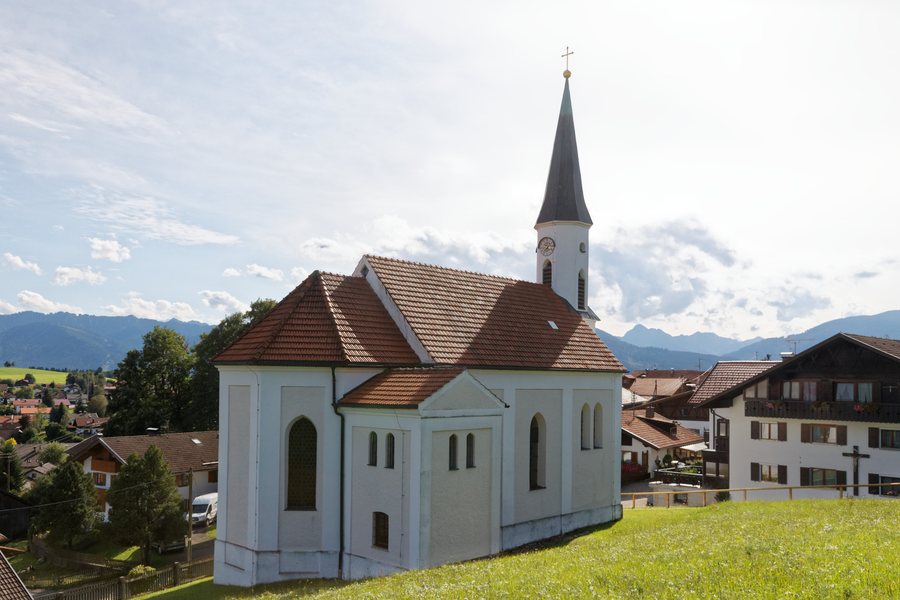
St. Francis Church was built in the Neo-Gothic style in 1858. Archbishop Gregor von Scherr consecrated it on 27 August 1860. The Fatima Chapel is a small votive chapel on a ridge in Saulgrub; from there, the view extends across the northern Ammertal valley. It was consecrated on 12 September 1954.
The history of technology is also represented here: Kammerl railway hydroelectric power station was built in the Art Nouveau style from 1897 to 1899, along with the Murnau–Oberammergau railway line. The dates for the church, chapel and hydroelectric power station provide different chronological reference points for the area’s building and local history.
Practical information for your trip
A bicycle service station is available at the Saulgrub Tourist Information Office, Kohlgruber Straße 2. It has an air pump and various tools for bicycle repairs, providing a specific place to go for minor bike maintenance.
If you’re looking for a hotel in Saulgrub, you can use the themes mentioned above to plan your stay: the natural environment and gorge, the sensory-focused routes, or the area’s architectural and technological history. This can help you decide what you’d like to focus on during your trip before choosing a specific place to stay.
Discover more destinations: Bad Bayersoien, Grainau, Uffing am Staffelsee, Seehausen am Staffelsee, Ohlstadt, Murnau am Staffelsee, Farchant, Unterammergau.
For the overview of the wider travel area: Garmisch-Partenkirchen District.

