
Seehausen on the Staffelsee: Staffelsee, circular trail and local history
Accommodation in Seehausen am Staffelsee
Seehausen on the Staffelsee combines the lake with hiking options and a local history reflected in its churches, chapels and art. For planning your trip, two main themes stand out: the lake and its circular trail, and the town’s historic buildings and art.
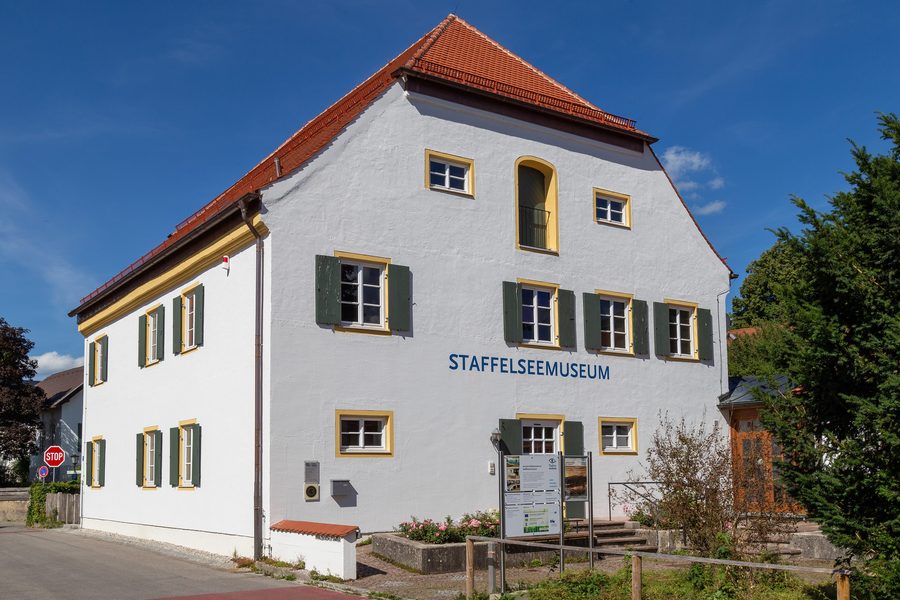 Das Staffelseemuseum widmet sich der Geschichte von Ort und See sowie Themen wie Archäologie, Natur und Fischerei.
Photo: Stefan Karl via Wikimedia Commons, CC BY-SA 4.0
Staffelsee: water and trails
The Staffelsee circular trail starts in Seehausen and is 20.5 kilometres long. This gives hikers a specific distance to work with when planning and can be considered separately from swimming or cultural visits. The Staffelsee has seven islands; the island of Wörth is also connected with the town’s history.
The Staffelsee is a well-known warm-water swimming lake. In midsummer, water temperatures range from 22 to 26 °C. The Seehausen lido has a large sunbathing lawn, a café terrace and a gently sloping beach more than 300 metres long. These details clearly describe the water and the lido: the temperature range applies to midsummer, while the lawn, terrace and beach are specific features of the swimming area.
These are different considerations when choosing between hiking and swimming days: the circular trail has a set length for planning a hike, while the lido offers a separate focus by the water. If you would like to include both in your stay, you can balance these interests when planning your schedule.
Churches and chapels with their own histories
St. Michael in Seehausen on the Staffelsee was built using stones from the former island church on the island of Wörth. That earlier church was demolished in 1773/1774, and Prince-Bishop Wenzeslaus consecrated St. Michael in 1782. The historical connection lies in the reused building materials and the sequence of events involving the two churches.
In 1838, the island chapel of St. Simpert was founded on the island of Wörth in the Neo-Romanesque style as a replacement for the demolished monastery church. This building’s history also relates to an earlier church, but in a different way: St. Simpert was founded as a replacement, whereas stones from the demolished island church were used for St. Michael.
Further religious buildings are located in the districts of Riedhausen and Rieden. The Mauritius Chapel in Riedhausen dates back to the founding of the settlement and has wall paintings from the 15th century. The Chapel of St. Peter and St. Paul in Rieden stands right next to Rieden Castle, also dates from the 15th century, and has a high altar from the 17th century. Each site has its own distinguishing details: the wall paintings in Riedhausen, and the connection to the castle and the high altar in Rieden.
Reverse glass painting and finding accommodation
The Staffelsee Museum explores reverse glass painting. Together with the Gege and Noder painter dynasties, Seehausen was an important centre for this art form. The museum’s subject adds an art-historical theme to the history of the buildings, one that is explicitly connected with the town.
When looking for a hotel or accommodation in Seehausen on the Staffelsee, you can base your choice on the activities you have planned for your holiday: will the circular trail, the lido or local history take priority? These themes give your search a clear direction without requiring you to follow a set itinerary combining hiking, swimming and culture.
Discover more destinations: Garmisch-Partenkirchen, Oberammergau, Krün, Saulgrub, Oberau, Farchant, Unterammergau, Mittenwald.
For the broader travel overview: Garmisch-Partenkirchen district.

