
Waldsassen: Baroque, Glassmaking and Paths by the Water
Accommodation in Waldsassen
Waldsassen combines baroque church art with glassmaking, gardens and paths through the town and surrounding countryside. These themes offer different starting points for planning your trip: you can explore historic buildings, choose a walking tour based on its length, or find out about the activities on offer around the monastery garden and glassworks. The following local features provide factual guidance to help you choose where to stay and what to do.
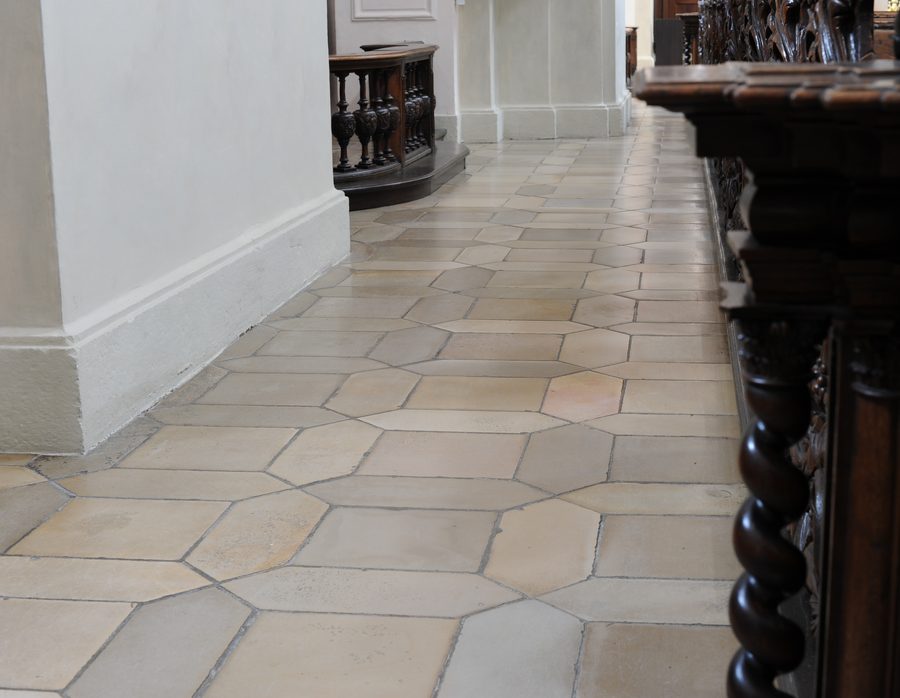 Rosenspitzmuster im Boden der Basilika Waldsassen.
Photo: Lysippos via Wikimedia Commons, CC BY-SA 4.0
Baroque Basilica, Music and Pilgrimages
The collegiate basilica in Waldsassen was built between 1685 and 1704 and is a Baroque building. It has an organ with 104 stops and 7,784 pipes. A stop on an organ refers to a distinct tone color or rank of pipes; together, the number of stops and pipes gives a specific impression of the instrument.
Two major pilgrimages take place at the basilica: the Heilig-Leiber-Fest on the first Sunday in August and the pilgrimage to the Desecrated Saviour on the Sunday after the Feast of the Exaltation of the Holy Cross on 14 September. Sacred music is also part of the annual calendar: a concert series has been held there every year from March to October for more than 50 years. If you would like to attend a particular event, check the date in advance.
Town Walks and Paths by the Water
The walking tour of Waldsassen has 11 stops and is about 1.5 kilometres long. Along the way, window displays tell the story of individual buildings and streets in the town centre. The tour combines a manageable distance with insights into the town’s history, rather than focusing solely on individual buildings.
The Wondreb Water Experience Trail is longer, at just under five kilometres. It has 13 stops, some with interactive features, and is signposted as Route 4 and, from stop 11 onward, as Route 4a. A bridge with two steps means that the route is not fully accessible.
Another path connects Waldsassen with the pilgrimage church of Kappl: the Rosary Stations Path is also Hiking Trail No. 5. Along the route are 15 Baroque station pillars decorated with rosary motifs. The church itself was built between 1685 and 1689 by Georg Dientzenhofer on the 628-metre-high Glasberg near Münchenreuth; it is three kilometres from Waldsassen.
Monastery Garden and Glassmaking
The monastery garden of the Waldsassen Cistercian Abbey includes a medicinal herb garden with herbs based on the teachings of Hildegard of Bingen, Kneipp and TCM. The Bee Adventure Trail, which features a bee sauna, is also located there. A guided tour for families is scheduled for the third Sunday of each month. Check the current date before visiting.
Mouth-blown flat glass is a special feature of the Lamberts Glassworks: it is one of only two manufacturing sites for this type of glass in the world. The site also includes the historic furnace hall, built in 1906/07 and protected as an industrial heritage monument. In Waldsassen, craftsmanship and industrial history thus offer distinct areas of interest alongside the town’s Baroque architectural heritage.
Mountain Biking
Mountain bikers will find five downhill trails, a flow trail and an MTB dirt park with a pump track and dirt lines in Waldsassen. The NORA Trail is graded S2 (blue) and is suitable for beginners. This grade applies to this trail and should not be assumed to apply to the other routes. As information about trail operations can change, check the latest details before your trip.
Tirschenreuth: Fishing and Regional Culture
In Tirschenreuth, the MuseumsQuartier brings together the Upper Palatinate Fisheries Museum and six other specialist exhibitions in a former monastery. Visitors can explore almost 1,000 years of fishing and fish farming history and see native fish in four large aquariums. The regular programme includes special exhibitions, talks, readings and concerts; check the dates of individual events.
In the centre of the Fischhofpark in Tirschenreuth are the historic Fischhof Bridge and the Fischhof, which houses the district court. Tirschenreuth district is also known for Zoigl, the Upper Palatinate Forest’s traditional beer, and for carp from the pond landscapes of the “Land of 1,000 Ponds.” These regional features complement Waldsassen’s local history without conflating the attractions in Tirschenreuth with those of the town itself.
Discover more destinations: Neualbenreuth, Mitterteich, Fuchsmühl, Kulmain, Bärnau, Friedenfels, Erbendorf, Neusorg.
Back to the main travel overview: Tirschenreuth.

