
Michelsneukirchen: Market Tradition and Hiking Trails
Accommodation in Michelsneukirchen
Get to know Michelsneukirchen through its market tradition, churches and hiking trails. If you are looking for accommodation, these different interests can guide your trip planning: the Quermarkt combines a regular schedule with a long history, while Hiking Trail 100 offers an approximate distance and walking time. This lets you think ahead about whether your stay will focus more on visiting a market, local history or a hike.
The Quermarkt at St. Quirin
The Quermarkt takes place by St. Quirin Church. As a goods and draft-ox market, it has a history dating back to the Middle Ages. After the last market in 1969, it was revived in 2002. Since then, it has been held on the third Sunday after Pentecost each year. This date pattern helps you plan when to visit, but does not replace checking the exact date before your trip.
The market attracts more than a hundred stallholders as well as thousands of customers and onlookers. Goods and draft oxen are therefore both part of the market tradition described here. If you are interested in its history, you can view the dates as a continuous development: the medieval beginnings were followed by the last market in 1969 and its revival in 2002. The recurring Sunday after Pentecost also gives the market a distinctive place in the annual calendar. When planning a trip, both its historical connection with St. Quirin and the specific date are therefore relevant.
Two churches with their own histories
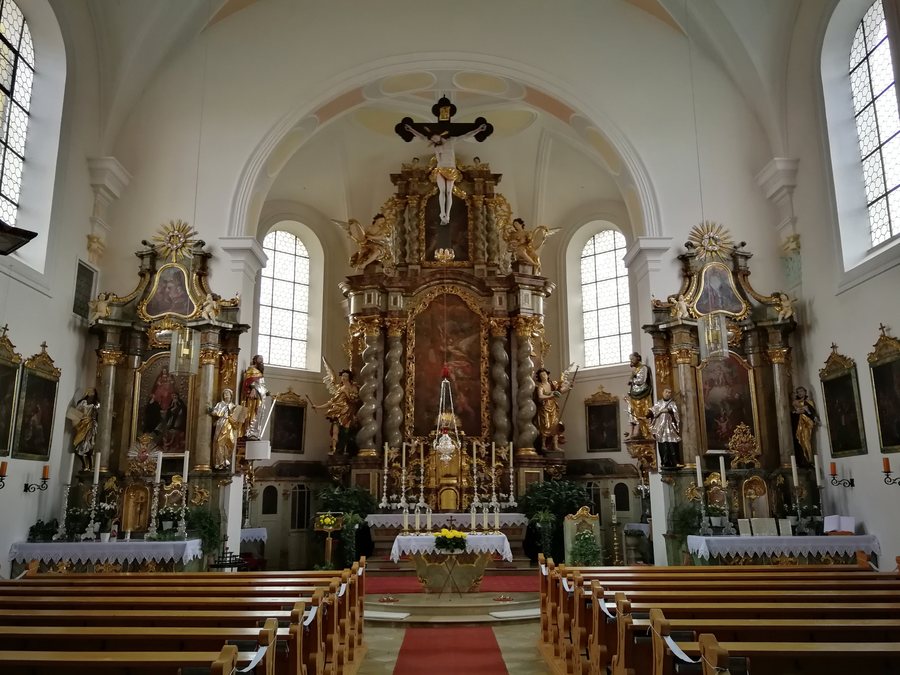
St. Quirin is not the only church in Michelsneukirchen with a recorded history. St. Quirin Church is dated to 1332 and is dedicated to Saints Quirinus, Vitus and Wolfgang. Its connection with the Quermarkt makes it a point of reference for the market’s local history. The date and the three patron saints also provide specific points of interest for anyone interested in the churches and the town’s historical development during their stay.
The parish church of St. Michael is a separate church. It was rebuilt between 1707 and 1711 and is classified as a typical Baroque village church. The different names and dates help distinguish the two churches: St. Quirin is connected with the Quermarkt and is dated to 1332; St. Michael was rebuilt in the early 18th century. Together, these details offer insight into different periods of the town’s history, without attributing the building history of one church to the other.
Hiking: markers and Trail 100
All hiking trails in Michelsneukirchen are marked with numbered signs depicting the “Wild Man.” If you are planning a hike, look out for these trail markers and check the signs along the way before relying on them. The numbers help you find your way on the trails; the figure on the signs is another feature that helps you recognize the markers.
Hiking Trail 100 is listed as approximately 8.5 kilometres long, with a walking time of around three hours. Along the trail, beautiful views of the Bavarian Forest panorama open up repeatedly. The distance and approximate duration give you two specific points of reference for planning your day; the views add a scenic aspect to the hike. The time given is a guideline for the trail and should not be taken as an indication of its difficulty or of any individual’s walking speed.
The market tradition and the hike offer different reasons to discover Michelsneukirchen: for the Quermarkt, the key date is the Sunday after Pentecost; for Trail 100, it is the approximate distance and walking time. When choosing accommodation, you can first decide which of these is the main focus of your stay. The places and trails mentioned can help you make that decision without assuming any particular location or amenities for your accommodation.
Discover more destinations: Falkenstein, Furth im Wald, Waldmünchen, Lohberg, Bad Kötzting, Arnschwang, Lam, Eschlkam.
Go to the main travel overview: Cham.

