
Linares De Mora: Local History, Trails and Via Ferrata
Accommodation in Linares De Mora
Culture and History
The village ensemble of Linares de Mora is recognized as a historic-artistic ensemble and as a Bien de Interés Cultural. This recognition applies to the ensemble of Linares de Mora as a whole. In the historic village center, the Iglesia de la Inmaculada and its bell tower are considered important stops during a visit. The present-day construction of Linares de Mora Castle dates from the 13th century. Thus, both the cohesive historic buildings in the village center and individual structures with their own historical character are central features. For those interested in culture, the church, bell tower and castle are among the specifically named destinations within the historic village center.
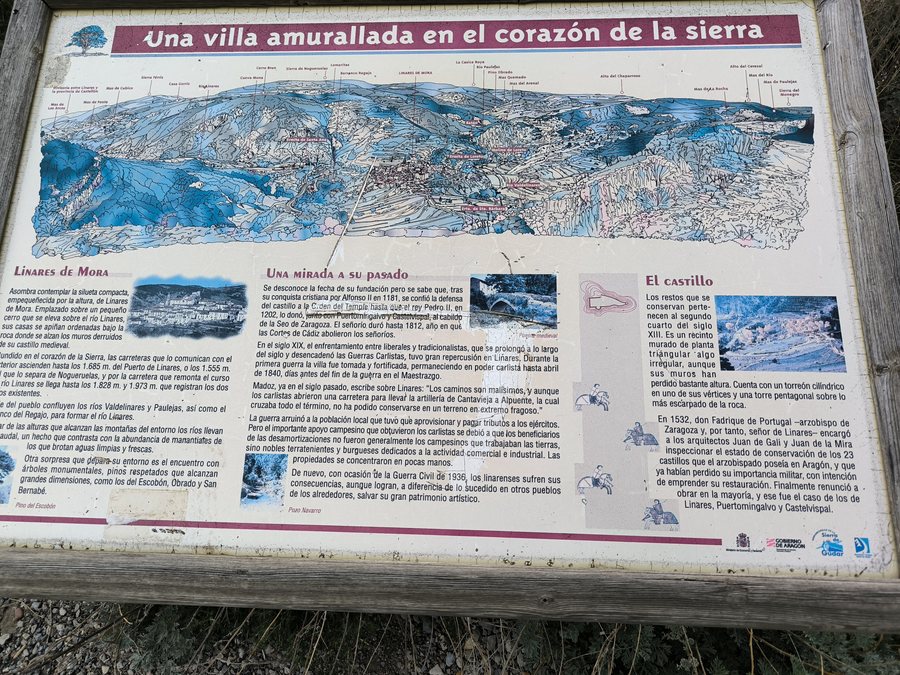 File:Cartells turístics de Linares de Mora 2.jpg
Photo: Pitxiquin via Wikimedia Commons, CC BY-SA 4.0
File:Cartells turístics de Linares de Mora 2.jpg
Photo: Pitxiquin via Wikimedia Commons, CC BY-SA 4.0
Festival Traditions
The Jota de Santa Ana is part of the local festival tradition. Its annual performance on July 25, the feast day of Saint James, includes the local jota group and the town band. La Rogativa is a pilgrimage held on the second Monday in May. During this pilgrimage, the residents of Linares de Mora walk to the Sanctuary of the Virgen de la Vega in Alcalá de la Selva. The two customs also differ in their fixed places in the annual calendar: the jota takes place in July, while La Rogativa takes place on a Monday in May. When traveling to a performance or pilgrimage scheduled for a specific date, the current event dates should be checked in advance. Festival events with a fixed date should be checked for their current start time before arrival. Pilgrimages also follow a specific calendar day; the date and starting time should be verified before the trip.
Hiking Trails
The PR-TE 29 is catalogued and inventoried by the Government of Aragon as a Sendero Turístico de Aragón. As a circular hiking trail, it reaches Linares de Mora, then continues to Pino El Escobón and on to El Molinete.
The linear riverside trail from the Ermita del Loreto via Cueva Mona to Fuente del Bartolo is three kilometers long, calculated for the outward and return journey. Before the turnoff to the cave, the riverside trail crosses an old iron bridge. At Fuente del Bartolo, there is a small fenced picnic area with tables and chairs. Hikes involving the riverside trail, bridge or cave require checking the current trail conditions before setting out.
Via ferrata Cueva Mona
The Cueva Mona via ferrata has a difficulty rating of K2, is 87 meters long, comprises four sections and ascends 40 meters in elevation. Its features include an approximately 15-meter-long Tibetan bridge. It is also possible to descend through the cave on a 15-meter-long free-hanging rope. The current trail conditions should be checked before attempting the route. An outing involving the Tibetan bridge and free-hanging rope should be prepared based on the current trail conditions.
For the overarching travel overview: Teruel.
More Destinations
More places within the same destination:

