
Banska Bela: Accommodation amid Mining History and Tajchy
Accommodation in Banska Bela
Culture and History
The parish church in Banská Belá was built in the first half of the 13th century in the late Romanesque style and consecrated in 1243. It retains its original tower and an original late Romanesque window. Inside is a Neo-Gothic wooden high altar, acquired at the Millennium Exhibition in Budapest in 1896. The wooden reliefs of the Stations of the Cross were created in 1985 by local woodcarver Ján Bazalka. The church complex was fortified with a wall in the 16th century; surviving parts of the fortifications were reconstructed in 1985.
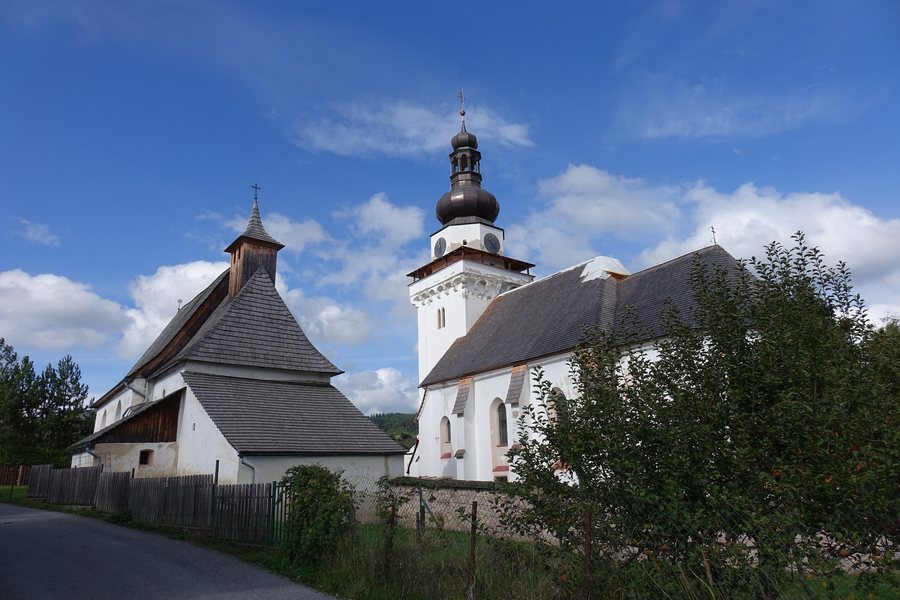
The Church of Our Lady of the Scapular originated from a miners’ chapel built in the 15th century above a mine tunnel and was expanded with a nave in 1708. The Rococo Chapel of Saint John of Nepomuk is one of the important cultural monuments of Banská Belá. Pilgrimages to the Feast of Our Lady of the Scapular have been held here every year since 1713.
Mining and Townscape
The Belianska Heritage Tunnel is one of the technical cultural monuments in Banská Belá. The mining heritage site of Banská Belá–Nová šachta is documented by a prominent spoil heap in the centre of Banská Belá. Banská Belá was one of the seven central Slovak mining towns and has preserved its rural character shaped by the hilly terrain.
Banská Belá is part of the Banskoštiavnický Geopark, which has been a national geopark of the Slovak Republic since 2016.
Water Landscape
The Halčiansky tajch belongs to the Štiavnica Tajchy system, the reservoirs built for mining in the 18th century, and is connected to the Halča valley of Banská Belá. The Jasenica waterworks is another mining reservoir in the cadastral area of Banská Belá in the direction of Kysyhýbel and also belongs to the Štiavnica Tajchy system.
The traditional cultural event “Výlov krokodíla”, featuring an extensive cultural programme, takes place at Halčiansky tajch; this special folk custom has existed since 1962.
Transport Connections
The standard-gauge railway line Hronská Dúbrava–Banská Štiavnica is named Trať mládeže. It began operating in 1949 and replaced a narrow-gauge railway built in 1873. Regional bus connections link Banská Belá with Banská Štiavnica, Zvolen and Banská Bystrica.
Cycling Routes
The Beliansky okruh can be ridden in both directions. It starts at the Dinas plant in Banská Belá and ends in the centre of Banská Belá. Štiavnicka Anča is a green-marked cycling route that can be ridden in both directions and ends at the Banská Belá landmark.
For accommodation in Banská Belá, you can compare the individual offers objectively. It is also worth checking which services are actually included and which price components make up the total amount. Also pay attention to the applicable booking and cancellation conditions.
These points should be considered independently of the town’s sights and cycling routes.
Related destinations: Banska Stiavnica, Ilija, Svätý Anton, Banský Studenec, Dekýš, Vysoká, Štiavnické Bane.
To the higher-level travel overview: Okres Banská Štiavnica.
More Travel Destinations
More places within the same destination:

