
Kletno – Nature and Mining History
Accommodation in Kletno
The village lies entirely within the Śnieżnicki Park Krajobrazowy. In addition, Jaskinia Niedźwiedzia is a nature reserve. Other features include the former Kletno I marble quarry, a visitor route in the Kopalnia Uranu w Kletnie and municipal Route No. 4, “Trzy doliny”, which passes through the village. These themes describe different facets of Kletno. When comparing accommodation, you can first consider which of them is most likely to shape your stay.
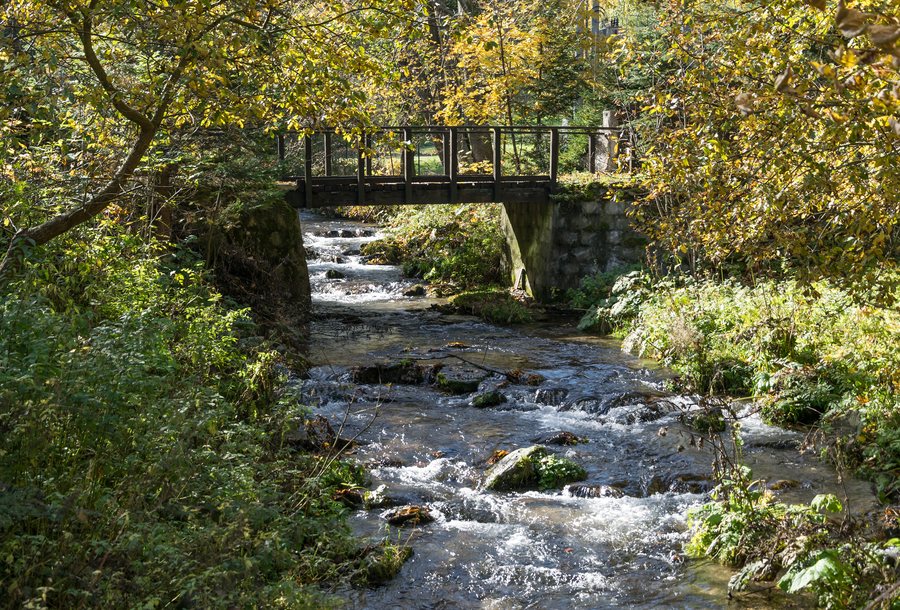
Protected Landscape and Nature Conservation
The fact that Kletno lies entirely within the Śnieżnicki Park Krajobrazowy describes the landscape setting of the entire village. By contrast, the protected-area designation for Jaskinia Niedźwiedzia applies to the cave: it is a nature reserve. The two designations therefore refer to different areas and are not interchangeable. This distinction can help you orient yourself when considering the village as a whole and the cave as a distinct natural site. These protected-area designations shape Kletno’s connection to nature, without implying anything about whether the cave is accessible.
Traces of Mining and Geological History
At the former Kletno I marble quarry, past resource extraction meets present-day ecological importance. The quarry operated from 1865 to 1993. Today, it is one of the region’s most important refuges for non-forested habitats. The dates help put the site’s history in context: extraction belongs to the past, while its importance as a habitat is a feature of the present. Kletno I can thus be understood both through its former use and its current role in the regional landscape.
The visitor route at the Kopalnia Uranu w Kletnie offers another perspective on mining history. It features local minerals as well as historical maps and mining equipment. The route passes through colorful tunnel corridors and, through the geological history of the Śnieżnik Massif, presents 500 million years of evolutionary history. In contrast to Kletno I, the focus here is on minerals, historical equipment and geological development; at the former marble quarry, it is the connection between mining history and habitat. If this visitor route is important to your plans, check before travelling whether it is currently operating.
Routes Through Kletno and Planning Your Stay
Municipal Route No. 4, “Trzy doliny”, passes through Kletno. It is another point of reference for finding your way around the village, while the mine’s visitor route focuses on a specific theme and its content. The two descriptions answer different questions: one identifies a route through Kletno, while the other explains what you can see on the mine’s visitor route. If you plan to take Route No. 4, check the route conditions before setting out. This keeps route planning separate from the decision to make a themed visit.
When choosing accommodation, you can use these features of the village as a guide to your interests: are you most interested in the natural landscape, in the history of marble extraction and its present-day ecological importance, or in mining and geological history? The route through Kletno may also play a part in planning your stay. These answers can help you identify your priorities without treating the cave, quarry, tunnel route and municipal route as one and the same destination. Then compare accommodation based on the specific details provided for each listing.
For the broader travel overview: Kłodzki.
More Destinations
More places within the same destination:

