
Valle Di Cadore: Mountain Trails and Historical Traces
Accommodation in Valle Di Cadore
Mountain Landscape and Trails
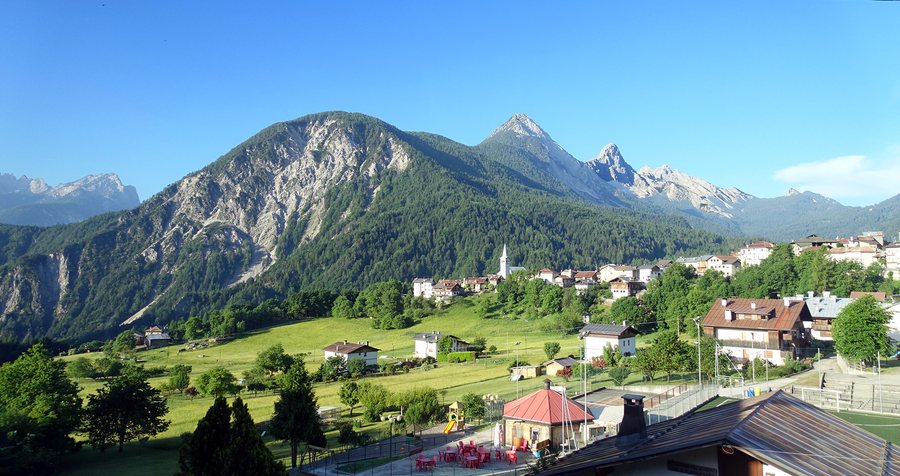
Valle Di Cadore lies on the green valley floor at the foot of Monte Antelao. San Martino stands on a rocky outcrop above the Valle del Boite. From Rifugio Costapiana, there are views of Monte Antelao and the upper Valle del Boite. S. Dionisio is an almost 2,000-metre-high hill with a 360-degree panoramic view.
The Lunga Via delle Dolomiti cycle path runs through Valle Di Cadore. The Lunga Via delle Dolomiti is completely closed to motorised traffic, paved and has consistent, manageable gradients. The Lunga Via delle Dolomiti can be travelled by bicycle or walked.
From Valle Di Cadore, follow the paved road to Rifugio Costapiana. The road climbs to the upper part of the village. At the marked bend with a spring and the hut sign, you can continue along the route on foot or by car in about two hours. Rifugio Costapiana can be reached on foot, with snowshoes or on touring skis.
From Rifugio Costapiana, S. Dionisio can be reached on foot in about one and a half hours.
Historical Traces in Valle Di Cadore
Costa is a historic village. Houses with distinctive Venetian features stand alongside traditional mountain houses of Cadore and buildings dating from the first centuries AD. The historic Via Romana runs through Costa. Along the route are buildings with vaults, balconies, coats of arms and elaborately designed corners.
The 18th-century Church of San Martino stands on the ruins of a castle of Roman origin. The Church of San Martino is currently closed for safety reasons. The church contains paintings by Antonio Lazzarini and an altarpiece by Francesco da Milano.
In Rusecco, three bronze situlae were found in 1910. One bore a Venetic inscription dedicated to Loudera, a deity equated with the Roman Libera and associated with the cycles of death and rebirth in nature.
In Fies, in the higher part of the village, a stone slab with a Latin inscription dating from the 1st century AD was found. The stone slab attests that Lucius Saufeius donated a schola, that is, a meeting and ceremonial room, as well as a solarium, a terrace, to an association or corporation.
Four buildings from Roman times were discovered in the districts of Stean and Villa, probably to be interpreted as villas. Two buildings in Villa had rooms with floral-decorated plaster and mosaic floors. One of these buildings contained a room measuring 15 × 11 m, while the other contained a room measuring 9 × 9 m. The buildings date from the 1st to the 2nd century AD.
A chapel of the same name stands at Rifugio Costapiana. The chapel was built and consecrated in 1508 to provide shelter for people who fled before the Battle of Rusecco and took refuge in the high mountains.
More destinations for your planning: Caviola, San Vito Di Cadore, San Nicolò Di Comelico, Lorenzago Di Cadore, Falcade, Castion, Selva Di Cadore, Puos Dʼalpago.
Back to the main travel overview: Province of Belluno.

