
Fucine: History, Peaks and Cycling Route
Accommodation in Fucine
History and Architectural Heritage
The settlement of Fucine developed from an exceptionally dense concentration of industrial sites established between the late 14th and early 15th centuries during the exploitation of the ore deposits of Peio. The Casa del Dazio dates from the 17th century. Its building retains a significant façade painted in 1671 on the orders of the tax collector Carlo Busetti. A façade is the designed exterior face of a building. The Casa del Dazio also has a sundial. A sundial indicates the time of day using the position of the sun and, in the case of the Casa del Dazio, represents another surviving feature of the building.
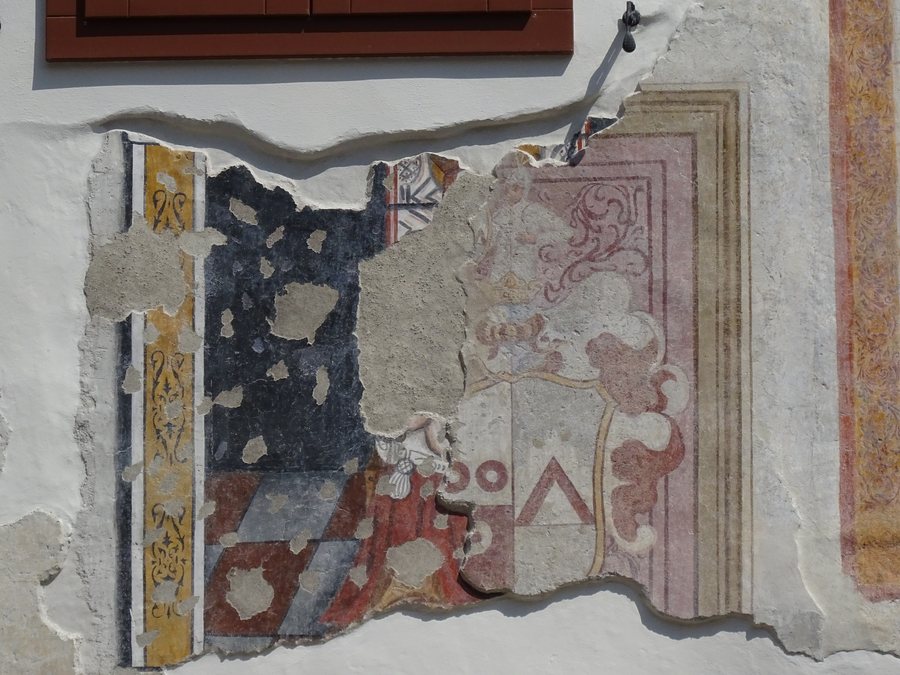 File:Fucine - Casa del dazio - Affresco frammentario.jpg
Photo: Syrio via Wikimedia Commons, CC BY-SA 4.0
File:Fucine - Casa del dazio - Affresco frammentario.jpg
Photo: Syrio via Wikimedia Commons, CC BY-SA 4.0
Churches and Historical Periods
The church of Fucine was rebuilt between 1902 and 1904 after the previous church building was destroyed by the 1849 flood. Rebuilding means the re-erection of a previously destroyed building. The Church of San Carlo Borromeo in Fucine dates from the 17th to the 20th century. The two churches are therefore characterized by separate historical facts, each with its own period and building history.
The Surrounding Landscape
In Fucine, the Vermigliana stream flows into the Noce. Cima Boai is a peak in the vicinity of Fucine. Cima di Stavei is a mountain in the area around Fucine. Cima le Pozze is a peak in the area around Fucine. Cima Palù is a peak in the area around Fucine. A peak is the highest point of a mountain or mountain ridge, while the term mountain has a broader meaning. The names Cima Boai, Cima di Stavei, Cima le Pozze and Cima Palù each refer to individual landforms in the area around Fucine.
Castles in the Wider Regional Area
Castello di Cles is a castle in the wider regional area around Fucine. Castel Thun is a castle in the wider regional area around Fucine. A castle is a fortified historic complex. Both structures are described as castles, but they are located in the wider regional area around Fucine and are not part of the village itself.
Cycling Route and Transport
The Pista Ciclopedonale della Val di Sole passes through Fucine and extends for more than 30 kilometres from the upper Val di Sole to Mostizzolo. After Fucine, the Pista Ciclopedonale della Val di Sole continues northwest into Val di Peio. A cycling route is a route designated for bicycle traffic. The Bike-Train service carries bicycles on the Mostizzolo–Mezzana section of the Val di Sole cycling route. There is a bus stop in Fucine on the Ponte di Legno–Ossana route.
Traditions and Events
The historic Fiera di San Michele in Fucine includes an exhibition of crafts from the Val di Sole. An exhibition brings together objects or works for joint presentation. The Fera dei Sét is a traditional livestock fair in Ossana-Fucine. A livestock fair focuses on the trade, presentation or exchange of livestock. The two events have different focuses: the Fiera di San Michele includes crafts, while the Fera dei Sét is described as a livestock fair.
Other places: Civezzano, Revò, Pergine Valsugana, Sarnonico, Salobbi, Mezzocorona, Cogolo and Tres.
To the main travel overview: Trentino–South Tyrol.

