
Carano: Church, Spring and Trails
Accommodation in Carano
Carano Between History and Local Life
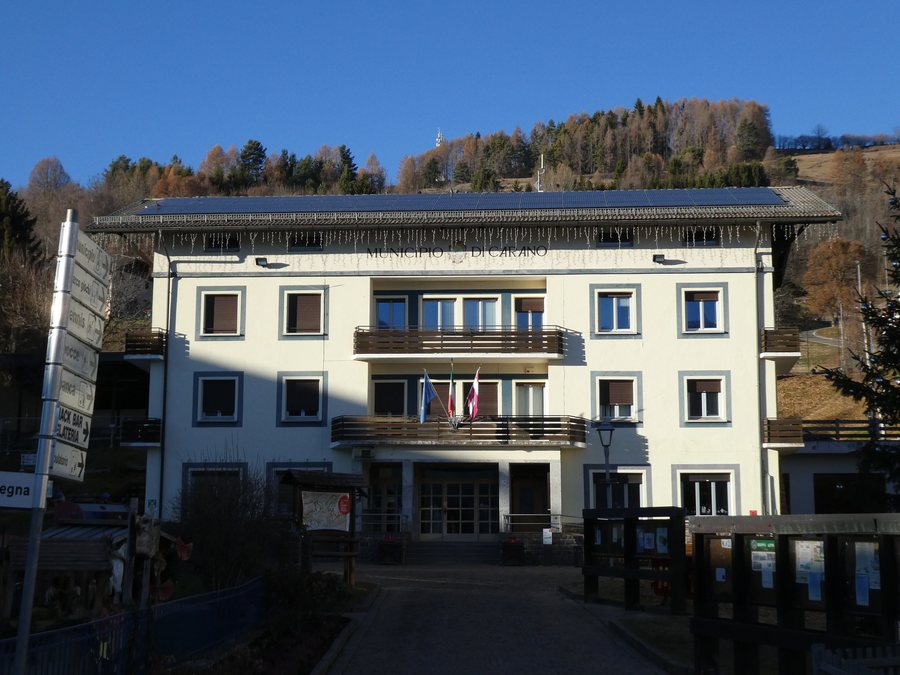
Carano can be discovered through its local history, buildings and paths through the landscape. The first documented mention of Carano dates from 1188. A documented mention is a written record preserved in documentary form. On this basis, Carano’s local history can be traced back to the 12th century.
The Church of San Nicolò di Carano
The Church of San Nicolò di Carano was consecrated in 1193 and rebuilt in the 16th century. The building has three naves, meaning it is divided into three longitudinal sections. The apse contains a crucifix and a Madonna del Rosario by Antonio Longo from 1796.
Ceva Spring and Casa Begna
The old Ceva spring provides sulphate-containing calcium-magnesium water. Since the mid-18th century, the spring water has been attributed with healing properties. It was drunk and used for traditional baths, including steam baths. Casa Begna, a house museum in an old farmhouse, is located in the centre of Carano. Casa Begna preserves memories of rural life as well as the traditions, customs and ways of life of Val di Fiemme. The term house museum refers to a museum established in a specific house; in the case of Casa Begna, it is an old farmhouse.
Circular Trails and Forest Landscape
The Passeggiata dei Pini is an easy 4-kilometre circular trail that takes approximately 1 hour and 20 minutes and leads around Dosso di Veronza. A circular trail returns to its starting point; for this route, the stated time remains an approximate duration. The Giro del Solombo is a varied route behind the village of Carano. The Giro del Solombo runs almost entirely through a forest of Norway spruce, pine and larch trees. The Giro del Solombo offers a view of the Lagorai range.
Market and Ville di Fiemme
The Mercato di Carano is a weekly market with five or six stalls. A weekly market takes place regularly on a specific day of the week; at the Mercato di Carano, this is Wednesday. From June to September, the market takes place on Wednesday mornings, approximately from 8 a.m. to 1 p.m. In the centre of Ville di Fiemme, the so-called “Cortazze” or “Corti” form a large network of passageways and narrow lanes on the steepest slope. Both terms refer to this network, which facilitates water drainage. During a walk through Ville di Fiemme, murals and frescoes can be seen. The monolithic fountain in Ville di Fiemme was built in 1888.
Getting There from Cavalese
Carano can be reached from Cavalese by scheduled buses operated by Trentino Trasporti. In this connection, Cavalese is the starting point and Carano the destination.
Other places: Flavon, Canazei, Taio, Molveno, Sporminore, Balbido-Rango, Pomarolo, Passo Del Tonale
To the higher-level travel overview: Trentino-South Tyrol.

