
Völs am Schlern: Ponds, Cultural Landscape and History
Accommodation in Völs am Schlern
Nature and Water in Völs am Schlern
Völser Weiher lies at the foot of the Schlern amid the Schlern-Rosengarten Nature Park. It covers 1 ha, lies at an elevation of 1,036 m and reaches a maximum depth of 3.5 m. The pond has a public bathing jetty and a sunbathing lawn. In summer, it is used for swimming; in winter, for ice skating. From May to October, shuttle bus no. 13 runs from Völs am Schlern via St. Anton directly to Völser Weiher. A nature park is a large-scale landscape in which nature and cultural landscapes coexist.
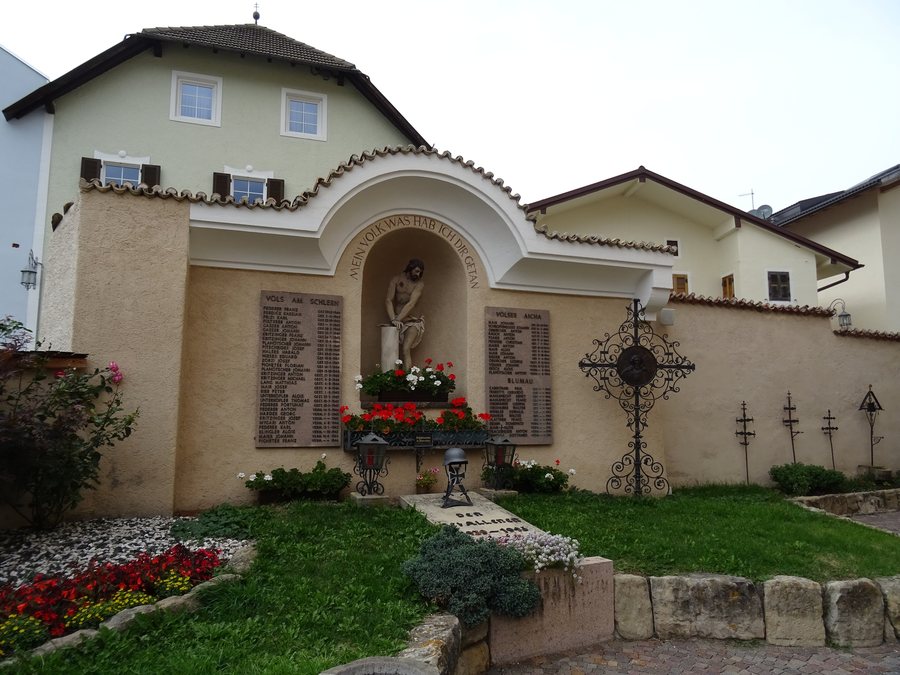 File:Cimitero vecchio di Fiè allo Sciliar - Monumento ai caduti.jpg
Photo: Syrio via Wikimedia Commons, CC BY-SA 4.0
File:Cimitero vecchio di Fiè allo Sciliar - Monumento ai caduti.jpg
Photo: Syrio via Wikimedia Commons, CC BY-SA 4.0
The 7-Pond Trail
The 7-Pond Trail connects seven ponds between Völser Aicha and St. Konstantin: Salmseiner Weiher, Gflierer Weiher, Völser Weiher, Huber Weiher, Umser Weiher, Oachner Weiher and St. Konstantiner Weiher. Sections of the trail lead through diverse natural surroundings, through an ancient and unique cultural landscape, and through the Schlern-Rosengarten Nature Park, which is a UNESCO World Heritage Site. The trail takes about 4 hours, is 13.2 km long and is not suitable for strollers. A cultural landscape is shaped by the interplay of natural conditions and human design. UNESCO World Heritage is an international designation for cultural or natural sites that are particularly worthy of protection.
Archaeology at Peterbühl
The historically significant Peterbühl hill lies west of the center of Völs am Schlern. This is where the beginnings of Völs am Schlern and the entire Schlern area can be traced; people settled there as early as many millennia BC. The Peterbühl themed trail documents archaeological finds from various periods, from the Late Bronze Age to the Early Middle Ages. Information panels present, among other things, house pits, enclosure walls and fortifications. Archaeology examines human traces and remains from times past.
Churches and Prösels Castle
Prösels Castle was built around 1200 by the Lords of Völs. In the early 16th century, Leonhard von Völs expanded Prösels Castle into a Renaissance castle complex. The parish church of the Assumption of Mary in Völs am Schlern is a Late Gothic parish church. Next to the parish church of Völs am Schlern stands St. Michael's Chapel, also known as the cemetery chapel, dating from the Romanesque period. Today, St. Michael's Chapel houses an archaeological collection and the Völs parish museum. Romanesque, Late Gothic and Renaissance refer to different periods in the history of art and architecture.
Regional Cuisine and Hay Bath
Völser Kuchlkastl takes place in Völs am Schlern from October 1 to October 31, 2026. It celebrates seasonal and, above all, regional products such as meat from Völs cattle, locally sourced game meat, and vegetables and fruit from local gardens. The hay bath originated in Völs am Schlern. Regional products come from a specific region; seasonal products follow the course of the year.
More Destinations
More travel destinations: Nova Levante, Santa Cristina Valgardena, Lake Carezza, Ortisei, Tiers, Sarntal, Mölten and Renon.
To the overarching travel overview: Salten-Schlern.

