
Feldthurns: Castle Culture and Paths Through the Landscape
Accommodation in Feldthurns
Velthurns Castle and Renaissance Art
Velthurns Castle (Castel Velturno) is a cultural heritage site, is used as a museum and serves as an event venue. Its late Renaissance interiors are impressive. The museum is open to the public between March and November. Castel Velturno was built from 1577 to 1587. Cultural heritage refers to a site of cultural or historical significance; a museum preserves and communicates cultural assets. For travel planning, the museum visit can therefore be limited to the period from March to November.
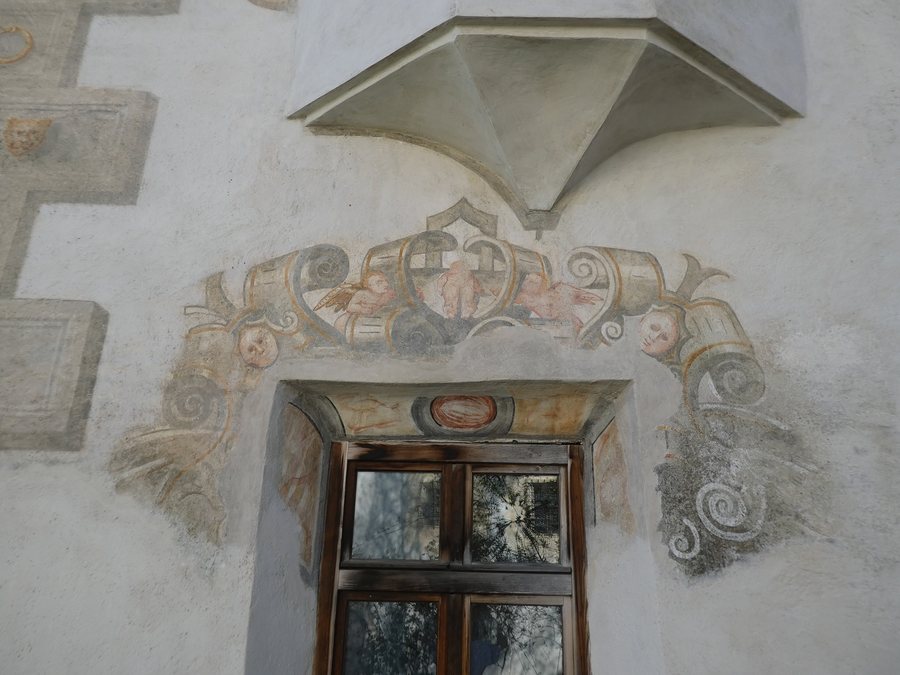 File:Castel Velturno - Affresco intorno a una finestra.jpg
Photo: Syrio via Wikimedia Commons, CC BY-SA 4.0
File:Castel Velturno - Affresco intorno a una finestra.jpg
Photo: Syrio via Wikimedia Commons, CC BY-SA 4.0
At Velthurns Castle, the interior furnishings include paneling, inlay work, carved portals and wooden ceilings. These works are among the most significant examples of Renaissance cabinetmaking in the entire southern German-speaking region. Paneling consists of wooden wall coverings, while inlay work consists of decorative patterns set into a surface. The late Renaissance refers to a late phase of the Renaissance.
Parish Church of the Assumption of Mary
The Parish Church of the Assumption of Mary is the oldest house of worship in Feldthurns. In 1112, the Parish Church of the Assumption of Mary was built as a small, modest chapel. From 1170 onward, the Parish Church of the Assumption of Mary served as a parish church. The Parish Church of the Assumption of Mary acquired its present late Gothic form during the renovation from 1894 to 1899. Late Gothic refers to a late expression of the Gothic style. A house of worship is a building used for religious purposes; the designation parish church refers to its ecclesiastical function. The church’s present form therefore dates from a considerably later construction phase than the chapel’s construction in 1112.
Archaeological Traces
The Feldthurns Archaeoparc is an archaeological site with burial grounds and remains of pottery production. Archaeology studies past human activities on the basis of material traces. Pottery production refers to the manufacture of objects from clay.
Hiking Trails with Views of the Dolomites
The Panorama Trail in Feldthurns is an easy hike with a 360° view of the Dolomites, leading through picturesque meadows and forests. A 360° view is an all-round view. The Panorama Trail in Feldthurns can be reached from Klausen by bus no. 343 and from Brixen by bus no. 342. Klausen and Brixen, with their respective specified bus lines, are therefore available as starting points.
The varied Feldthurns–Schnauders–Garn–Verdings Village Circuit leads around Feldthurns, passing Velthurns Castle, traditional farmsteads and chestnut groves, and offers beautiful views of the South Tyrolean landscape.
The Keschtnweg section from Feldthurns to Klausen begins at St. Anthony’s Church in Feldthurns and leads via Pardell to Säben Abbey. From Säben Abbey, the Keschtnweg section descends to Klausen, offering scenic views along the way. For route planning, St. Anthony’s Church marks the starting point and Klausen the endpoint of the Keschtnweg section.
Swimming Pool and Törggelen
The Feldthurns swimming pool is a public swimming pool in the municipality of Feldthurns.
During Törggelen, Törggele establishments serve homemade farm-style cuisine, new wine and roasted “Keschtn” (chestnuts). Farm-style cuisine here refers to homemade dishes from the farming culinary tradition; “Keschtn” is the term for chestnuts.
Further destinations: Mühlbach, Rodeneck, Meransen, Brixen, Barbian, Natz-Schabs, Villanders and Klausen.
For the overarching travel overview: Eisack Valley.

