
Mühlbach: Churches, Chapels and Historic Sites
Accommodation in Mühlbach
Churches and Chapels in Mühlbach
The parish church of St. Helena in Mühlbach was first mentioned in official documents in 1277. The Chapel of St. Florian is a two-storey building and served as an ossuary until 1740. The Stöcklvater Chapel was built in 1729 and developed into a pilgrimage site. The Maria-Hilf Chapel dates from the High Baroque period. For those interested in culture, Mühlbach focuses on sacred architecture and religious traditions.
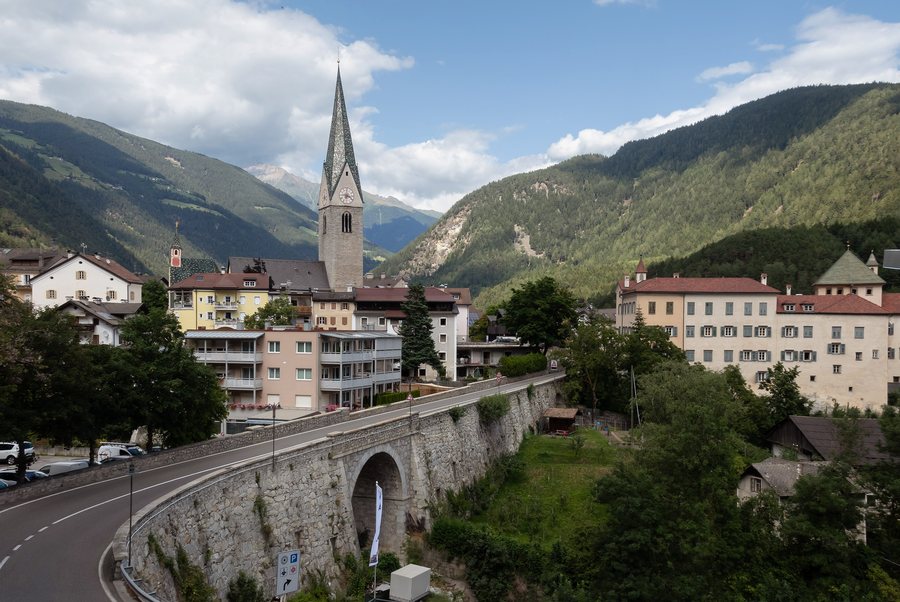 File:Mühlbach, dorpszicht met kerk IMG 1076 2019-08-03 15.37.jpg
Photo: Michielverbeek via Wikimedia Commons, CC BY-SA 4.0
File:Mühlbach, dorpszicht met kerk IMG 1076 2019-08-03 15.37.jpg
Photo: Michielverbeek via Wikimedia Commons, CC BY-SA 4.0
The Stöcklvater processions take place on Sundays during Lent. Anyone wishing to include the Stöcklvater processions in their travel plans should take Sunday and Lent into account as the relevant time frame. The procession can therefore be scheduled as a separate appointment independently of visiting the churches and chapels.
Historic Townscape of Rio di Pusteria
In Rio di Pusteria, visitors will find old walls, historic buildings and stately residences. Rio di Pusteria has held market town status since 1269. Historically, Rio di Pusteria was a border and customs station between the counties of Gorizia and Tyrol. In addition to the old walls, historic buildings and residences, the former border and customs function between Gorizia and Tyrol is also part of Rio di Pusteria's history.
Arrival and Orientation
By car, Rio di Pusteria can be reached via the Bressanone-Varna exit on the A22, followed by the route towards Brunico. From the east, the Puster Valley state road leads directly to Rio di Pusteria. For travelling by car, two options can therefore be planned: after taking the Bressanone-Varna exit on the A22, follow the direction towards Brunico, while from the east the Puster Valley state road leads directly to Rio di Pusteria.
By train, travellers from the north, south or west can change trains in Fortezza and continue to Rio di Pusteria. From the east, it is possible to get off directly at Rio di Pusteria railway station. When travelling to Rio di Pusteria by train, the direction of departure should therefore be taken into account before planning the specific route.
There is a convenient car park at the Mühlbacher Klause. Rio di Pusteria is connected by public transport to all excursion destinations and mountain cable cars. For route planning, the car park at the Mühlbacher Klause and the public connections to excursion destinations and mountain cable cars can therefore be considered as different transport options.
Cycling Tour through the Landscape
The Puster Valley cycle path from Rio di Pusteria to San Candido is 25.5 kilometres long, runs on flat terrain and is suitable for a pleasant cycling tour through the landscape. Anyone planning the route can use the 25.5 kilometres as a fixed framework. The flat course can be taken into account when allocating personal time. The start and destination remain Rio di Pusteria and San Candido; breaks can be distributed along this route.
Further travel destinations: Lüsen, Rodeneck, Villanders, Natz-Schabs, Barbian, Feldthurns, Meransen and Brixen.
To the higher-level travel overview: Eisack Valley.

