
Kühndorf: Johanniterburg, Churches and Half-Timbered Houses
Accommodation in Kühndorf
Kühndorf offers historic buildings, churches and local traditions as different points of interest for a stay. The Johanniterburg reflects the history of the town and offers views of the Rhön and the Thuringian Forest. Churches, the cemetery museum and the local history room offer other highlights. Nearby, the Dolmar and a described cycling route provide further points of reference. Which of these aspects interests you most can shape how you see the town.
Johanniterburg and Castle Barn
The Johanniterburg in Kühndorf was built between 1291 and 1315 by knights of the Order of St John. Its largely preserved upper castle consists of two residential buildings set at right angles to each other, a keep that has since been substantially shortened, and a kitchen building. The two residential buildings form structures that meet at right angles; the keep and kitchen building add further elements to the description of the complex. The upper floors offer views of the Rhön and the Thuringian Forest.
The castle barn is another historic landmark: the Counts of Henneberg-Römhild completed it in 1538. These different dates provide several points of reference in the town’s history—the construction period of the Johanniterburg and the later completion of the barn. The Kühndorf local history rooms are next to the castle barn.
Churches, Cemetery Museum and Local History Room
The churches also feature a range of historic details. The church in Kühndorf was rebuilt around 1520; its octagonal baptismal font dates from 1576. St. Dionysius Church in Kühndorf is considered worth seeing. The cemetery, with its cemetery church dating from 1617, is also considered worth seeing. The cemetery museum is housed in this church. Exhibits include a funeral bier, numerous cast-iron crosses, distinctive tombstones and other historically significant objects. Here, the focus is on burial and commemoration traditions, while the Johanniterburg presents another side of the town’s history.
The Kühndorf local history room gives visitors a vivid impression of the hard and laborious lives of earlier generations. The listed weekly opening hours date from 2013, so check current visitor information before your visit. The room’s location is also helpful when finding your way around town: the local history rooms are next to the castle barn, while the local history room offers insights into everyday life in the past.
Half-Timbered Houses, Bakehouse and Events
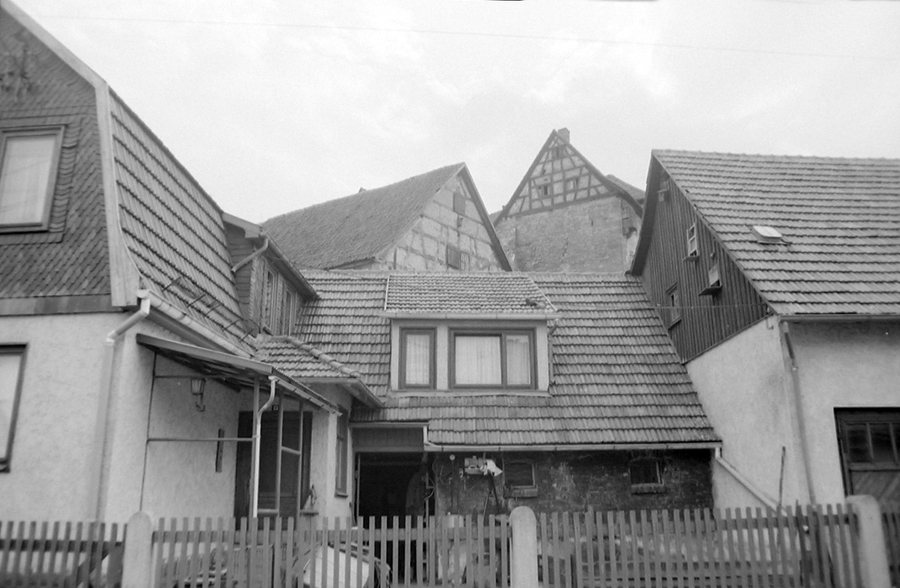
Kühndorf has half-timbered houses in the Franconian architectural style. A well-preserved bakehouse is operated by local residents specifically for bakehouse festivals.
Every year on Open Monument Day, a traditional flea market takes place in and around the historic castle barn in Kühndorf. If you are planning a future visit, check the local events calendar to confirm the date of that year’s market.
Countryside and Activities Nearby
The 739.5-metre-high Dolmar is near Kühndorf and is designated a natural monument. Traces of a ring fort covering around eight hectares, probably dating from the Celtic period, are visible on its ridge. The Dolmar is a landmark near the town, not a feature within Kühndorf.
A described cycling tour also offers Kühndorf as a possible route back: it passes through neighbouring municipalities and to the Dolmar, and the return route can go via Kühndorf, past the Johanniterburg, and through Schwarza. Ultralight sightseeing flights take off and land at Dolmar airfield in Kühndorf; flights are by appointment. These activities require different arrangements: the cycling tour is described as a possible return route, while a time must be arranged for the flights. Alongside its historic buildings, Kühndorf thus offers different themes to consider when planning a stay, from architecture and local history to activities nearby.
Discover more destinations: Christes, Bermbach, Trusetal-Laudenbach, Kleinschmalkalden, Fambach, Steinbach-Hallenberg, Schmalkalden, Unterschönau
Go to the main travel overview: Schmalkalden-Meiningen.

