
Neustadt am Rennsteig – Panorama, Trails and History
Accommodation in Neustadt am Rennsteig
Neustadt am Rennsteig can be understood through its location in the Thuringian Forest, the Rennsteig ridge trail and its local history. If you are looking for accommodation, these features can help you choose a destination based on your own interests: the landscape and hiking trails sit alongside historical traces that reach back to the region’s former border history.
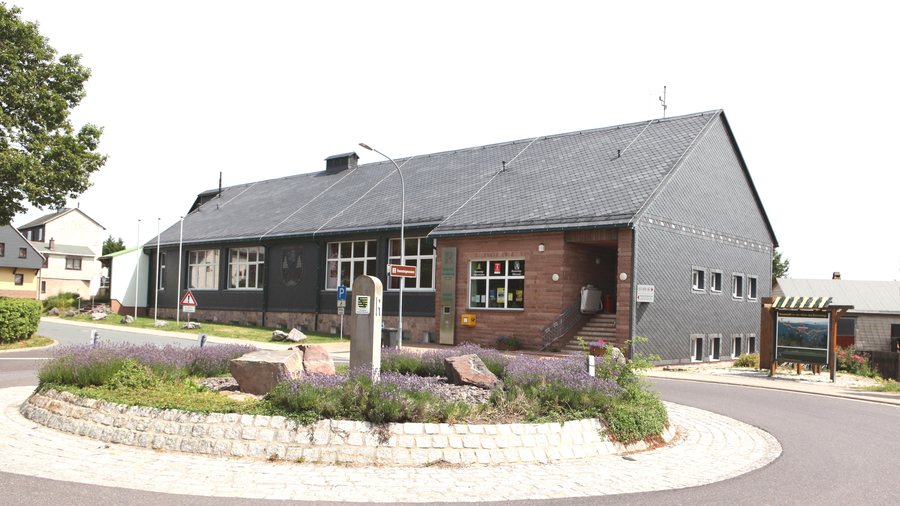 Gemeindezentrum und Rennsteigmuseum in Neustadt am Rennsteig
Photo: Störfix via Wikimedia Commons, CC BY-SA 3.0 de
Gemeindezentrum und Rennsteigmuseum in Neustadt am Rennsteig
Photo: Störfix via Wikimedia Commons, CC BY-SA 3.0 de
Key facts
- The Rennsteig ridge trail runs right through Neustadt am Rennsteig.
- The town is located in the southeastern part of the Thuringian Forest Nature Park.
- Neustadt am Rennsteig offers panoramic views across the expanses of the Thuringian Forest.
- A well-signposted network of hiking trails leads from the town into the surrounding side valleys.
- Neustadt am Rennsteig is over 530 years old.
- Former local occupations included charcoal burners, pitch boilers, glassmakers, sponge beaters and match makers.
- The wider destination of Großbreitenbach is home to St. Trinitatis Church, a large half-timbered church with 600 seats.
Landscape and trails around Neustadt am Rennsteig
Its location in the southeastern part of the Thuringian Forest Nature Park and the panoramic views across the Thuringian Forest give a sense of the town’s landscape. At the same time, the Rennsteig ridge trail runs right through Neustadt am Rennsteig. This brings together two distinct perspectives: views across the forest and a direct connection to a named ridge trail.
For hikes, a well-signposted network of trails leads from Neustadt am Rennsteig into the surrounding side valleys. This offers a different way to explore the area from following the Rennsteig through the town. When choosing accommodation, you can first consider whether you are most interested in the Rennsteig, the panoramic views or the trails into the side valleys.
Local history and the Rennsteig as a border
Neustadt am Rennsteig is over 530 years old. The town’s former occupations included several different trades: charcoal burners, pitch boilers, glassmakers, sponge beaters and match makers. This historical diversity adds a social and economic perspective on the town to its present-day landscape.
The history of the Rennsteig is also linked to Neustadt am Rennsteig. Until 1923, the trail here also ran along the border between the Duchy of Saxe-Meiningen and the Principality of Schwarzburg-Sondershausen. The Rennsteig is therefore not just a ridge trail; in this location, it also had a historical function as a border. This offers two different ways of understanding the destination: as a trail through the landscape and in terms of its former political significance.
Additional regional context: Großbreitenbach
St. Trinitatis Church gives Großbreitenbach its own distinctive church-history landmark. St. Trinitatis Church in Großbreitenbach has 600 seats and is considered Thuringia’s largest half-timbered church. It is completely clad in slate, and a distinctive hexagonal roof turret sits atop the steep roof of its broad nave. These architectural features belong to the church in Großbreitenbach, not to Neustadt am Rennsteig.
The church’s construction history can also be traced through dates: construction began in 1679 as a replacement for the dilapidated St. John’s Church. The plans were drawn up by Andreas Rudolphi, the state master builder of Saxe-Gotha; St. Trinitatis Church was consecrated in 1690. The older St. John’s Church had been built in 1570 and collapsed in 1771, leaving only its church tower standing. A wooden baptismal stand in St. Trinitatis Church dates from 1677 and was transferred from the old St. John’s Church. This single furnishing thus points to the connection between the older church and the later building.
These local connections offer different points to consider when planning your trip: in Neustadt am Rennsteig, the focus is on the landscape, hiking trails and the history of the Rennsteig; Großbreitenbach adds a distinct church-history focus to the regional context. This can help you search for accommodation based on the place and topics that matter to you during your stay.
Discover more destinations: Gehren, Großbreitenbach, Herschdorf, Frankenhain, Frauenwald, Altenfeld, Geraberg, Elgersburg
FAQ
How old is Neustadt am Rennsteig?
Neustadt am Rennsteig is over 530 years old. This age estimate does not specify a particular year of foundation.
What were the former occupations in Neustadt am Rennsteig?
Former occupations included charcoal burners, pitch boilers, glassmakers, sponge beaters and match makers. The list covers various trades associated with the town’s history.
What historical role did the Rennsteig play in Neustadt am Rennsteig?
Until 1923, it also ran here along the border between the Duchy of Saxe-Meiningen and the Principality of Schwarzburg-Sondershausen.
What distinguishes St. Trinitatis Church in Großbreitenbach?
It has 600 seats and is considered Thuringia’s largest half-timbered church. Its features include complete slate cladding and a hexagonal roof turret on the steep roof of the broad nave.
How is the church’s baptismal stand connected to St. John’s Church?
The wooden baptismal stand dates from 1677 and was transferred from the old St. John’s Church. It is therefore a surviving furnishing from the period before the later church was built.
For the wider travel overview: Ilm District.

