
Rheingau-Taunus District: Rhine Landscape, Viticulture and the Limes
Accommodation in Rheingau-Taunus District
In the Rheingau-Taunus District, the landscape, viticulture and cultural history offer practical points of reference for planning your trip. When choosing accommodation, you can first decide whether you would like to focus more on the Rhine cultural landscape, the Riesling loops or the history of the Upper German-Raetian Limes. The different local and thematic connections can help you tailor your search to your travel group's interests.
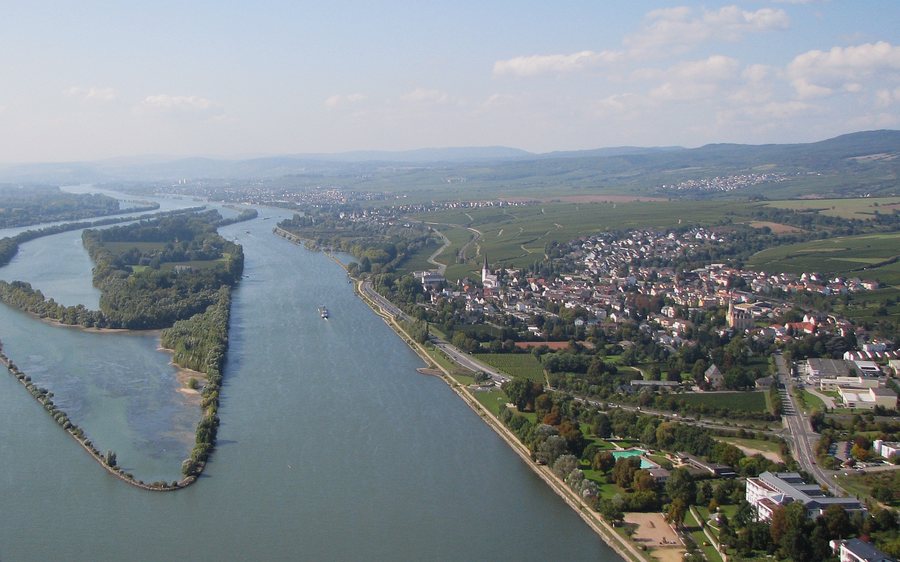 Erbach with Mariannenaue aerial view, Rheingau-Taunus-Kreis
Photo: Wolfgang Pehlemann via Source, CC BY-SA 3.0 DE
Rhine Landscape and Viticulture
In the UNESCO World Heritage Site of the Upper Middle Rhine Valley, steep river slopes, steep-slope and terraced vineyards, numerous castles, historic townscapes and the Rhine shape the cultural landscape. The Rheingau-Taunus District is part of the World Heritage Site through the municipal areas of Rüdesheim am Rhein and Lorch. These place names provide a specific point of reference if you are interested in the section of the cultural landscape in which the district participates. Viticulture and the river landscape are characteristic themes alongside the historic townscapes and castles.
Riesling Loops in the Rheingau
The 14 Riesling loops are circular routes between 4 and 8 kilometres long, running between Flörsheim am Main and Lorch am Rhein. They focus on Riesling, viticulture and the cultural landscape of the Rheingau. The route length gives you a concrete measure for planning each walk; its theme helps you decide whether viticulture should be a focus of your stay. If you are interested in Riesling and viticulture, this offers a different theme from a trip focused primarily on Roman history.
The Limes and Roman History
The Upper German-Raetian Limes crosses the Rheingau-Taunus District for about 35 kilometres and has been a UNESCO World Heritage Site since July 2005. In the Rhein-Taunus Nature Park, it runs for around 33 kilometres. These two lengths refer to areas with different names, so it is best to consider them separately. A specific place in this context is the Zugmantel fort: it lies in the Rhein-Taunus Nature Park and was part of the UNESCO World Heritage Site of the Upper German-Raetian Limes.
Wine and Town History
In the courtyard of Schloss Johannisberg, a monument to the Spätlesereiter commemorates the discovery of late-harvest wine in 1775. In Eltville, the tower of the Electoral Castle houses a Gutenberg memorial site with an exhibition on the art of printing, as well as a historical collection on the town's history. These cultural points of reference differ in their subject matter: Schloss Johannisberg recalls the history of late-harvest wine, while the collection in Eltville covers the art of printing and local history.
Arriving by Train
The right-bank Rhine railway line runs from Koblenz via Rüdesheim am Rhein and Wiesbaden to Frankfurt am Main. Lorch, Geisenheim, Oestrich-Winkel, Eltville and Walluf in the Rheingau are therefore directly connected to Deutsche Bahn's long-distance rail network. The route information describes the connection; for your planning, it is also important to consider which of the cultural or landscape highlights mentioned best suits your trip.
To compare other destinations, you can also explore Idstein, Lahn-Dill District, Werra-Meißner District, Wetterau, Main-Kinzig District, Main-Taunus, Schwalm-Eder District and Gießen.
For the overarching travel overview: Hesse.

