
Idstein: Half-Timbered Houses, Old Town and History
Accommodation in Idstein
Idstein offers a clear focus for planning your trip: the historic town centre, with its half-timbered houses and notable buildings. The town’s history is also reflected in the museum in the Killingerhaus, the residential palace and the Witch’s Tower. A guided photo walk and hiking tours around Idstein are further ways to discover the town and its surroundings.
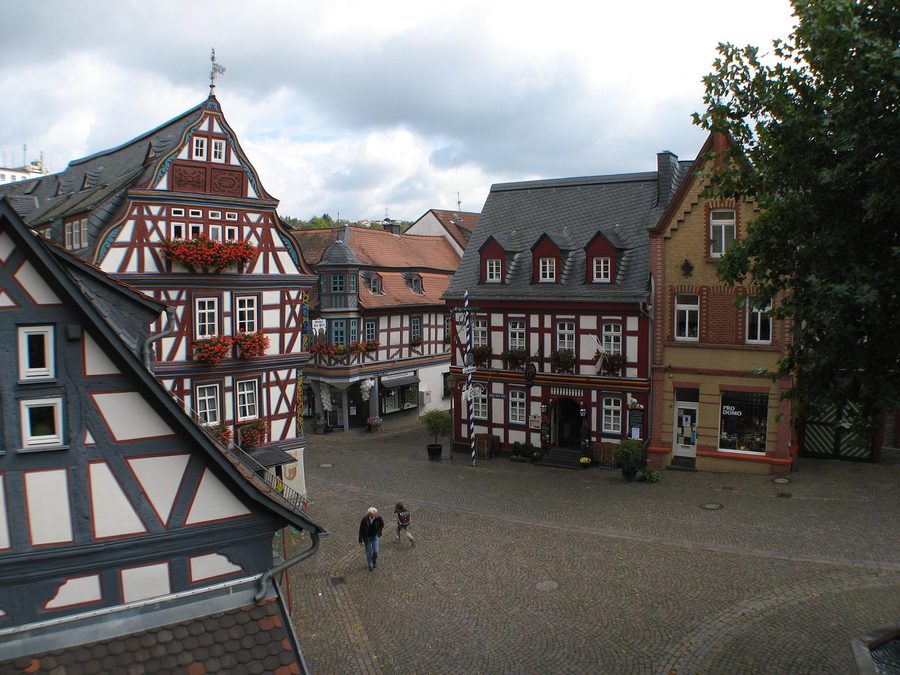 Blick auf die historische Altstadt von Idstein und die Ostseite des König-Adolf-Platzes.
Photo: Oliver Abels ( SBT ) via Wikimedia Commons, CC BY 2.5
Half-Timbered Houses and the Old Town
The historic town centre is characterised by around 200 half-timbered buildings, dating from 1410 to the mid-18th century. In the heritage-protected old town, old lanes and restored half-timbered houses bring together four centuries of predominantly Hessian-Franconian half-timbered architecture. Many of the houses are richly decorated. Those interested in architectural history can explore several aspects together here: the long period over which the buildings were constructed, the regional half-timbered style and the elaborate design of individual buildings.
Idstein’s old town cannot be reduced to a single building. The half-timbered houses define the historic town centre, while the lanes and the different periods of construction convey a sense of its architecture as it developed over time. This makes it a useful focus when choosing places to visit if you want to prioritise culture and local history.
The Killingerhaus and Town Museum
The Killingerhaus is now home to the Idstein Tourist Information Office and town museum. Of Idstein’s half-timbered houses, it has the richest carved ornamentation. The museum offers views of König-Adolf-Platz and presents Idstein’s 900-year history through numerous exhibits from several centuries. This brings together, in one building, a striking example of half-timbered design and a historical account of the town.
The different periods provide a useful point of reference: the collection includes exhibits from several centuries, while the town’s history spans 900 years. Together with the old town’s half-timbered houses, this creates a cultural focus that encompasses both individual buildings and Idstein’s development.
Residential Palace, Palace Garden and Witch’s Tower
The Renaissance-style residential palace of the Counts and Princes of Nassau-Idstein was built mainly between 1614 and 1634, incorporating parts of an earlier building. A pleasure garden on the grounds of Idstein Palace can be traced back at least to 1566. Idstein Palace Garden was laid out again in 2016, using only historically documented plants. The information about the palace and garden therefore points to different periods in the town’s history, from the earliest documented garden history to the later construction of the palace and the garden’s redesign.
The Witch’s Tower is Idstein’s oldest surviving building and is considered a landmark of the town. You can borrow the key during Tourist Information opening hours by paying a deposit. Advance booking is required for large groups; key collection may not be possible due to guided tours or other restrictions. Before your visit, check with the Tourist Information Office whether the key will be available at your chosen time.
Photo Walks, Hiking and Limes History
The Historical Photo Walk in Idstein combines a leisurely stroll, creative photography and local history. It takes you to half-timbered buildings, picturesque lanes and the town’s best photo spots. This guided experience focuses on both the architecture and the history of the town. A variety of hiking tours around Idstein also invite you to experience the surrounding countryside.
The history of the Limes is also present at several locations. The Limes Tower stands on the L3026 road between Idstein and Niedernhausen. On Dasbacher Höhe, a reconstruction of a Roman watchtower on the World Heritage Site Limes was completed in time for Hessentag 2002. These references describe two different locations and should not be confused: one tower stands beside the road between the two towns, while the reconstruction is on Dasbacher Höhe.
For the wider regional context, the Rheingau-Taunus District is a separate point of reference: the Upper Germanic-Raetian Limes runs through the district for about 35 kilometres and has been a UNESCO World Heritage Site since July 2005. It runs for around 33 kilometres through the Rhein-Taunus Nature Park.
For the wider travel overview: Rheingau-Taunus District.

