
Kleines Wiesental: Moorland, Nature and History
Accommodation in Kleines Wiesental
Kleines Wiesental offers several specific points of interest to help you choose your destination: a distinctive moorland landscape, ancient trees, trails and historic places. Nonnenmattweiher combines a striking altitude with an unusual story of how it came to be. Tegernau and Neuenweg offer different points of interest.
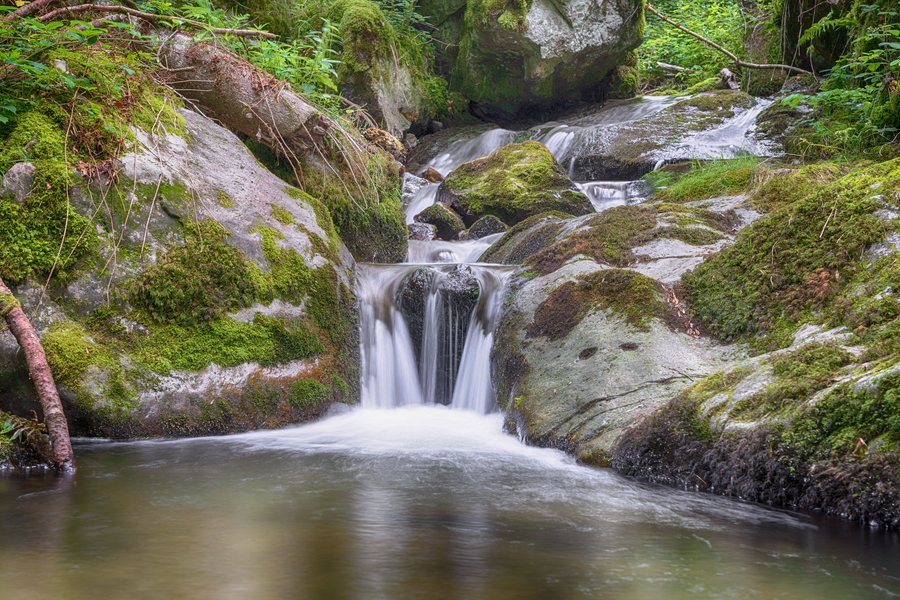 File:Kleines Wiesental - Klemmbach-Wasserfälle Bild 1.jpg
Photo: PantaRhei via Wikimedia Commons, CC BY-SA 4.0
File:Kleines Wiesental - Klemmbach-Wasserfälle Bild 1.jpg
Photo: PantaRhei via Wikimedia Commons, CC BY-SA 4.0
Moorland at Nonnenmattweiher
Nonnenmattweiher lies at an altitude of 913 metres and is one of the highest standing bodies of water in the Black Forest. It was artificially dammed in the early 18th century. In the process, part of the peat-covered basin floor broke away and formed a floating peat island. Altitude, moor and island come together here: the pond is not just a body of water, but also a place with a distinctive landscape and history of formation.
Several species of sphagnum moss grow on the peat island, as well as hare’s-tail cottongrass (Eriophorum vaginatum), cranberry (Vacinium oxycoccos) and round-leaved sundew (Drosera rotundifolia). The plants present may vary with the seasons. Those interested in moorland landscapes will find a botanical focus here in addition to the altitude.
A footpath leads around the moor at Nonnenmattweiher; bathing is permitted at the far end. Check the local notices before your visit. This lets you include both the walk and the bathing area in your plans without treating them as the same thing: the path goes around the moor, while bathing is permitted at the far end.
Trails and ancient trees
A very old, broad-spreading pollarded beech stands in Neuenweg. It offers a distinct point of interest alongside the open moorland at Nonnenmattweiher: here, it is a single, striking tree, while over there, the landscape is shaped by water, peat soil and plants. If you are looking for nature highlights to help plan your trip, these two places offer different attractions.
The Black Forest Association Kleines Wiesental maintains 240 kilometres of Yellow Route trails in Kleines Wiesental. One specifically described hike is the summit tour to Köhlgarten: it starts at the Stockmatt hiking lodge at an altitude of 890 metres and climbs gradually through old woodland. The tour is available on request; check its availability with the guide in advance. This gives you both information about the maintained trail network and a described route, including its starting point and altitude, for your planning.
Historic places in Tegernau
In 1935, Tegernau Church was described as a small “forest church” with a little bell turret. This historical description gives the church a clear place among the area’s cultural attractions. It adds another way to experience the place alongside its natural highlights, without requiring a longer excursion.
The Zur Krone museum inn in Tegernau also has its own historical significance. Its interior includes a historic dining room with an adjoining room, an old “Chuchi” with a vaulted cellar and a historic ballroom. There are also sleeping chambers in the loft and a “Schisshüsli” dating from 1901. The different rooms bring the historic furnishings vividly to life; they present the museum inn as a place with several facets, rather than just a single exhibit.
Additional cultural and landscape attractions in Lörrach
Lörrach lies in the southwest of Baden-Württemberg, in the Markgräflerland, directly on the Swiss border and close to the neighbouring city of Basel. The Dreiländermuseum Lörrach has a permanent exhibition covering around 1,000 square metres. The Lörrach Sculpture Trail runs through the city and features 23 sculptures, fountains and monuments by renowned sculptors. These are distinct cultural attractions in Lörrach and complement the focus on the local area and nature in Kleines Wiesental.
The Burghof Lörrach’s cultural programme includes singing and music, dance, cabaret, literature and children’s theatre. Burghof Lörrach GmbH also holds the international STIMMEN Festival every year; check the relevant events calendar for specific dates. The Lörrach weekly market has been running since 1403.
The wine trails on Tüllinger Berg offer a different landscape highlight: they pass through around 90 hectares of vineyards with the vineyard sites “Riehener Schlipfer”, “Tüllinger Sonnenbrunnen”, “Weiler Schlipf”, “Haltinger Stiege” and “Ötlinger Sonnhole”. From Lörrach-Tüllingen, the Tüllinger Wine Trail connects the Riehener Wine Trail with the Weiler Wine Trail. Along the way, it offers views of the Wiesental and Rhine valleys, as well as insights into the work of winegrowers throughout the year.
Discover more destinations: Elbenschwand, Neuenweg, Schönau Im Schwarzwald, Hasel, Böllen, Aitern, Utzenfeld, Fröhnd.
See the overview of the wider region: Lörrach.

