
Saga: Churches, Mountains and the Camí de Sant Jaume
Accommodation in Saga
Four named mountains and peaks are located in the surroundings of Saga: the mountain Pic de les Molleres del Puigpedrós, the mountain la Tosa, the peak Pic de Mollet and the peak les Suquetes. Together with the references to church history and the Camí de Sant Jaume, they provide several distinct ways of approaching this place in the Pyrenean area.
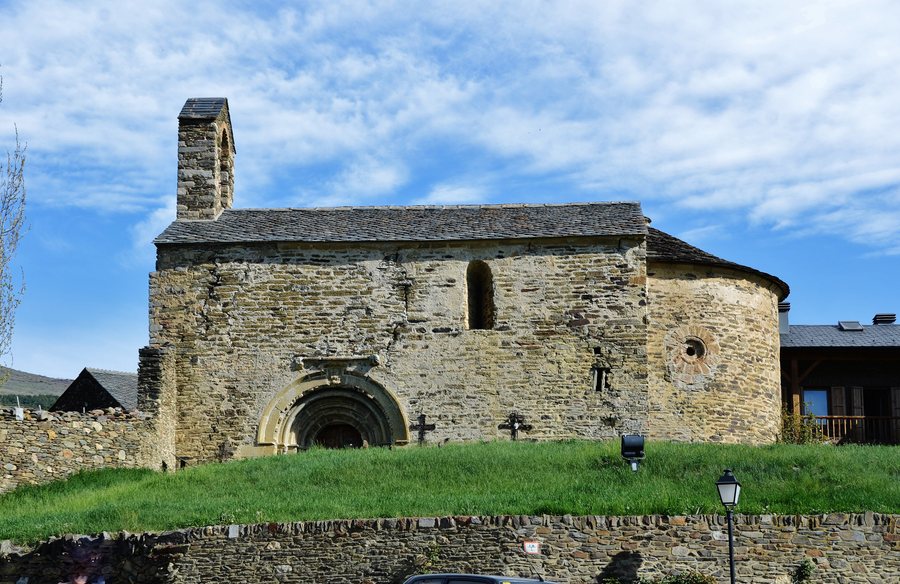 File:WLM14ES - Parroquia de Santa Eugenia de Saga, Segle X Ger, Cerdanya - MARIA ROSA FERRE (1).jpg
Photo: MARIA ROSA FERRE ✿ from Vilafranca del penedes, Catalunya via Source, CC BY-SA 2.0
File:WLM14ES - Parroquia de Santa Eugenia de Saga, Segle X Ger, Cerdanya - MARIA ROSA FERRE (1).jpg
Photo: MARIA ROSA FERRE ✿ from Vilafranca del penedes, Catalunya via Source, CC BY-SA 2.0
Culture and History
The parish of Saga has been mentioned since the 10th century. Saga is also one of the villages that illustrate traditional Pyrenean architectural styles. Santa Eugènia de Saga is located in the hamlet of Saga, northeast of Ger, on the N-260 road.
A polychrome wooden altarpiece from Santa Eugènia de Saga depicts the life of Saint Eugènia in four scenes. The work is dated to the first half of the 13th century and is held at the Musée des Arts Décoratifs in Paris.
The tour “Les claus de les esglésies de la Cerdanya” focuses in particular on church portals and includes Santa Eugènia de Saga in Ger. As part of the tour, the interiors of the participating churches are visited and their characteristic features explained. Most of the churches participating in the tour are usually closed to the public.
The Museu Municipal De Llívia is a museum in the surroundings of Saga. A festival is celebrated in Saga in mid-May.
When choosing accommodation in Saga, you can compare travel dates, room categories and cancellation policies on the offer pages. This information supports objective planning, while the church-related references, the Camí de Sant Jaume and the mountain landscape can independently be considered different themes of the place.
Routes and Surroundings
The Camí de Sant Jaume, whose origins date back to prehistoric times, can be experienced on foot, by bicycle or on horseback. In the third section of the Camí de Sant Jaume, Santa Eugènia de Saga is listed as a point of interest.
The third section of the Camí de Sant Jaume is 9 km 80 m long and is stated to take 1 hour 40 minutes. In the wider regional surroundings of Saga are the Emprius de la Llosada Park and Parc Infantil Park.
When planning, you can consider the route according to its historical classification, means of transport and scope. The different levels help distinguish mentally between the overarching route context, the specific section and the point of interest listed there. For the third section from Santa Eugènia de Saga, these details can be read particularly clearly side by side: the historical classification of the Camí de Sant Jaume, its possible means of transport, and the specific length and duration each describe a different aspect of the same route reference.
The destinations in the surrounding area can also be read separately from the references directly related to Saga. This keeps the local history, natural environment, route and wider regional surroundings recognizable as different themes.
For the overarching travel overview: Ger.

.jpg)