
San Roque De Riomiera – Nature, Hiking and Cultural Heritage
Accommodation in San Roque De Riomiera
San Roque de Riomiera lies along the upper course of the Miera River. The area is classified as a Site of Community Importance within the Natura 2000 network. To help you understand the setting, you can consider its location by the river and the area's classification as two separate starting points.
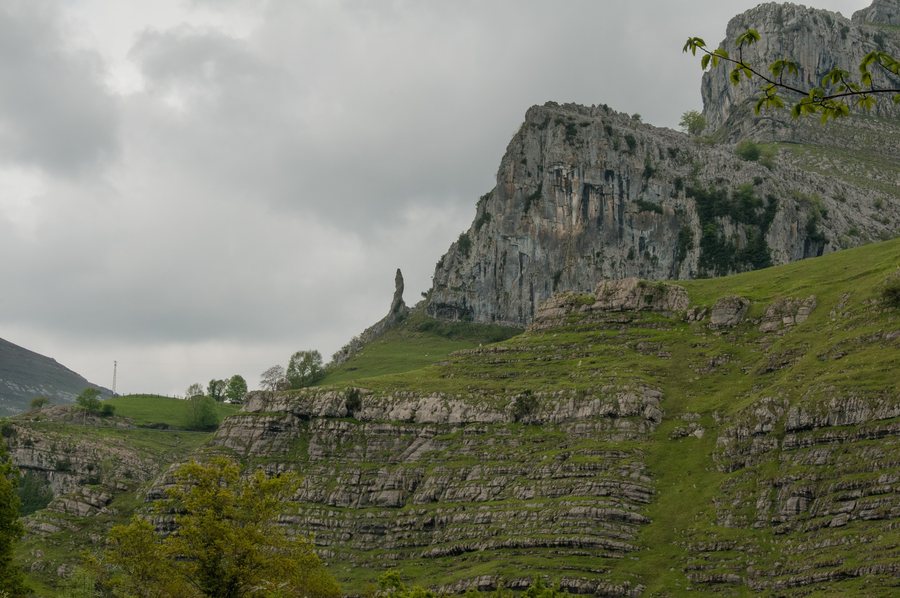 File:Sedimentary Rocks near San Roque de Riomiera in Cantabria Spain.jpg
Photo: Graeme Churchard (GOC53) https://www.flickr.com/people/graeme/ via Source, CC BY 2.0
File:Sedimentary Rocks near San Roque de Riomiera in Cantabria Spain.jpg
Photo: Graeme Churchard (GOC53) https://www.flickr.com/people/graeme/ via Source, CC BY 2.0
Nature
In the upper Miera Valley, the landscape features glacial cirques, moraines, material deposits, as well as rounded and smoothed riverbeds. These terms describe different forms within the valley and give the landscape description several clearly distinct points of reference.
A path runs along the upper edge of the Hayedo de Haza Mina, one of the region's most significant remaining high-altitude woodland areas on heavily karstified terrain. Here, the forest's name, the regional importance of the high-altitude woodland area and the type of terrain each stand as separate pieces of information.
If you want to organize the natural features, you can consider the valley forms and the high-altitude woodland separately rather than combining them under a general landscape designation.
Hiking
One clearly named hiking option in San Roque de Riomiera is the self-guided Alto Miera–Casa del Rey trail, which is 10.6 km long. The hiking section can be read as a separate topic alongside the geological landforms and the woodland area described above. This gives you a specified distance, while the natural features define the landscape setting through the valley, woodland and karst.
Culture
La Pedrosa comprises cobbled lanes, an 18th-century bridge, a mill and several inhabited huts. For an understanding of the settlement, you can consider these elements as different components of the same described inhabited area.
The Iglesia parroquial de La Pedrosa was built in the 17th century; its main altarpiece dates from the mid-18th century. The church and its furnishings belong together in the description, but are dated by reference to different periods and structural elements.
The Iglesia de San Roque preserves a Baroque altarpiece from the 18th century. This furnishing adds an explicitly Baroque reference to the religious architecture.
In Morilla, the Ermita de Los Desamparados is a vernacular building from the 17th century. In the case of the churches, the place names help you distinguish the buildings from one another conceptually.
You can distinguish the religious buildings by location, construction period and furnishings; in La Pedrosa, the combination of lanes, bridge, mill and inhabited huts is an additional aspect.
You can access further destination pages for Valcaba and Hermandad De Campoo De Suso.
When comparing accommodation for a ski holiday in San Roque De Riomiera, you can compare the travel dates, room category and cancellation conditions on the respective offer pages. These three details provide an objective basis for personal planning and can be read side by side in the same format.
Local Products
At the market in San Roque de Riomiera, products from livestock farming are sold, including traditionally made cheese and butter from cow's milk. The market adds a product-focused perspective to the landscape and architectural features. If you want to compare different focal points side by side, you can weigh the natural formations, hiking route, religious buildings and market products separately. The topics mentioned remain clearly distinguishable: terrain and woodland, a self-guided trail, historic buildings and products from livestock farming.
For the overarching travel overview: Cantabria.

