
Eriste: Nature Trails, Culture and Mountain Architecture
Accommodation in Eriste
Eriste combines trails, water and historical traces. The Linsoles Reservoir lies at the foot of Eriste. The Linsoles Reservoir has recommended walking paths; the area is closed to motorised traffic and equipped with tables and benches. La Espigantosa waterfall has a drop of 300 metres and can be reached on foot in about an hour and a half via a 4.5-kilometre-long path.
Nature and Trails
The trails around Eriste differ in their destinations, points along the way and the way they return. The PR-HU 33 runs from Eriste via Anciles to Cerler and back to Eriste. The PR-HU 36 runs from Eriste via the Tramarríus Bridge, as well as the bridge and La Espigantosa waterfall, to the Ángel Orús Refuge, also known as El Forcau, and back to Eriste. The BTT route 22 runs from Eriste via the Linsoles Reservoir and La Borda de Arnaldet campsite to Sesué and back to Eriste.
The routes therefore connect different landscape and activity themes: in addition to hiking trails, there is also a route designated as a BTT route. The PR-HU 35 crosses the dense forests of Tuasa and ends in Selva de Conques. The PR-HU 34 begins in Eriste and leads to Casa Conques. The different routes can therefore be compared by destination, return route and activity.
The Camino de la Montaña, also known as the Ruta Real, leads uphill through the Eriste Valley and passes the Palanca de Tramarrius and Espigantosa waterfall. Alongside the routes via Anciles, Cerler and Sesué, this provides access to trails with named points in the valley and on the mountain slopes.
Culture and History
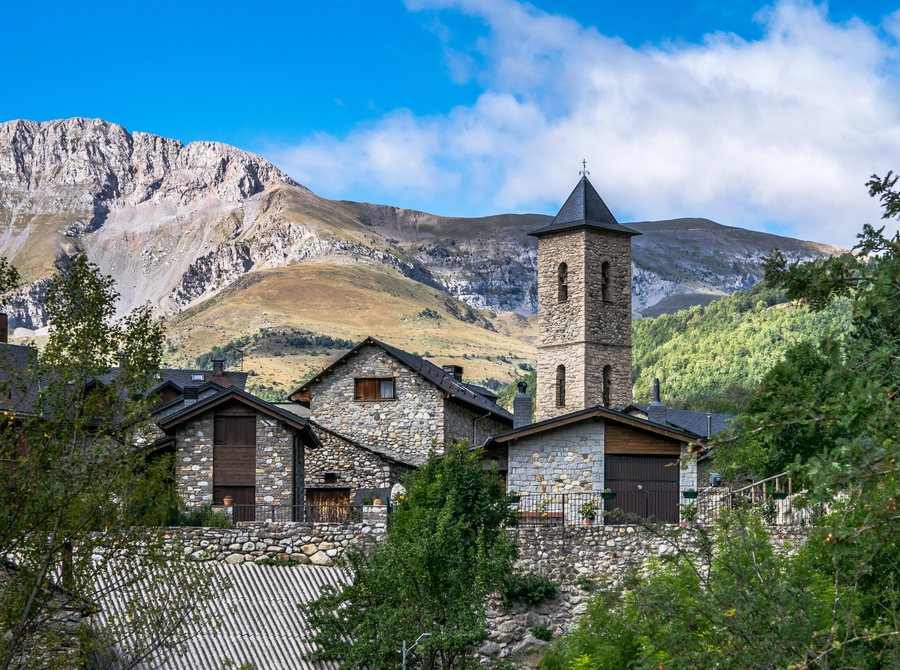
Eriste has Romanesque origins and experienced its greatest prosperity in the Middle Ages. The Church of San Félix in Eriste dates from the 12th century and is a building of Romanesque origin. Many houses in Eriste preserve the characteristics of mountain architecture, with broad stone walls, slate roofs and woodwork.
The Ruta de las Tradiciones passes through Eriste, Eresué and Sahún and introduces visitors to local customs, traditions and crafts. The parts of this route relating to Eriste cover the carnival figures Hombre de Hiedra and Juan Gerundio, as well as the Ball de Grist. Casa Conques is considered a former feudal estate from the 14th century that ruled over extensive mountain areas in Ribagorza.
Romanesque architectural history, mountain architecture and traditional customs thus stand side by side in Eriste. The historical content ranges from the town's medieval development and the Church of San Félix to the figures and dances of the Ruta de las Tradiciones.
Landscape and Knowledge
The Interpretation Centre explains the values of the Natural Monument of the Pyrenean Glaciers and their importance as indicators of climate change. It also offers an interactive exhibition about the glacial landscape and climate change. Landscape-related topics and cultural-historical sites therefore form two clearly distinct focal points of the information about Eriste.
For the overarching travel overview: Sahún.

