
Bratislava: Hotels and Accommodations
Accommodation in Bratislava
In the Bratislava area, the densely forested Little Carpathians separate the Záhorie Lowland from the Danube Lowland. In the Bratislava Region, the Danube floodplain forests are among the last remaining floodplain forests in Europe.
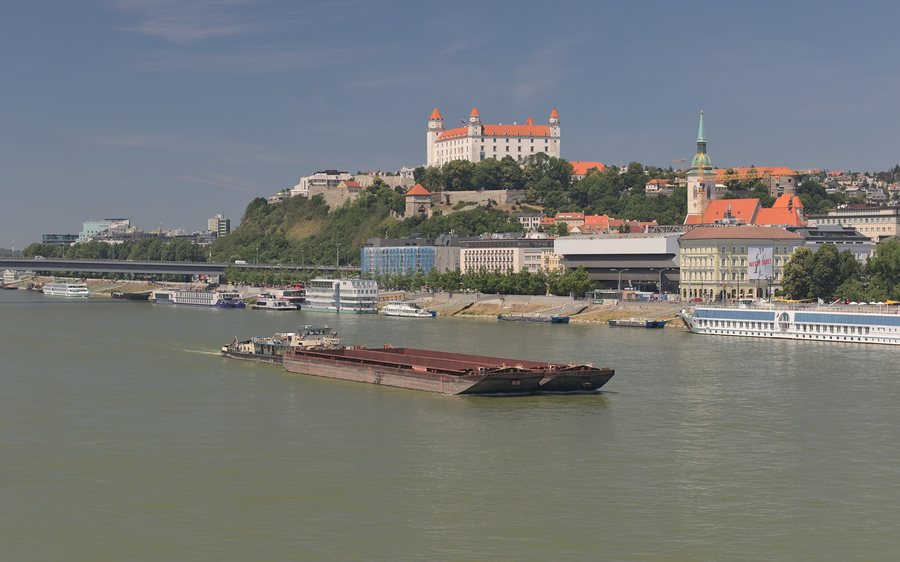 File:2017-06-15 SK Bratislava I & Bratislava V, Dunaj, Most SNP, Bratislavský hrad, Katedrála svätého Martina, Nosice 33000494, A'Rosa Bella 04801170 (50154313676).jpg
Photo: Photo: Paul Korecky
File:2017-06-15 SK Bratislava I & Bratislava V, Dunaj, Most SNP, Bratislavský hrad, Katedrála svätého Martina, Nosice 33000494, A'Rosa Bella 04801170 (50154313676).jpg
Photo: Photo: Paul Korecky
If you would like to book a hotel in Bratislava, this overview provides context on the region’s landscapes, history, culture, and activities.
Geographical Setting
Devínska Kobyla is a national nature reserve and is suitable for hiking and cycling. The Rozhľadňa Alexandra Filípka observation tower can be reached via several hiking trails; the shortest route starts at Zochova chata. From there, visitors can enjoy views of the Little Carpathians, the Záhorie Lowland, and the Danube Lowland.
Culture and History
Marianka is considered the oldest pilgrimage site in Slovakia. Bratislava Castle houses the Slovak National Museum with temporary exhibitions as well as the permanent exhibitions “Treasury” and “History of Slovakia” from prehistoric times to the Middle Ages. At the same time, the castle is an important monument to the social and historical development of Great Moravia, Austria-Hungary, Czechoslovakia, and modern Slovakia. A newly restored Baroque garden invites visitors to take a stroll, and the castle also offers a beautiful view.
Devín Castle was declared a national monument in 1961. Archaeological research has been carried out at the castle intermittently since the 1930s; the exhibits on display provide information about various historical periods.
The history of Červený Kameň Castle dates back to the first half of the 13th century. The Slovak National Museum offers various tours of the castle, including visits to the historically furnished interiors and the outdoor areas. The castle is also home to the Astur falconry area, which features flight demonstrations by birds of prey.
Plavecký hrad Castle is freely accessible to the public; it was probably built in the 13th century as a royal border fortress. Pajštún Castle is also freely accessible to the public.
The Danubiana Meulensteen Art Museum is a museum of modern art on a peninsula in the Danube River near Čunovo.
Cycling Routes and River Landscape
The Bratislava Region has up to 1,700 kilometers of cycling routes. EuroVelo 13 connects Petržalka, Devín, and Devínska Nová Ves, as well as settlements along the route via Vysoká pri Morave, Záhorská Ves, Suchohrad, and Gajary with Moravský Svätý Ján. The cycling route runs along the border of the former Iron Curtain and leads via Bratislava, Petržalka, Devín, Devínska Nová Ves, Vysoká pri Morave, Záhorská Ves, Suchohrad, and Gajary to Moravský Svätý Ján.
On the Little Danube, rafting offers the chance to experience the peaceful river landscape and rare animal species; the activity is described as straightforward and also suitable for families with children.
Regional Specialties
The Malokarpatské Museum in Pezinok displays the largest collection of wine presses in Europe. Slovenský Grob is known for goose specialties served with red cabbage and Lokša.
More local pages: Malatzka, Pressburg.
To the main travel overview: Slovakia.
More Destinations
More places under the same destination:
